
Forum
»
 Henry Kissinger dead at 100
Henry Kissinger dead at 100
- Results 1 to 6 of 6
-
Page 1 of 1
Thread:
Henry Kissinger dead at 100
 11-29-2023, 07:05 PM
-
#1
- BrianDaMan
- Registered User
-

- BrianDaMan
- Registered User
- Join Date: Jun 2011
- Posts: 22,168
- Rep Power: 383523
-
-

Henry Kissinger dead at 100
https://archive.ph/FFhmA
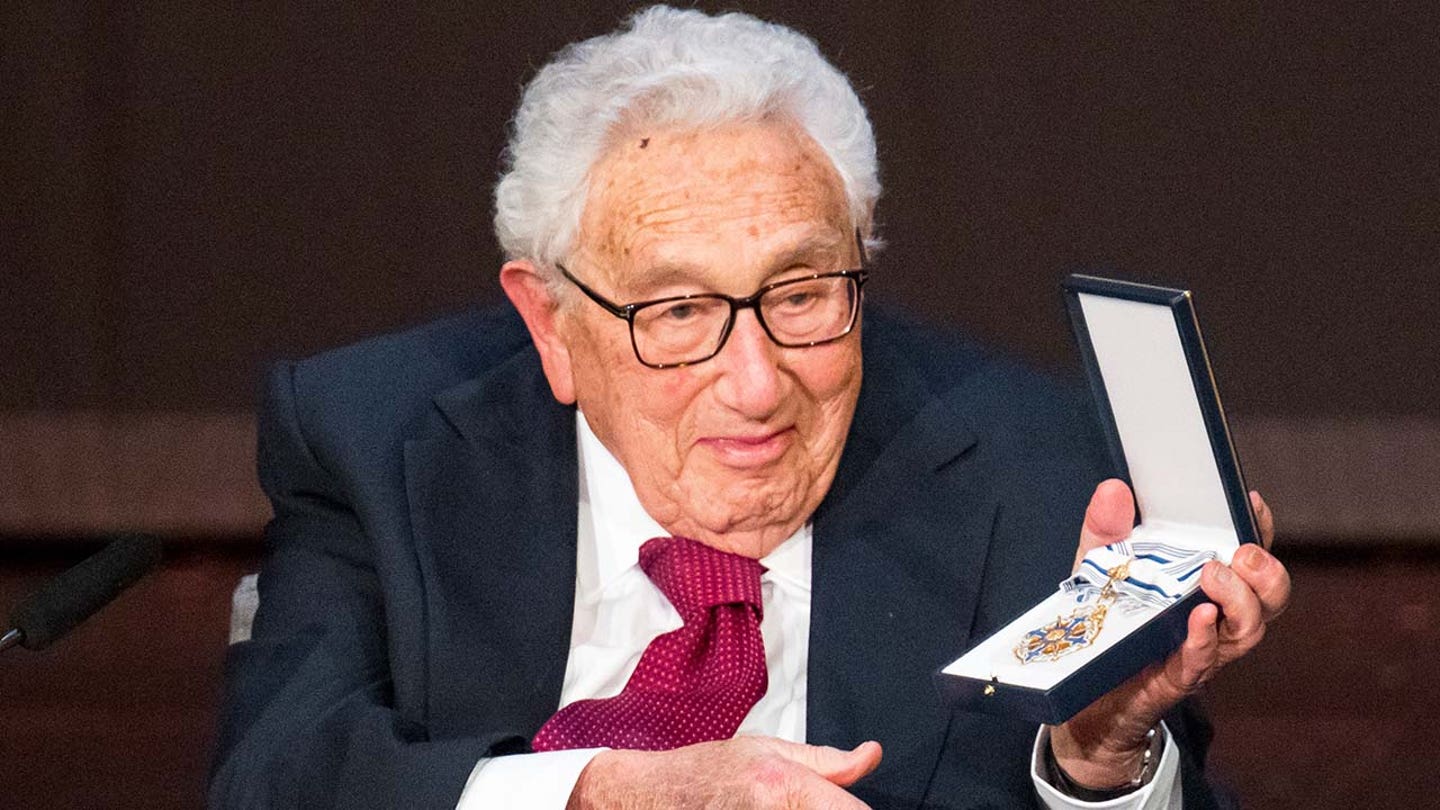
Henry A. Kissinger, a scholar, statesman and celebrity diplomat who wielded unparalleled power over U.S. foreign policy throughout the administrations of Presidents Richard M. Nixon and Gerald Ford, and who for decades afterward, as a consultant and writer, proffered opinions that shaped global politics and business, died Nov. 29 at his home in Connecticut. He was 100.
His death was announced in a statement by his consulting firm, which did not give a cause.
As a Jewish immigrant fleeing Nazi Germany, Dr. Kissinger spoke little English when he arrived in the United States as a teenager in 1938. But he harnessed a keen intellect, a mastery of history and his skill as a writer to rise quickly from Harvard undergraduate to Harvard faculty member before establishing himself in Washington.
As the only person ever to be White House national security adviser and secretary of state at the same time, he exercised a control over U.S. foreign policy that has rarely been equaled by anyone who was not president.
He and Vietnam’s Le Duc Tho shared the Nobel Peace Prize for the secret negotiations that produced the 1973 Paris agreement and ended U.S. military participation in the Vietnam War. His famous “shuttle diplomacy” after the 1973 Middle East war helped stabilize relations between Israel and its Arab neighbors.
As the impresario of Nixon’s historic opening to China and as the theoretician of détente with the Soviet Union, Dr. Kissinger earned much of the credit for seismic policy shifts that redirected the course of world affairs.
With his German accent, incisive wit, owlish looks and zest for socializing in Hollywood and dating movie stars, he was instantly recognized all over the world, in stark contrast to most of his understated predecessors. Shamelessly courting publicity, he was as much a star of the tabloids as he was of the heavy-duty quarterlies that ruminated over his ideas about geostrategy. When he was appointed secretary of state, a Gallup poll found him to be the most admired person in the country.
But he also became the target of relentless critics who deemed him unprincipled and amoral. He refrained from traveling to Oslo to accept the Nobel award for fear of hostile demonstrations — Tho rejected the prize outright — and in later years the animosity he inspired would intensify.
What he viewed as pragmatic, many writers and analysts regarded as unprincipled maneuvering, unguided by respect for human rights or even human life. Dr. Kissinger achieved power, fame and wealth beyond the dreams of most people in public life, yet he spent his final decades defending himself and his place in history, explaining that he did what he had to do.
Ronald Reagan and other conservatives blasted Dr. Kissinger’s quest for accommodation with Moscow as a sellout of countries then in the Warsaw Pact, and of American values. On the other hand, President George W. Bush called him “one of our nation’s most accomplished and respected public servants,” and senior officials of the Bush administration consulted him frequently about international affairs.
On the left, loud voices accused him of a coldblooded pragmatism that put strategic gains ahead of human rights. Some of his critics said the Paris agreement left a longtime ally, the government of South Vietnam, to a dark fate as the North Vietnamese seized control. Others accused him of letting the war continue for three years while he negotiated a deal that he could have had from the beginning.
Critics held Dr. Kissinger responsible for the 1969 “secret bombing” of neutral Cambodia and for the American ground invasion of that country the following year, which expanded the conflict in Southeast Asia and led to a takeover of the country by the murderous Khmer Rouge.
They said his policy of promoting the shah of Iran as the anchor of U.S. policy in the Persian Gulf encouraged the shah to raise oil prices and fed the megalomania that led to the Iranian revolution. They accused him of conniving at the 1974 coup that overthrew the government of Cyprus, and of supporting Pakistan’s brutal campaign to quash a secessionist rebellion in what is now Bangladesh because Pakistan was his secret conduit to the Chinese.
And they said Dr. Kissinger was at least indirectly responsible for the CIA-inspired coup that overthrew the legally elected socialist government of Salvador Allende in Chile — as well as the earlier murder of Gen. René Schneider, commander in chief of Chile’s armed forces, who staunchly opposed a coup.
Two of the most vociferous critics, Christopher Hitchens and William Shawcross, branded Dr. Kissinger a war criminal. Journalist Seymour M. Hersh, in “The Price of Power,” said Dr. Kissinger and Nixon were basically two of a kind: They “remained blind to the human costs of their actions. The dead and maimed in Vietnam and Cambodia — as in Chile, Bangladesh, Biafra and the Middle East — seemed not to count as the President and his national security adviser battled the Soviet Union, their misconceptions, their political enemies, and each other.”
At the very least, those who did not admire Dr. Kissinger felt that his focus on Cold War realities and his willingness to use force — openly or covertly — to advance U.S. objectives blinded him to humanitarian and human rights considerations.
As one example, they cited his opposition to the Jackson-Vanik amendment, legislation that conditioned normal trade relations with the Soviet Union on Moscow’s allowing Soviet Jews to emigrate. Dr. Kissinger, himself a Jewish refugee from persecution, considered the amendment a hindrance to his pursuit of détente.
His willingness to place strategic interest ahead of high-minded values was demonstrated in July 1975, when he persuaded Ford not to meet exiled Russian author Alexander Solzhenitsyn at the White House. Solzhenitsyn was a living symbol of courageous resistance to Soviet oppression, but Dr. Kissinger feared a negative impact on his policy of détente with Moscow.
He was operating, he said, “in a world where power remains the ultimate arbiter.” Reagan, then governor of California, made an issue of the Solzhenitsyn affair when he challenged Ford for the Republican presidential nomination the next year.
In his comprehensive biography of Dr. Kissinger, journalist Walter Isaacson came to the conclusion that he “had an instinctive feel for power and for creating a new global balance that could help America cope with its withdrawal syndrome after Vietnam. But it was not matched by a similar feel for the strength to be derived from the openness of America’s democratic system or for the moral values that are the true source of its global influence.”
Isaacson, who had full access to Dr. Kissinger and many of his friends, described him as “brilliant, conspiratorial, furtive, sensitive to linkages and nuances, prone to rivalries and power struggles, charming yet at times deceitful.”
Dr. Kissinger, responding to his critics, ascribed to realpolitik a moral imperative of its own.
“History presents unambiguous alternatives only in the rarest of circumstances,” he wrote in “Ending the Vietnam War,” published in 2003. “Most of the time, statesmen must strike a balance between their values and their necessities, or to put it another way, they are obliged to approach their goals not in one leap but in stages, each by definition imperfect by absolute standards. It is always possible to invoke that imperfection as an excuse to recoil before responsibilities, or as a pretext to indict one’s own society.”
Or as he put it more bluntly in another context, “Covert action should not be confused with missionary work.”
11-29-2023, 07:07 PM
-
#2
- HairyWBush
- Democrats are terrorists
-

- HairyWBush
- Democrats are terrorists
- Join Date: Oct 2012
- Location: Florida, United States
- Posts: 20,103
- Rep Power: 77712
-
-
about ****in time, head of the new world order
R 135
L├┼┤
246
"Slide down your throat?? We chew them, savor them, suck up the little juice left behind in the shell then swallow them. Only amateurs try to swallow them whole."
-Kingfabian: BBC loads: https://forum.obnoxiousbrutes.com/showthread.php?t=181634953&p=1666337753&viewfull=1#post1666337753
"America lost pretty much every war in history lol" -pandaboy89
as seen here: https://forum.obnoxiousbrutes.com/showthread.php?t=180019913&p=1636230303&viewfull=1#post1636230303
11-29-2023, 07:11 PM
-
#3

Only in the U.S do the most corrupt people die of old age instead of ending up like El Jefe Epstein.
*Uncircumcised crew*
*Unvaxxed crew*
*Never wore a condom crew*
*Never took an STD test cuz scared crew*
*No tattoo crew*
*Negs people who misuse SRS tag crew*........srs
11-29-2023, 07:21 PM
-
#4
- Adam16121
- Registered User
-

- Adam16121
- Registered User
- Join Date: Apr 2017
- Age: 41
- Posts: 20,009
- Rep Power: 314711
-
-

Well Damn
Edit: Disclaimer that rolling stone has sucked for years. Not sure if they are right on this one but I did read he’s kind of been a dick at times. Still an article that draws a wow from me.
11-29-2023, 07:33 PM
-
#5
- GuineaDago585
- Bert McGirt
-

- GuineaDago585
- Bert McGirt
- Join Date: Nov 2012
- Posts: 40,584
- Subscribers: 3
- Rep Power: 406124
-
-

I always found it odd that every single president from Nixon to Biden had to kiss his ass upon taking office. Very strange behavior that went beyond seeking advice. I always thought on some level he was one of the “men behind the curtain.”
11-29-2023, 07:35 PM
-
#6
- GuineaDago585
- Bert McGirt
-
- GuineaDago585
- Bert McGirt
- Join Date: Nov 2012
- Posts: 40,584
- Subscribers: 3
- Rep Power: 406124
-
-
And it went even beyond presidents. For example when anti-war protestors confronted Kissinger, McCain went off on a tirade talking chit and apologizing profusely to him. I think he was more pissed at some college kids yelling at Kissinger than he was at the Viet Cong
Bookmarks
-

- Digg
-

- del.icio.us
-

- StumbleUpon
-

-

Posting Permissions
- You may not post new threads
- You may not post replies
- You may not post attachments
- You may not edit your posts