
Forum
»
Trump trial date chess game: Smith unlikely to get conviction before election
- Results 1 to 27 of 27
-
Page 1 of 1
 01-28-2024, 12:58 PM
-
#1

- gachase21
- Join Date: Dec 2010
- Location: Georgia, United States
- Posts: 31,767
- Subscribers: 4
- Rep Power: 389233
-
-

Trump trial date chess game: Smith unlikely to get conviction before election
And Judge Cannon holds the middle of the board... (and yes, she is intentionally playing trial date chess)
I'm going to repost and carry on a discussion from another thread this morning- as this is a different subject that needs it's own thread.
This discussion is about criminal trials only, not civil ones.
What is at play:
[b]Jack Smith Flordia Trial:[/b]
-Flordia "documents trial"
-Ultra MAGA Trump appointed Judge
[URL=https://en.wikipedia.org/wiki/Aileen_Cannon]https://en.wikipedia.org/wiki/Aileen_Cannon[/URL]
-Least likely trial to get a conviction due to the Jury pool alone. 65% maga jury pool, only 1 needs to be a holdout to frig it all up
-Multiple constitutional issues that could overturn any conviction, even as the laws state otherwise
-If he wins before trial, Trump could actually direct AG to have all charges dropped
-In theory, Trump could pardon himself (still debatable)
[b]Jack Smith DC trial:[/b]
-January 6th intersection trial
-Ultra TDS lefty outspoken Trump hatting Obama appointed Judge
[URL=https://en.wikipedia.org/wiki/Tanya_Chutkan]https://en.wikipedia.org/wiki/Tanya_Chutkan[/URL]
-Most likely trial to get a conviction (if it actually goes to trial on all charges) as jury pool is about 0% maga, with unfavorable prior rulings towards Trump
-If he wins before trial, Trump could actually direct AG to have all charges dropped
-In theory, Trump could pardon himself (still debatable)
[b]Georgia attempt to steal election rico trial:[/b]
-A Republican appointed Federalist Society judge, who seems very impartial so far. However could possibly lean maga if given an opportunity. unlikely so.
[URL=https://en.wikipedia.org/wiki/Scott_F._McAfee]https://en.wikipedia.org/wiki/Scott_F._McAfee[/URL]
-All proceeding on youtube
[URL=https://www.youtube.com/@judgescottmcafee]https://www.youtube.com/@judgescottmcafee[/URL]
-Fanni Willis mess
-Most likely to actually be guilty of some of the charges, however some constitutional issues that could come up in both state supreme court, and federal supreme court
-Jury pool is only about 20% MAGA, however, the venue could possibly change
-Governor Kemp has no pardon power, as well Governor Kemp has no power over the DA (contrary to social media BS)
-Trump has no pardon power (even if moved to federal court), as well has no power over the DA
[b]Alvin Bragg NY porn star hush money case[/b]
-Weakest case of all
-Not any likey jail time on a very unlikely event of conviction
-Trial date set for March 25th (was expected to change to last trial, but now might actually go first)
-Judge Juan Merchan, whose daughter works with democrat donors
[URL=https://en.wikipedia.org/wiki/Juan_Merchan]https://en.wikipedia.org/wiki/Juan_Merchan[/URL]
-Pretrial hearings in February to decide actually trial date
It is a fairly complicated conversation, with a complex webb- So I will use the following convo as a way to present the argument...
Now I'm going to start by copy/paste a discussion that got started in another thread- where I made a post that Jack Smith was unlikely to have a trial before the election, and this poster responded- my response follows:
[QUOTE=Reliance012 post_id=1697068083]The trial could still begin as early as March, but will probably start between April and June. Trump would need flagrant and extreme help from the SC if he’s to delay the 1/6 trial into fall. The timeline below was assuming an appeals court decision last week, which didn’t happen, though I expect it’s coming any day.
“In sum, the shortest plausible timeline under our assumptions: The mandate issues after five days, there is no en banc petition, and cert is denied. That would be about 19 days after the DC Circuit panel issues its decision.
The longest plausible timeline under our assumptions: Trump receives 30 days to petition for rehearing en banc, the mandate only issues until 7 days after the en banc petition is denied, Trump petitions the Supreme Court, which then grants cert and decides the case. That would be about four-and-a-half months after the DC Circuit panel decision, and would take us up to mid-May.”
[URL=https://www.justsecurity.org/91108/how-long-will-trumps-dc-immunity-appeal-take-analyzing-the-alternative-timelines/]https://www.justsecurity.org/91108/h...ive-timelines/[/URL][/QUOTE]This article, and the timeline it suggested, was a horrible analysis- mocked by people in the legal community on both the left and right side.
As demonstrated so far with how wrong it has been on the timeline so far.
What makes it strange is the writers are fairly respectable - but this just turned out to be another demonstration as to how normal-thinking people can absolutely lose their chit it terms of rational thinking when it comes to anything involving Trump.
-The mere suggestion a decision- with 5 unprecedented measures- would come so quickly to start with is baffling.
-The left out the impact of Fisher??? a case that can likely eliminate 2 of Trump's 4 DC charges, that aren't even in Scotus until June
-The ignored Cannons stronghold of the May trial date in Florida, which MAGA Cannons helped team Trump in delaying everything else - except the trial date- which she will likely do in March. (she has to now with all the other measures delayed). But by waiting for the delay, it's preventing Chutkan from doing March or June
-Many other things it missed- horrid write-up
Here is the reality:
Since that article was published...
1. On January 18th DC trial Judge Chutkan acknowledged in a ruling the March trial date won't work anymore, with the delay in appeals, and her lack of Jursdition until it's finished. She also stated that when it is finally returned to her court, Trump was og allotted 7 months of prep time, and the clock is paused until it is back to her court- so he will still have all the remaining time left.
Also, Judge Chutkan barred special counsel Jack Smith from filing substantive new motions without advance permission while the trial is out of her jurisdiction on appeal.
[URL=https://storage.courtlistener.com/recap/gov.uscourts.dcd.258148/gov.uscourts.dcd.258148.195.0.pdf]https://storage.courtlistener.com/re...8148.195.0.pdf[/URL]
2. After that, in seeing the reality of the delay, on the 24th she went further into going ahead and scheduling a different Trial for April (meaning that slot is now occupied)
[URL=https://imgbb.com/][img]https://i.ibb.co/j5k30sY/GEn92-Ba-XEAAPh0e.jpg[/img][/URL]
3. And then you got the reality of how long an en banc and SCOTUS hearing could go. If it ends up getting cert grant by SCOTUS- and making it there - are looking Last week June, 1st few days of July ruling likely- in which according the January 18th dc Judge filing- Trump's 7 7-month clock would just then continue.
But wait, there's more!!!
Next, you have Ultrea MAGA Judge Cannon in Florida who had delayed virtually everything, even suspended hearings, - except the May trial date (which has to be delayed now) and she doesn't plan on having the delayed hearing until March. Thus excluding Judge Chutkan from getting a May, or even early June, Trial anyway. And the pace Cannon plan- Trump will for sure not have that trial before election...
It is a trial chess game, and Judge Cannon holds the middle of the board...
Smith also made a crucial strategic error in filling the FL trial 1st- so now she has leverage.
More on that:
[QUOTE][b]Judge Cannon Hands Donald Trump Much-Needed Delay in Blow to Jack Smith[/b]
Jan 13, 2024 at 11:00 AM EST
The judge overseeing Donald Trump's federal classified-documents case has been accused of failing to enforce a routine deadline, amid claims the former president is hoping to delay the trial until after November's presidential election.
Judge Aileen Cannon, who was nominated to the bench by Trump, has rejected Special Counsel Jack Smith's request to force the former president to reveal if he plans on using a defense that he was merely relying on advice of his lawyers during the trial. Newsweek contacted the Department of Justice (DOJ) on Saturday for comment via email.
Trump has pleaded not guilty to 40 charges relating to allegations he illegally retained top-secret and classified material after he left office in January 2021, then obstructed the federal attempt to retrieve them from his Mar-a-Lago, Florida, home. The former president has denied any wrongdoing and has repeatedly said that the charges are part of a political witch hunt that seeks to derail him as frontrunner for the 2024 GOP presidential nomination.
Cannon has previously faced calls to recuse herself from the case in which she was randomly selected to oversee because she has already made a number of decisions that could be seen to have benefited the Republican.
In a court filings on Friday, Cannon rejected federal prosecutors "motion to compel disclosure regarding advice-of-counsel defense," while saying such a request is "not amenable to proper consideration at this juncture."
As noted on X, formerly Twitter, by Katie Phang, a lawyer and MSNBC legal analyst, Cannon "basically says that it's too early in the litigation to consider forcing Donald Trump to have to disclose this information."
Joyce Vance, a former federal prosecutor, was one of those who said that Cannon's decision is helping Trump delay the start of the classified documents trial, which is currently scheduled for May 20
The proceedings in Florida may yet change when a scheduling conference for the case takes place on March 1, just days before Trump's federal trial over 2020 election obstruction and conspiracy allegations is scheduled to begin.
Trump has long been accused of trying to delay the start of both the federal classified documents and election trials. If he wins the 2024 election, he could call on the DOJ to drop the federal investigations into him once he enters office in January 2025, or pardon himself as president if he is convicted beforehand.
Because the case involves highly sensitive documents, some of them involving national security, however, Judge Cannon has had to put elaborate security protocols in place that have delayed the trial by months.
"In the Mar-a-Lago case, Judge Cannon has just refused to enforce a routine deadline & it's entirely clear she has no intention of letting this case go to trial before the election or possibly ever," Vance posted on X.
Others also criticized Cannon for not helping Trump's case move forward towards its scheduled deadline.
"His luck in drawing Cannon for this open-and-shut case cannot be overstated," posted the Scary Lawyer Guy social-media account. "While [Judge Tanya] Chutkan *may* be able to get his other trial in before November, a more experienced (+ less biased) judge would have had the MAL [Mar-aLago] case on the calendar months ago. Instead, she's slow walking things."
Cannon has already faced calls to remove herself from the case over claims she may be biased towards the former president.
The judge previously handed down a decision that meant that Trump would not have to testify under oath his unsubstantiated claim that the FBI may have "planted" evidence against him during the August raid at his Mar-a-Lago resort in 2022.
Another ruling from Cannon also meant that Trump would not have to state which of the materials recovered from his Florida resort had allegedly been declassified before he left the White House in January 2021. This is another disputed claim by the former president that has never been backed up by his lawyers in official court filings.
[/QUOTE]
But wait, there's more!!!
Also, you have the Fisher case- which isn't set to be heard until June- and would possibly all but negate 2 of Trump's major DC charges
Cont next post...
I'm going to repost and carry on a discussion from another thread this morning- as this is a different subject that needs it's own thread.
This discussion is about criminal trials only, not civil ones.
What is at play:
[b]Jack Smith Flordia Trial:[/b]
-Flordia "documents trial"
-Ultra MAGA Trump appointed Judge
[URL=https://en.wikipedia.org/wiki/Aileen_Cannon]https://en.wikipedia.org/wiki/Aileen_Cannon[/URL]
-Least likely trial to get a conviction due to the Jury pool alone. 65% maga jury pool, only 1 needs to be a holdout to frig it all up
-Multiple constitutional issues that could overturn any conviction, even as the laws state otherwise
-If he wins before trial, Trump could actually direct AG to have all charges dropped
-In theory, Trump could pardon himself (still debatable)
[b]Jack Smith DC trial:[/b]
-January 6th intersection trial
-Ultra TDS lefty outspoken Trump hatting Obama appointed Judge
[URL=https://en.wikipedia.org/wiki/Tanya_Chutkan]https://en.wikipedia.org/wiki/Tanya_Chutkan[/URL]
-Most likely trial to get a conviction (if it actually goes to trial on all charges) as jury pool is about 0% maga, with unfavorable prior rulings towards Trump
-If he wins before trial, Trump could actually direct AG to have all charges dropped
-In theory, Trump could pardon himself (still debatable)
[b]Georgia attempt to steal election rico trial:[/b]
-A Republican appointed Federalist Society judge, who seems very impartial so far. However could possibly lean maga if given an opportunity. unlikely so.
[URL=https://en.wikipedia.org/wiki/Scott_F._McAfee]https://en.wikipedia.org/wiki/Scott_F._McAfee[/URL]
-All proceeding on youtube
[URL=https://www.youtube.com/@judgescottmcafee]https://www.youtube.com/@judgescottmcafee[/URL]
-Fanni Willis mess
-Most likely to actually be guilty of some of the charges, however some constitutional issues that could come up in both state supreme court, and federal supreme court
-Jury pool is only about 20% MAGA, however, the venue could possibly change
-Governor Kemp has no pardon power, as well Governor Kemp has no power over the DA (contrary to social media BS)
-Trump has no pardon power (even if moved to federal court), as well has no power over the DA
[b]Alvin Bragg NY porn star hush money case[/b]
-Weakest case of all
-Not any likey jail time on a very unlikely event of conviction
-Trial date set for March 25th (was expected to change to last trial, but now might actually go first)
-Judge Juan Merchan, whose daughter works with democrat donors
[URL=https://en.wikipedia.org/wiki/Juan_Merchan]https://en.wikipedia.org/wiki/Juan_Merchan[/URL]
-Pretrial hearings in February to decide actually trial date
It is a fairly complicated conversation, with a complex webb- So I will use the following convo as a way to present the argument...
Now I'm going to start by copy/paste a discussion that got started in another thread- where I made a post that Jack Smith was unlikely to have a trial before the election, and this poster responded- my response follows:
[QUOTE=Reliance012 post_id=1697068083]The trial could still begin as early as March, but will probably start between April and June. Trump would need flagrant and extreme help from the SC if he’s to delay the 1/6 trial into fall. The timeline below was assuming an appeals court decision last week, which didn’t happen, though I expect it’s coming any day.
“In sum, the shortest plausible timeline under our assumptions: The mandate issues after five days, there is no en banc petition, and cert is denied. That would be about 19 days after the DC Circuit panel issues its decision.
The longest plausible timeline under our assumptions: Trump receives 30 days to petition for rehearing en banc, the mandate only issues until 7 days after the en banc petition is denied, Trump petitions the Supreme Court, which then grants cert and decides the case. That would be about four-and-a-half months after the DC Circuit panel decision, and would take us up to mid-May.”
[URL=https://www.justsecurity.org/91108/how-long-will-trumps-dc-immunity-appeal-take-analyzing-the-alternative-timelines/]https://www.justsecurity.org/91108/h...ive-timelines/[/URL][/QUOTE]This article, and the timeline it suggested, was a horrible analysis- mocked by people in the legal community on both the left and right side.
As demonstrated so far with how wrong it has been on the timeline so far.
What makes it strange is the writers are fairly respectable - but this just turned out to be another demonstration as to how normal-thinking people can absolutely lose their chit it terms of rational thinking when it comes to anything involving Trump.
-The mere suggestion a decision- with 5 unprecedented measures- would come so quickly to start with is baffling.
-The left out the impact of Fisher??? a case that can likely eliminate 2 of Trump's 4 DC charges, that aren't even in Scotus until June
-The ignored Cannons stronghold of the May trial date in Florida, which MAGA Cannons helped team Trump in delaying everything else - except the trial date- which she will likely do in March. (she has to now with all the other measures delayed). But by waiting for the delay, it's preventing Chutkan from doing March or June
-Many other things it missed- horrid write-up
Here is the reality:
Since that article was published...
1. On January 18th DC trial Judge Chutkan acknowledged in a ruling the March trial date won't work anymore, with the delay in appeals, and her lack of Jursdition until it's finished. She also stated that when it is finally returned to her court, Trump was og allotted 7 months of prep time, and the clock is paused until it is back to her court- so he will still have all the remaining time left.
Also, Judge Chutkan barred special counsel Jack Smith from filing substantive new motions without advance permission while the trial is out of her jurisdiction on appeal.
[URL=https://storage.courtlistener.com/recap/gov.uscourts.dcd.258148/gov.uscourts.dcd.258148.195.0.pdf]https://storage.courtlistener.com/re...8148.195.0.pdf[/URL]
2. After that, in seeing the reality of the delay, on the 24th she went further into going ahead and scheduling a different Trial for April (meaning that slot is now occupied)
[URL=https://imgbb.com/][img]https://i.ibb.co/j5k30sY/GEn92-Ba-XEAAPh0e.jpg[/img][/URL]
3. And then you got the reality of how long an en banc and SCOTUS hearing could go. If it ends up getting cert grant by SCOTUS- and making it there - are looking Last week June, 1st few days of July ruling likely- in which according the January 18th dc Judge filing- Trump's 7 7-month clock would just then continue.
But wait, there's more!!!
Next, you have Ultrea MAGA Judge Cannon in Florida who had delayed virtually everything, even suspended hearings, - except the May trial date (which has to be delayed now) and she doesn't plan on having the delayed hearing until March. Thus excluding Judge Chutkan from getting a May, or even early June, Trial anyway. And the pace Cannon plan- Trump will for sure not have that trial before election...
It is a trial chess game, and Judge Cannon holds the middle of the board...
Smith also made a crucial strategic error in filling the FL trial 1st- so now she has leverage.
More on that:
[QUOTE][b]Judge Cannon Hands Donald Trump Much-Needed Delay in Blow to Jack Smith[/b]
Jan 13, 2024 at 11:00 AM EST
The judge overseeing Donald Trump's federal classified-documents case has been accused of failing to enforce a routine deadline, amid claims the former president is hoping to delay the trial until after November's presidential election.
Judge Aileen Cannon, who was nominated to the bench by Trump, has rejected Special Counsel Jack Smith's request to force the former president to reveal if he plans on using a defense that he was merely relying on advice of his lawyers during the trial. Newsweek contacted the Department of Justice (DOJ) on Saturday for comment via email.
Trump has pleaded not guilty to 40 charges relating to allegations he illegally retained top-secret and classified material after he left office in January 2021, then obstructed the federal attempt to retrieve them from his Mar-a-Lago, Florida, home. The former president has denied any wrongdoing and has repeatedly said that the charges are part of a political witch hunt that seeks to derail him as frontrunner for the 2024 GOP presidential nomination.
Cannon has previously faced calls to recuse herself from the case in which she was randomly selected to oversee because she has already made a number of decisions that could be seen to have benefited the Republican.
In a court filings on Friday, Cannon rejected federal prosecutors "motion to compel disclosure regarding advice-of-counsel defense," while saying such a request is "not amenable to proper consideration at this juncture."
As noted on X, formerly Twitter, by Katie Phang, a lawyer and MSNBC legal analyst, Cannon "basically says that it's too early in the litigation to consider forcing Donald Trump to have to disclose this information."
Joyce Vance, a former federal prosecutor, was one of those who said that Cannon's decision is helping Trump delay the start of the classified documents trial, which is currently scheduled for May 20
The proceedings in Florida may yet change when a scheduling conference for the case takes place on March 1, just days before Trump's federal trial over 2020 election obstruction and conspiracy allegations is scheduled to begin.
Trump has long been accused of trying to delay the start of both the federal classified documents and election trials. If he wins the 2024 election, he could call on the DOJ to drop the federal investigations into him once he enters office in January 2025, or pardon himself as president if he is convicted beforehand.
Because the case involves highly sensitive documents, some of them involving national security, however, Judge Cannon has had to put elaborate security protocols in place that have delayed the trial by months.
"In the Mar-a-Lago case, Judge Cannon has just refused to enforce a routine deadline & it's entirely clear she has no intention of letting this case go to trial before the election or possibly ever," Vance posted on X.
Others also criticized Cannon for not helping Trump's case move forward towards its scheduled deadline.
"His luck in drawing Cannon for this open-and-shut case cannot be overstated," posted the Scary Lawyer Guy social-media account. "While [Judge Tanya] Chutkan *may* be able to get his other trial in before November, a more experienced (+ less biased) judge would have had the MAL [Mar-aLago] case on the calendar months ago. Instead, she's slow walking things."
Cannon has already faced calls to remove herself from the case over claims she may be biased towards the former president.
The judge previously handed down a decision that meant that Trump would not have to testify under oath his unsubstantiated claim that the FBI may have "planted" evidence against him during the August raid at his Mar-a-Lago resort in 2022.
Another ruling from Cannon also meant that Trump would not have to state which of the materials recovered from his Florida resort had allegedly been declassified before he left the White House in January 2021. This is another disputed claim by the former president that has never been backed up by his lawyers in official court filings.
[/QUOTE]
But wait, there's more!!!
Also, you have the Fisher case- which isn't set to be heard until June- and would possibly all but negate 2 of Trump's major DC charges
Cont next post...
01-28-2024, 12:59 PM
-
#2


Bro, that post set you off lmao.
Chill out.
Chill out.
"I am a rational animal who occupies the intermediary position between angel and beast"
"The upper class is afforded their position by the collective burden the underclass must carry for them"
**Summer Walker Crew**
01-28-2024, 01:00 PM
-
#3
- gachase21
- Join Date: Dec 2010
- Location: Georgia, United States
- Posts: 31,767
- Subscribers: 4
- Rep Power: 389233
-
-
[QUOTE][b]The ‘Sleeping Giant’ Case that Could Upend Jack Smith’s Prosecution of Trump
The Supreme Court has agreed to consider a case that doesn’t mention the former president, but that could invalidate half of the Jan. 6 charges against him.[/b]
here’s been a lot of attention paid to the Supreme Court’s upcoming decision on Donald Trump’s claim of immunity from prosecution for actions taken while president, a judgment that will have big implications for the 2024 presidential campaign and special counsel Jack Smith’s indictment of the former president on charges related to Jan. 6. But there’s a sleeping giant of a case also percolating in the Supreme Court that’s even more likely than the immunity issue to impact Smith’s prosecution of Trump.
The case is Joseph W. Fischer v. United States, which the court agreed to hear in December, and which doesn’t explicitly mention Trump. At issue is whether prosecutors and the Department of Justice have been improperly using a 2002 law originally aimed at curbing financial crimes to prosecute a Jan. 6 defendant named Joseph Fischer. Should the court side with Fischer, it would also call into question the use of the law against other Jan. 6 defendants — including Trump.
Smith’s indictment contains four counts in total. Two of those are for obstruction of an official proceeding and for conspiracy to do so. Those crimes are part of a relatively recent criminal statute governing financial disclosures known as the Sarbanes-Oxley (or “SOX”) Act, which was enacted following the Enron corporate accounting scandal, and which makes it a crime to obstruct an official proceeding of the U.S. government. The Justice Department has so far used it to charge over 300 people involved in the Jan. 6 insurrection; more than 150 have been convicted of the offense following jury trials or pleaded guilty to it.
Many of these defendants, including Fischer, have argued that the “obstruction of an official proceeding” part of the SOX Act was only meant to apply narrowly to financial crimes similar to the ones that produced the law in the first place — and not as broadly as the Justice Department has used it in the Jan. 6 cases.
Courts across the country have already been wrestling with the question of whether the SOX Act’s obstruction provisions apply to the various means by which people tried to halt Congress’ examination and ratification of the presidential election results favoring Joe Biden. As of this month, at least 14 judges in 22 cases had backed DOJ’s interpretation. But some have expressed doubts after the Supreme Court agreed to hear Fischer’s case; in at least two of the Jan. 6 cases, trial judges have delayed the defendants’ sentencings pending the Supreme Court’s ruling on the issue, meaning the underlying SOX Act charges may be vulnerable.
The impact of Fischer on the Jan. 6 trial against Trump might not be known until after the Supreme Court wraps up its term in June, at which point it could knock out half of Smith’s counts against Trump. And it could also disrupt the convictions of many Jan. 6 defendants already serving time for their role in the insurrection.
Several conservative members of the high court describe themselves as “textualists” who take the words of a law at face value, and to a textualist reader the SOX Act would likely seem straightforward. Consider its language: “Whoever corruptly . . . obstructs, influences, or impedes any official proceeding, or attempts to do so, shall be fined under this title or imprisoned not more than 20 years, or both.” The statute’s language does not clearly specify that only certain kinds of obstruction qualify.
The broader reading of the statute would appear to be what Congress intended. Remarking on the bill that became the SOX Act, then-Rep. Jim Sensenbrenner (R-Wis.) repeatedly observed that it “strengthens laws that criminalize document shredding and other forms of obstruction of justice.” Referring to the statute in a 2002 White House press release, President George W. Bush likewise touted “strengthening laws that criminalize document shredding and other forms of obstruction of justice.” (Emphases added.) Another part of the law defines “official proceeding” as including “a proceeding before the Congress.”
So, DOJ’s legal equation would appear logically simple: On Jan.. 6, Congress was engaged in the official proceeding of counting the Electoral College votes for president under the Constitution and the Electoral Count Act. Trump took numerous steps to impede that process, and he did it corruptly, which loosely means that he knew what he was doing and his purpose was unlawful.
But here’s the wrinkle. Immediately preceding this language is another provision of the SOX Act, which specifies that whoever “corruptly — alters, destroys, mutilates, or conceals a record, document, or other object ... with the intent to impair the object’s integrity or availability for use in an official proceeding,” engages in a criminal act, too. (Emphasis added.) The Fischer argument is that the two provisions must be read together — that the phrase “or otherwise obstructs” in the broad part of the statute is confined by the narrower provision that came before it, with the link between the two being the opening word “corruptly.”
Under this reading, Smith would be required to prove that the defendants “corruptly” altered a record as a threshold matter before they can be charged more broadly with obstructing a congressional proceeding. He could add charges that the same defendants “otherwise” engaged in other, similar forms of obstruction using records or documents, the argument goes, but the statute doesn’t allow a standalone charge of obstruction of an official proceeding based on conduct such as trespassing on the Capitol building. Fischer and two other defendants in the case, Edward Lang and Garrett Miller, are charged with participating in the events of Jan. 6 — not personally taking any actions regarding records or documents.
The lower court agreed with the defendants, but the U.S. Court of Appeals for the D.C. Circuit reversed, finding that the SOX Act language is broad enough to cover their conduct. (The Supreme Court only took up Fischer’s case, leaving the D.C. Circuit ruling to stand for now as to Lang and Miller.)
The government’s argument is that the broad language of the provision employed by DOJ is clear, and there’s no need to read between the lines to intuit a conclusion that Congress actually meant to qualify all parts of the statute to require a corrupt nexus to a document or record. After all, the law refers to altering a record or otherwise obstructing an official proceeding — it doesn’t say “and.” In the words of Justice Oliver Wendell Holmes, writing in 1929, “there is no canon against using common sense in construing laws as saying what they obviously mean.” Although conservative jurists, adhering to the plainest reading of the text, would presumably agree with the Justice Department, the fact that the Supreme Court voted to consider the Fischer case after so many Jan. 6 defendants have been convicted of violating the SOX Act means that a number of justices do have a problem with DOJ’s interpretation.
Needless to say, a Supreme Court ruling that limits the application of the obstruction charge to documents or records has the potential to undermine Smith’s prosecution of Trump and overturn hundreds of existing Jan. 6 convictions. A saving grace for Smith could be that in Trump’s case, the indictment contains other allegations, including that he assisted in devising and implementing a plan to submit fraudulent slates of presidential electors to obstruct the certification proceeding, so it seems distinguishable from Fischer’s case. A fraudulent slate of electors is a document, after all. But until such point that the Jan. 6 case against Trump goes to the jury for deliberation on a verdict, the Supreme Court could rule in a way that gives Trump room to file a fresh motion to dismiss the SOX Act counts against him, which would produce even more delay.
The trial is currently set for March 4 on four charges — the two SOX Act charges, plus one count of conspiracy to defraud the United States and one count of conspiracy to threaten the exercise of rights secured under the Constitution, in this case, the right to vote. Although the presidential immunity appeal could slow things down, the Supreme Court hasn’t even agreed to hear it yet and could conceivably decline. Moreover, Trump will likely lose anyway, which means Smith would have to wait that one out until the court rules in June, at the latest. At that point, he can go to trial over the summer on all four counts in sufficient time to secure a jury verdict before the November election.
If the immunity issue resolves before March 4, or at least before Fischer is decided, Smith — and for that matter, U.S. District Judge Tanya Chutkan — may go forward with a trial on all four counts despite the risk that two of them might be declared invalid. (Smith could seek expedited review of Fischer in the Supreme Court, but it denied a rush request on the immunity issue, so that effort would seem futile.) If the trial occurs on the sooner side, and the Supreme Court later rules in a way that impacts Trump’s case, it could give Trump a basis to appeal a conviction on the rationale that the jury was tainted by evidence bearing on flawed SOX Act charges. (The problem for Trump would be that the relevant evidence probably overlaps with the conspiracy to defraud the United States charge anyway.) If a guilty verdict is reversed on appeal for some reason, Smith would have to retry Trump, which is not feasible given the treacherous politics of prosecuting former presidents not once, but twice. And if Trump wins the election, he’d surely call off the prosecution or try to pardon himself. Alternatively, Smith could go to trial in March on just the two remaining counts, but that would cut down the numerical odds of a guilty verdict — not to mention the fact that the first SOX Act count is the only one that doesn’t require proof of a conspiracy, or a meeting of the minds between more than one person — and will be perceived as a political triumph for Trump.
At a minimum, then, the Supreme Court’s decision to hear the Fischer case means the Jan. 6 case against Trump has legal exposure if it goes to trial on March 4, although the court might ultimately uphold DOJ’s use of the obstruction charge in Fischer. And if it doesn’t back the government … well, that would have enormous legal and political impacts for hundreds of Americans, perhaps most especially for a certain former president.
[/QUOTE][URL=https://www.politico.com/news/magazine/2024/01/17/supreme-court-case-trump-prosecution-00135852]https://www.politico.com/news/magazi...ution-00135852[/URL]
Now keep in mind, the above article was written before DC Judge conceded the March trial not happening, the 7-month prepare clock paused, and moved on to schedule another April trial as well.
When you look at the conflicting trial dates, consider DCCA's already delayed timeline, and consider SCOTUS quickest timeline...
The earliest possible time Smith could pull off a trial before the election at this point is mid October. Now if you want to risk the options of Trump being stuck in a courtroom the 3 prime weeks before the election, wow.
In reality, that is the quickest- likely it can't happen anyway.
With 1 exception- Smith drops charges in Flordia Trial, then removes Cannon's stronghold of the chess board.
Most experts agree Smith is very unlikely to get a convention in Florida anyway with a 65% maga jury pool.
With GA all but out, the only likely remaining criminal Trial Trump could see is alvin bragg NY trial- which is simply the weakest case against him.
The Supreme Court has agreed to consider a case that doesn’t mention the former president, but that could invalidate half of the Jan. 6 charges against him.[/b]
here’s been a lot of attention paid to the Supreme Court’s upcoming decision on Donald Trump’s claim of immunity from prosecution for actions taken while president, a judgment that will have big implications for the 2024 presidential campaign and special counsel Jack Smith’s indictment of the former president on charges related to Jan. 6. But there’s a sleeping giant of a case also percolating in the Supreme Court that’s even more likely than the immunity issue to impact Smith’s prosecution of Trump.
The case is Joseph W. Fischer v. United States, which the court agreed to hear in December, and which doesn’t explicitly mention Trump. At issue is whether prosecutors and the Department of Justice have been improperly using a 2002 law originally aimed at curbing financial crimes to prosecute a Jan. 6 defendant named Joseph Fischer. Should the court side with Fischer, it would also call into question the use of the law against other Jan. 6 defendants — including Trump.
Smith’s indictment contains four counts in total. Two of those are for obstruction of an official proceeding and for conspiracy to do so. Those crimes are part of a relatively recent criminal statute governing financial disclosures known as the Sarbanes-Oxley (or “SOX”) Act, which was enacted following the Enron corporate accounting scandal, and which makes it a crime to obstruct an official proceeding of the U.S. government. The Justice Department has so far used it to charge over 300 people involved in the Jan. 6 insurrection; more than 150 have been convicted of the offense following jury trials or pleaded guilty to it.
Many of these defendants, including Fischer, have argued that the “obstruction of an official proceeding” part of the SOX Act was only meant to apply narrowly to financial crimes similar to the ones that produced the law in the first place — and not as broadly as the Justice Department has used it in the Jan. 6 cases.
Courts across the country have already been wrestling with the question of whether the SOX Act’s obstruction provisions apply to the various means by which people tried to halt Congress’ examination and ratification of the presidential election results favoring Joe Biden. As of this month, at least 14 judges in 22 cases had backed DOJ’s interpretation. But some have expressed doubts after the Supreme Court agreed to hear Fischer’s case; in at least two of the Jan. 6 cases, trial judges have delayed the defendants’ sentencings pending the Supreme Court’s ruling on the issue, meaning the underlying SOX Act charges may be vulnerable.
The impact of Fischer on the Jan. 6 trial against Trump might not be known until after the Supreme Court wraps up its term in June, at which point it could knock out half of Smith’s counts against Trump. And it could also disrupt the convictions of many Jan. 6 defendants already serving time for their role in the insurrection.
Several conservative members of the high court describe themselves as “textualists” who take the words of a law at face value, and to a textualist reader the SOX Act would likely seem straightforward. Consider its language: “Whoever corruptly . . . obstructs, influences, or impedes any official proceeding, or attempts to do so, shall be fined under this title or imprisoned not more than 20 years, or both.” The statute’s language does not clearly specify that only certain kinds of obstruction qualify.
The broader reading of the statute would appear to be what Congress intended. Remarking on the bill that became the SOX Act, then-Rep. Jim Sensenbrenner (R-Wis.) repeatedly observed that it “strengthens laws that criminalize document shredding and other forms of obstruction of justice.” Referring to the statute in a 2002 White House press release, President George W. Bush likewise touted “strengthening laws that criminalize document shredding and other forms of obstruction of justice.” (Emphases added.) Another part of the law defines “official proceeding” as including “a proceeding before the Congress.”
So, DOJ’s legal equation would appear logically simple: On Jan.. 6, Congress was engaged in the official proceeding of counting the Electoral College votes for president under the Constitution and the Electoral Count Act. Trump took numerous steps to impede that process, and he did it corruptly, which loosely means that he knew what he was doing and his purpose was unlawful.
But here’s the wrinkle. Immediately preceding this language is another provision of the SOX Act, which specifies that whoever “corruptly — alters, destroys, mutilates, or conceals a record, document, or other object ... with the intent to impair the object’s integrity or availability for use in an official proceeding,” engages in a criminal act, too. (Emphasis added.) The Fischer argument is that the two provisions must be read together — that the phrase “or otherwise obstructs” in the broad part of the statute is confined by the narrower provision that came before it, with the link between the two being the opening word “corruptly.”
Under this reading, Smith would be required to prove that the defendants “corruptly” altered a record as a threshold matter before they can be charged more broadly with obstructing a congressional proceeding. He could add charges that the same defendants “otherwise” engaged in other, similar forms of obstruction using records or documents, the argument goes, but the statute doesn’t allow a standalone charge of obstruction of an official proceeding based on conduct such as trespassing on the Capitol building. Fischer and two other defendants in the case, Edward Lang and Garrett Miller, are charged with participating in the events of Jan. 6 — not personally taking any actions regarding records or documents.
The lower court agreed with the defendants, but the U.S. Court of Appeals for the D.C. Circuit reversed, finding that the SOX Act language is broad enough to cover their conduct. (The Supreme Court only took up Fischer’s case, leaving the D.C. Circuit ruling to stand for now as to Lang and Miller.)
The government’s argument is that the broad language of the provision employed by DOJ is clear, and there’s no need to read between the lines to intuit a conclusion that Congress actually meant to qualify all parts of the statute to require a corrupt nexus to a document or record. After all, the law refers to altering a record or otherwise obstructing an official proceeding — it doesn’t say “and.” In the words of Justice Oliver Wendell Holmes, writing in 1929, “there is no canon against using common sense in construing laws as saying what they obviously mean.” Although conservative jurists, adhering to the plainest reading of the text, would presumably agree with the Justice Department, the fact that the Supreme Court voted to consider the Fischer case after so many Jan. 6 defendants have been convicted of violating the SOX Act means that a number of justices do have a problem with DOJ’s interpretation.
Needless to say, a Supreme Court ruling that limits the application of the obstruction charge to documents or records has the potential to undermine Smith’s prosecution of Trump and overturn hundreds of existing Jan. 6 convictions. A saving grace for Smith could be that in Trump’s case, the indictment contains other allegations, including that he assisted in devising and implementing a plan to submit fraudulent slates of presidential electors to obstruct the certification proceeding, so it seems distinguishable from Fischer’s case. A fraudulent slate of electors is a document, after all. But until such point that the Jan. 6 case against Trump goes to the jury for deliberation on a verdict, the Supreme Court could rule in a way that gives Trump room to file a fresh motion to dismiss the SOX Act counts against him, which would produce even more delay.
The trial is currently set for March 4 on four charges — the two SOX Act charges, plus one count of conspiracy to defraud the United States and one count of conspiracy to threaten the exercise of rights secured under the Constitution, in this case, the right to vote. Although the presidential immunity appeal could slow things down, the Supreme Court hasn’t even agreed to hear it yet and could conceivably decline. Moreover, Trump will likely lose anyway, which means Smith would have to wait that one out until the court rules in June, at the latest. At that point, he can go to trial over the summer on all four counts in sufficient time to secure a jury verdict before the November election.
If the immunity issue resolves before March 4, or at least before Fischer is decided, Smith — and for that matter, U.S. District Judge Tanya Chutkan — may go forward with a trial on all four counts despite the risk that two of them might be declared invalid. (Smith could seek expedited review of Fischer in the Supreme Court, but it denied a rush request on the immunity issue, so that effort would seem futile.) If the trial occurs on the sooner side, and the Supreme Court later rules in a way that impacts Trump’s case, it could give Trump a basis to appeal a conviction on the rationale that the jury was tainted by evidence bearing on flawed SOX Act charges. (The problem for Trump would be that the relevant evidence probably overlaps with the conspiracy to defraud the United States charge anyway.) If a guilty verdict is reversed on appeal for some reason, Smith would have to retry Trump, which is not feasible given the treacherous politics of prosecuting former presidents not once, but twice. And if Trump wins the election, he’d surely call off the prosecution or try to pardon himself. Alternatively, Smith could go to trial in March on just the two remaining counts, but that would cut down the numerical odds of a guilty verdict — not to mention the fact that the first SOX Act count is the only one that doesn’t require proof of a conspiracy, or a meeting of the minds between more than one person — and will be perceived as a political triumph for Trump.
At a minimum, then, the Supreme Court’s decision to hear the Fischer case means the Jan. 6 case against Trump has legal exposure if it goes to trial on March 4, although the court might ultimately uphold DOJ’s use of the obstruction charge in Fischer. And if it doesn’t back the government … well, that would have enormous legal and political impacts for hundreds of Americans, perhaps most especially for a certain former president.
[/QUOTE][URL=https://www.politico.com/news/magazine/2024/01/17/supreme-court-case-trump-prosecution-00135852]https://www.politico.com/news/magazi...ution-00135852[/URL]
Now keep in mind, the above article was written before DC Judge conceded the March trial not happening, the 7-month prepare clock paused, and moved on to schedule another April trial as well.
When you look at the conflicting trial dates, consider DCCA's already delayed timeline, and consider SCOTUS quickest timeline...
The earliest possible time Smith could pull off a trial before the election at this point is mid October. Now if you want to risk the options of Trump being stuck in a courtroom the 3 prime weeks before the election, wow.
In reality, that is the quickest- likely it can't happen anyway.
With 1 exception- Smith drops charges in Flordia Trial, then removes Cannon's stronghold of the chess board.
Most experts agree Smith is very unlikely to get a convention in Florida anyway with a 65% maga jury pool.
With GA all but out, the only likely remaining criminal Trial Trump could see is alvin bragg NY trial- which is simply the weakest case against him.
01-28-2024, 01:07 PM
-
#4
- gachase21
- Join Date: Dec 2010
- Location: Georgia, United States
- Posts: 31,767
- Subscribers: 4
- Rep Power: 389233
-
-
Bellow is a decent article describing it.
Not this article ran before it was known additionally DC judge went ahead and scheduled another April trial for someone else
Not this article ran before it was known additionally DC judge went ahead and scheduled another April trial for someone else
Trump Rivals Were Hoping for a Courtroom Knockout. Time Is Running Out.
The GOP front-runner has been more helped than harmed by the 91 charges he faces, and the prospect of that changing is dwindling
WASHINGTON—Donald Trump’s political opponents had hoped his legal difficulties would tor**** his latest run for the presidency. But a knockout blow before the election is looking increasingly unlikely.
The former president, who looks poised to sew up the Republican presidential nomination after his win Tuesday in New Hampshire, is proving less vulnerable on the legal front than many of his critics predicted.
His lawyers are having success maneuvering to delay any legal reckoning. And he has profited from good fortune in the two trials that pose his greatest political vulnerability: those on his efforts to reverse his 2020 election loss.
Thanks to a serendipitous challenge to a law he has been charged with breaking, the Supreme Court could water down Trump’s federal election-interference case in the coming months. Meanwhile, the parallel prosecution in Georgia faces steeper odds after allegations the prosecutor leading it may have hired a paramour to run the trial.
All the while, Trump has raised money on his legal battles, seeing his support grow as he depicts himself as a victim of partisan prosecutors marshaling a crooked justice system to thwart his bid for a second term in the White House. Prosecutors have denied that claim.
“Everything has broken his way in connection with feeding his political narrative of being a victim,” said Ty Cobb, a now critical former Trump lawyer. “He’s had some very lucky breaks.”
Trump spokesman Steven Cheung said the former president’s campaign trail success is a sign that some voters view the prosecutions as politically motivated, adding that Trump would win the election in “dominating fashion.” A spokesman for the federal special counsel, Jack Smith, declined to comment, and a spokesman for Fulton County, Ga., District Attorney Fani Willis didn’t respond to a request for comment.
A conviction could still pose general election problems for Trump. An exit poll published by CNN found that 42% of New Hampshire Republican primary voters, who include a sizable number of independents, said Trump would be unfit to serve if convicted. A Wall Street Journal poll in December found Trump leading Biden by four points, but Biden winning by one point if Trump had a federal conviction.
A legal obstacle course
Trump was charged last year in four separate criminal cases totaling 91 criminal counts. Two cases relate to his efforts to overturn his 2020 election loss, including one from local prosecutors in Georgia and one from Smith, the federal special counsel. Another case from Smith charged Trump with improperly retaining classified documents after leaving office, and a fourth came from local prosecutors in New York over his hush-money payments to Stormy Daniels during the 2016 election.
Trump’s opponents long cast that legal obstacle course as possibly fatal to his 2024 prospects. “The problem for Donald Trump in all of this is his own conduct. He’s his own worst enemy,” former New Jersey Gov. Chris Christie said after Trump’s first federal indictment last year.
At least for primary voters, that argument has fallen on fallow ground. This month, Christie dropped out of the GOP presidential nomination race with his campaign stalled.
Meanwhile, Trump’s supporters rallied around the former president’s accusation of an organized “witch hunt,” as did most of his primary rivals, keen not to alienate his devoted base. Even his one remaining Republican rival, Nikki Haley, has only obliquely referred to Trump’s legal jeopardy, calling him an agent of “Republican chaos.”
Trump, whose mug shot has become a campaign point of pride, has yet to face any comeuppance in court. He is scheduled to go on trial on the federal election-interference charges in Washington on March 4. But that date is on hold as he appeals his claim, rejected by the trial judge, that a former president generally can’t face criminal prosecution for official acts he took while in office.
Courts have been skeptical of the sweep of Trump’s immunity claim, but the challenge, which he is expected to try to take to the Supreme Court, is likely to delay any trial for several months.
Unforeseen support
An unrelated case the Supreme Court has already agreed to hear could also help Trump at trial. Joseph Fischer, a small-town police officer from Pennsylvania who participated in the Jan. 6, 2021, pro-Trump riot at the U.S. Capitol as Congress met to certify President Biden’s election win, is one of hundreds of Jan. 6 defendants charged with obstructing an official proceeding.
That charge also comprises two of the four counts Trump faces. It stems from a provision of the Sarbanes-Oxley Act of 2002—enacted after the Enron financial scandal—making it illegal to destroy records to interfere with official proceedings, or otherwise obstruct, influence or impede them. Fischer challenged the use of the statute, saying Congress’s vote certification wasn’t the type of proceedings the law was intended to cover. If Fischer wins, Trump could, too.
“The question is, can you obstruct justice even when there is no evidence, or no investigation?” said Nick Smith, who unsuccessfully argued the case for Fischer and several other Jan. 6 defendants before a federal appeals court.
Prosecutors counter that the law properly covers the rioters’ violent actions, which forced lawmakers to halt the proceedings and flee to safety.
The high court could also narrow the law’s scope so it doesn’t limit Trump’s case, which accuses him of fraudulently trying to alter the documented electoral results. “If Sarbanes-Oxley history requires some sort of document offense, then we have that,” said Timothy Heaphy, who was the chief investigative counsel for the House panel investigating the Jan. 6 attack.
Either way, the open case could force the judge to push back the trial further until the Supreme Court decides, legal experts said, likely in June.
Trump also could get a break in Georgia. Fulton County District Attorney Willis is facing allegations made public this month that she was dating special prosecutor Nathan Wade when she awarded him a lucrative contract to take on the case. Earlier this month another defendant in the case filed a motion arguing that the relationship created an impermissible conflict of interest. While she hasn’t commented on the allegations directly, Willis has attributed the criticisms to racial bias.
On Thursday Trump’s lawyer joined the motion and took aim at her response, calling it an attempt “to foment racial animus and prejudice against the defendants” that further warranted Willis’s dismissal and disqualification from the case.
The allegations aren’t likely to lead to that outcome, some legal-ethics experts have said. But they could infect the case at trial, where any local juror will have heard about their alleged affair, said Chris Timmons, an Atlanta lawyer who has prosecuted cases under the same racketeering law used against Trump.
“I have lost cases that were slam dunks when jurors thought the evidence was there but said, ‘We don’t think it’s fair,’ ” said Timmons, who is an ABC News contributor. “If they look at this and think there is something wrong with the investigation, even if they think the evidence is there, they will express their displeasure by acquitting.”
Slowly wending its way through court in South Florida, meanwhile, is the federal case stemming from Trump’s handling of classified documents at his Mar-a-Lago club. That trial is set for May, but a likely postponement has been signaled by the judge, U.S. District Judge Aileen Cannon, who was nominated by Trump in 2020 and confirmed by the Senate shortly after his November electoral loss.
Trump’s lawyers have privately cheered the random assignment process that directed his case to Cannon, who has allowed lawyers to tangle for months over evidentiary issues, criticized prosecutors and said she would revisit in March Trump’s request to push off the trial date.
“He got incredibly lucky to get that judge,” Cobb said.
So far, the criminal cases have only buoyed Trump. A Journal poll in December 2022 found the former president’s standing among Republican voters had fallen and that Florida Gov. Ron DeSantis held an early lead over him for the 2024 nomination. A year and four indictments later, DeSantis ended his presidential bid this month and endorsed Trump after losing to him in Iowa’s caucuses by 30%.
Thwarting a Trump victory was never a factor in getting grand juries to indict him, prosecutors have said repeatedly, but that intent remains a watchword among Trump supporters. “If creative prosecution was designed to hurt him politically, it clearly hasn’t,” said James Trusty, another former lawyer for Trump.
https://www.wsj.com/politics/electio...-2024-b97fecf3The GOP front-runner has been more helped than harmed by the 91 charges he faces, and the prospect of that changing is dwindling
WASHINGTON—Donald Trump’s political opponents had hoped his legal difficulties would tor**** his latest run for the presidency. But a knockout blow before the election is looking increasingly unlikely.
The former president, who looks poised to sew up the Republican presidential nomination after his win Tuesday in New Hampshire, is proving less vulnerable on the legal front than many of his critics predicted.
His lawyers are having success maneuvering to delay any legal reckoning. And he has profited from good fortune in the two trials that pose his greatest political vulnerability: those on his efforts to reverse his 2020 election loss.
Thanks to a serendipitous challenge to a law he has been charged with breaking, the Supreme Court could water down Trump’s federal election-interference case in the coming months. Meanwhile, the parallel prosecution in Georgia faces steeper odds after allegations the prosecutor leading it may have hired a paramour to run the trial.
All the while, Trump has raised money on his legal battles, seeing his support grow as he depicts himself as a victim of partisan prosecutors marshaling a crooked justice system to thwart his bid for a second term in the White House. Prosecutors have denied that claim.
“Everything has broken his way in connection with feeding his political narrative of being a victim,” said Ty Cobb, a now critical former Trump lawyer. “He’s had some very lucky breaks.”
Trump spokesman Steven Cheung said the former president’s campaign trail success is a sign that some voters view the prosecutions as politically motivated, adding that Trump would win the election in “dominating fashion.” A spokesman for the federal special counsel, Jack Smith, declined to comment, and a spokesman for Fulton County, Ga., District Attorney Fani Willis didn’t respond to a request for comment.
A conviction could still pose general election problems for Trump. An exit poll published by CNN found that 42% of New Hampshire Republican primary voters, who include a sizable number of independents, said Trump would be unfit to serve if convicted. A Wall Street Journal poll in December found Trump leading Biden by four points, but Biden winning by one point if Trump had a federal conviction.
A legal obstacle course
Trump was charged last year in four separate criminal cases totaling 91 criminal counts. Two cases relate to his efforts to overturn his 2020 election loss, including one from local prosecutors in Georgia and one from Smith, the federal special counsel. Another case from Smith charged Trump with improperly retaining classified documents after leaving office, and a fourth came from local prosecutors in New York over his hush-money payments to Stormy Daniels during the 2016 election.
Trump’s opponents long cast that legal obstacle course as possibly fatal to his 2024 prospects. “The problem for Donald Trump in all of this is his own conduct. He’s his own worst enemy,” former New Jersey Gov. Chris Christie said after Trump’s first federal indictment last year.
At least for primary voters, that argument has fallen on fallow ground. This month, Christie dropped out of the GOP presidential nomination race with his campaign stalled.
Meanwhile, Trump’s supporters rallied around the former president’s accusation of an organized “witch hunt,” as did most of his primary rivals, keen not to alienate his devoted base. Even his one remaining Republican rival, Nikki Haley, has only obliquely referred to Trump’s legal jeopardy, calling him an agent of “Republican chaos.”
Trump, whose mug shot has become a campaign point of pride, has yet to face any comeuppance in court. He is scheduled to go on trial on the federal election-interference charges in Washington on March 4. But that date is on hold as he appeals his claim, rejected by the trial judge, that a former president generally can’t face criminal prosecution for official acts he took while in office.
Courts have been skeptical of the sweep of Trump’s immunity claim, but the challenge, which he is expected to try to take to the Supreme Court, is likely to delay any trial for several months.
Unforeseen support
An unrelated case the Supreme Court has already agreed to hear could also help Trump at trial. Joseph Fischer, a small-town police officer from Pennsylvania who participated in the Jan. 6, 2021, pro-Trump riot at the U.S. Capitol as Congress met to certify President Biden’s election win, is one of hundreds of Jan. 6 defendants charged with obstructing an official proceeding.
That charge also comprises two of the four counts Trump faces. It stems from a provision of the Sarbanes-Oxley Act of 2002—enacted after the Enron financial scandal—making it illegal to destroy records to interfere with official proceedings, or otherwise obstruct, influence or impede them. Fischer challenged the use of the statute, saying Congress’s vote certification wasn’t the type of proceedings the law was intended to cover. If Fischer wins, Trump could, too.
“The question is, can you obstruct justice even when there is no evidence, or no investigation?” said Nick Smith, who unsuccessfully argued the case for Fischer and several other Jan. 6 defendants before a federal appeals court.
Prosecutors counter that the law properly covers the rioters’ violent actions, which forced lawmakers to halt the proceedings and flee to safety.
The high court could also narrow the law’s scope so it doesn’t limit Trump’s case, which accuses him of fraudulently trying to alter the documented electoral results. “If Sarbanes-Oxley history requires some sort of document offense, then we have that,” said Timothy Heaphy, who was the chief investigative counsel for the House panel investigating the Jan. 6 attack.
Either way, the open case could force the judge to push back the trial further until the Supreme Court decides, legal experts said, likely in June.
Trump also could get a break in Georgia. Fulton County District Attorney Willis is facing allegations made public this month that she was dating special prosecutor Nathan Wade when she awarded him a lucrative contract to take on the case. Earlier this month another defendant in the case filed a motion arguing that the relationship created an impermissible conflict of interest. While she hasn’t commented on the allegations directly, Willis has attributed the criticisms to racial bias.
On Thursday Trump’s lawyer joined the motion and took aim at her response, calling it an attempt “to foment racial animus and prejudice against the defendants” that further warranted Willis’s dismissal and disqualification from the case.
The allegations aren’t likely to lead to that outcome, some legal-ethics experts have said. But they could infect the case at trial, where any local juror will have heard about their alleged affair, said Chris Timmons, an Atlanta lawyer who has prosecuted cases under the same racketeering law used against Trump.
“I have lost cases that were slam dunks when jurors thought the evidence was there but said, ‘We don’t think it’s fair,’ ” said Timmons, who is an ABC News contributor. “If they look at this and think there is something wrong with the investigation, even if they think the evidence is there, they will express their displeasure by acquitting.”
Slowly wending its way through court in South Florida, meanwhile, is the federal case stemming from Trump’s handling of classified documents at his Mar-a-Lago club. That trial is set for May, but a likely postponement has been signaled by the judge, U.S. District Judge Aileen Cannon, who was nominated by Trump in 2020 and confirmed by the Senate shortly after his November electoral loss.
Trump’s lawyers have privately cheered the random assignment process that directed his case to Cannon, who has allowed lawyers to tangle for months over evidentiary issues, criticized prosecutors and said she would revisit in March Trump’s request to push off the trial date.
“He got incredibly lucky to get that judge,” Cobb said.
So far, the criminal cases have only buoyed Trump. A Journal poll in December 2022 found the former president’s standing among Republican voters had fallen and that Florida Gov. Ron DeSantis held an early lead over him for the 2024 nomination. A year and four indictments later, DeSantis ended his presidential bid this month and endorsed Trump after losing to him in Iowa’s caucuses by 30%.
Thwarting a Trump victory was never a factor in getting grand juries to indict him, prosecutors have said repeatedly, but that intent remains a watchword among Trump supporters. “If creative prosecution was designed to hurt him politically, it clearly hasn’t,” said James Trusty, another former lawyer for Trump.
01-28-2024, 01:08 PM
-
#5
01-28-2024, 01:15 PM
-
#6
- gachase21
- Join Date: Dec 2010
- Location: Georgia, United States
- Posts: 31,767
- Subscribers: 4
- Rep Power: 389233
-
-
One of many side notes....
Might hear about this later.....
It has been filed - when the first Jack Smith Trump case appeal for either case comes up - SCOTUS could choose, or not choose, to take action on this....
It gives scotus the ultimate out - they don't have to make an immunity decision- and they can fix misuse of the special counsels provisions.
And scotus would love to get out of this without having to make an immunity decision.
It is the "easy button" for scotus if they choose...
Copy of brief filed December 20th (under the radar)
[URL=https://www.supremecourt.gov/DocketPDF/23/23-624/293864/20231220140217967_US%20v.%20Trump%20amicus%20final.pdf]https://www.supremecourt.gov/DocketP...us%20final.pdf[/URL]
Context:
[QUOTE]
Is Jack Smith an Illegitimate Prosecutor? Has Every Act Taken by Him Been Without Lawful Authority?
On December 21, 2023, a very interesting amicus brief was filed with the United States Supreme Court in the matter of United States v. Trump. The brief was filed in response to Special Counsel Jack Smith’s effort to convince the Court to take up the immunity issue raised by former President Trump rather than have it decided first in the D.C. Circuit Court of Appeals. The brief was filed by former U.S. Attorney General Edwin Meese and law professors Steven Calabresi and Gary Lawson from Northwestern and Boston University Law Schools, respectively.
An amicus brief is one filed by persons who are not parties to the case but have some particularized interest or specialty with regard to the subject matter that might aid the Supreme Court in coming to a decision. Roughly translated, they are referred to as “Friend of the Court” briefs.
What the Meese brief argues is that Special Counsel Jack Smith occupies an office that is not recognized by law and was created by Attorney General Merrick Garland in violation of the Appointments Clause of the Constitution. The specific details and case law involving the Appointments Clause are beyond the scope of this one article, but the foundation of Meese’s argument is that Smith was given law enforcement authorities by Attorney General Garland that are equivalent to or greater than the authorities given to actual “Officers” of the United States – specifically U.S. Attorneys. However, unlike U.S. Attorneys who were appointed by the president and confirmed by the Senate, Special Counsel Smith – a private citizen – was put in place by Garland pursuant to a regulation of the Department of Justice.
Regulations are not “laws.” They are internal operating provisions that, for the most part, direct how the government departments conduct their business. The departments are authorized to create regulations by Congress, but some regulations are wholly internal and do not create rights or obligations for members of the public.
Jack Smith was named as “Special Counsel” under a regulation adopted by the Department of Justice after the independent counsel statute passed by Congress was allowed to expire without being extended near the end of the Clinton administration. Jack Smith’s position and authority were created by DOJ to solve an internal operating dilemma – how to conduct criminal investigations of a president or those close to him when the president is the source of the authority to conduct those investigations — a conflict of interest.
DOJ solved this problem at the end of the Clinton administration by adopting regulations that are set forth beginning at 28 CFR Sec. 600.1. That regulation reads:
[QUOTE]§ 600.1 Grounds for appointing a Special Counsel.
The Attorney General, or in cases in which the Attorney General is recused, the Acting Attorney General, will appoint a Special Counsel when he or she determines that criminal investigation of a person or matter is warranted and—
(a) That investigation or prosecution of that person or matter by a United States Attorney's Office or litigating Division of the Department of Justice would present a conflict of interest for the Department or other extraordinary circumstances; and
(b) That under the circumstances, it would be in the public interest to appoint an outside Special Counsel to assume responsibility for the matter.[/QUOTE]The Meese brief does not take issue with this regulation. Rather, the Meese brief addresses the question of the universe of individuals who can be lawfully appointed to the position of “Special Counsel” in order for this regulation to fit under federal statutes and the Constitution’s Appointment Clause.
Meese states that the appointments of Patrick Fitzgerald, John Huber, and John Durham as past “Special Counsels” were all valid because, at the time of their appointment, each was serving as a Senate-confirmed United States Attorney within the Department of Justice. Their appointment as “Special Counsel” did not alter their authority; it just granted them the same authority over a particular investigation pursuant to the regulation that they otherwise would not have under their individual geographic limitations.
Meese and his co-authors first published the objection set forth in the current brief in law journals and other publications following Robert Mueller’s appointment as Special Counsel, given that he was an attorney in private practice at the time he was named Special Counsel to investigate former President Trump, but never to a court.
Now, Meese and his co-authors are making the claim against Jack Smith to a court because of his effort to have the Supreme Court take up the immunity issue. This created an opportunity for them to raise the question by arguing that Smith lacks jurisdiction to seek the Court’s relief because he is not truly an “Officer” of the United States.
[QUOTE]Congress alone has the authority to create federal offices not established by the Constitution. And the Attorney General cannot ex nihilo fashion offices as he sees fit. Nor has Congress given the Attorney General power to appoint a Special Counsel of this nature. Thus, without legal office, Smith cannot wield the authority of the United States, including his present attempt to seek relief in this Court.[/QUOTE]The Meese brief notes that Attorney General Garland based his appointment of Smith on the language of 28 U.S.C. Sec. 515 – among other statutes – and that statute does concern the appointment by the Attorney General of “Special Attorneys.” The pertinent part of that statute reads:
[QUOTE](a) The Attorney General or any other officer of the Department of Justice, or any attorney specially appointed by the Attorney General under law, may, when specifically directed by the Attorney General, conduct any kind of legal proceeding, civil or criminal, including grand jury proceedings … which United States attorneys are authorized by law to conduct…
[/QUOTE]The Meese brief points out that while this authority to appoint “special counsels” may exist in a statute passed by Congress, that authority is nonetheless limited by provisions of the Constitution as to the individuals eligible for such appointment given the nature of the powers being conferred. Because Jack Smith was a private citizen when appointed, never having been nominated by a president or confirmed by a vote of the Senate, he was not within the scope of individuals who could be authorized by Garland to exercise prosecutorial authority equivalent to United States Attorneys. Any action purporting to create such a position – or “office” -- and vest it with the same authority as United States Attorneys is unconstitutional because it was not “created by law."
At the risk of doing great violence to the constitutional analysis set forth in the Meese brief, the following is a paraphrase of the argument advanced:
The Appointments Clause provides for the appointment of officers “which shall be established by Law.” “Officers” are – obviously – appointed to “Offices,” and the “Office of the President” is the only office created by the Constitution. Congress creates all other “offices” of the Executive Branch by statute, hence the “established by law” language.
The power to create these offices and vest them with lawful authority is part of the “Necessary and Proper” clause to carry into execution the powers conferred on the Executive. "Established by law” has been interpreted to mean not by regulation or Executive Order, as only Congress passes laws. Congress has the exclusive constitutional authority to create federal offices. The Constitution does not give the president nor the heads of Executive Branch departments the power to create offices to which individuals may be appointed.
The Department of Justice and the Office of the Attorney General were both created by Acts of Congress and vested with the prosecutorial function of the Executive Branch. The DOJ was created by Congress with several “offices” – Attorney General, Deputy Attorney General, Associate Attorney General, Solicitor General, eleven Assistant Attorneys General, a U.S. Attorney for each federal judicial district, and the heads of the various law enforcement agencies created. These are all considered officers of the Executive Branch, and the individuals picked to lead them are subject to the Appointment Clause.
One problem with the regulations establishing a Special Counsel is that the language therein specifically contemplates naming someone from outside the government to fill the role. It is curious that even though that is the case, all the Special Counsels other than Mueller and Smith have been U.S. Attorneys in the government at the time of their appointment. That suggests that the issues raised by the Meese brief have been considered in the past, and a choice was made to violate the regulation in that regard rather than potentially violate the Constitution with an unlawful appointment.
Among the most compelling arguments made by the Meese brief comes at the end when it notes the incarnation of a Special Counsel vested with a Javert-like mission, as compared to the statutorily-created officers of the Justice Department – the Attorney General, Deputy Attorney General, Associate Attorney General, Solicitor General, eleven Assistant AGs, and 94 U.S. Attorneys – all subject to presidential appointment and Senate confirmation. According to the Biden DOJ, the Attorney General can simply create a Special Counsel Office, appoint a non-government actor to that post, grant him the power to wield the authority of a grand jury, draw resources from various federal law enforcement agencies, and direct their conduct, and seek search and arrest warrants when loosed upon a member of the public.
[b]If the Meese brief’s argument is correct, then all the actions taken by Smith have been without lawful authority under federal law – beginning with the use of the grand jury in Washington D.C. to build the cases he has brought against former President Trump. The outcome would almost certainly mean that the cases would be dismissed.[/b]
What might come next? That’s a question for another day.
[/QUOTE]
[URL=https://redstate.com/shipwreckedcrew/2023/12/23/is-jack-smith-an-illegitimate-prosecutor-has-every-act-taken-by-him-been-without-lawful-authority-n2167897]https://redstate.com/shipwreckedcrew...ority-n2167897[/URL]
Might hear about this later.....
It has been filed - when the first Jack Smith Trump case appeal for either case comes up - SCOTUS could choose, or not choose, to take action on this....
It gives scotus the ultimate out - they don't have to make an immunity decision- and they can fix misuse of the special counsels provisions.
And scotus would love to get out of this without having to make an immunity decision.
It is the "easy button" for scotus if they choose...
Copy of brief filed December 20th (under the radar)
[URL=https://www.supremecourt.gov/DocketPDF/23/23-624/293864/20231220140217967_US%20v.%20Trump%20amicus%20final.pdf]https://www.supremecourt.gov/DocketP...us%20final.pdf[/URL]
Context:
[QUOTE]
Is Jack Smith an Illegitimate Prosecutor? Has Every Act Taken by Him Been Without Lawful Authority?
On December 21, 2023, a very interesting amicus brief was filed with the United States Supreme Court in the matter of United States v. Trump. The brief was filed in response to Special Counsel Jack Smith’s effort to convince the Court to take up the immunity issue raised by former President Trump rather than have it decided first in the D.C. Circuit Court of Appeals. The brief was filed by former U.S. Attorney General Edwin Meese and law professors Steven Calabresi and Gary Lawson from Northwestern and Boston University Law Schools, respectively.
An amicus brief is one filed by persons who are not parties to the case but have some particularized interest or specialty with regard to the subject matter that might aid the Supreme Court in coming to a decision. Roughly translated, they are referred to as “Friend of the Court” briefs.
What the Meese brief argues is that Special Counsel Jack Smith occupies an office that is not recognized by law and was created by Attorney General Merrick Garland in violation of the Appointments Clause of the Constitution. The specific details and case law involving the Appointments Clause are beyond the scope of this one article, but the foundation of Meese’s argument is that Smith was given law enforcement authorities by Attorney General Garland that are equivalent to or greater than the authorities given to actual “Officers” of the United States – specifically U.S. Attorneys. However, unlike U.S. Attorneys who were appointed by the president and confirmed by the Senate, Special Counsel Smith – a private citizen – was put in place by Garland pursuant to a regulation of the Department of Justice.
Regulations are not “laws.” They are internal operating provisions that, for the most part, direct how the government departments conduct their business. The departments are authorized to create regulations by Congress, but some regulations are wholly internal and do not create rights or obligations for members of the public.
Jack Smith was named as “Special Counsel” under a regulation adopted by the Department of Justice after the independent counsel statute passed by Congress was allowed to expire without being extended near the end of the Clinton administration. Jack Smith’s position and authority were created by DOJ to solve an internal operating dilemma – how to conduct criminal investigations of a president or those close to him when the president is the source of the authority to conduct those investigations — a conflict of interest.
DOJ solved this problem at the end of the Clinton administration by adopting regulations that are set forth beginning at 28 CFR Sec. 600.1. That regulation reads:
[QUOTE]§ 600.1 Grounds for appointing a Special Counsel.
The Attorney General, or in cases in which the Attorney General is recused, the Acting Attorney General, will appoint a Special Counsel when he or she determines that criminal investigation of a person or matter is warranted and—
(a) That investigation or prosecution of that person or matter by a United States Attorney's Office or litigating Division of the Department of Justice would present a conflict of interest for the Department or other extraordinary circumstances; and
(b) That under the circumstances, it would be in the public interest to appoint an outside Special Counsel to assume responsibility for the matter.[/QUOTE]The Meese brief does not take issue with this regulation. Rather, the Meese brief addresses the question of the universe of individuals who can be lawfully appointed to the position of “Special Counsel” in order for this regulation to fit under federal statutes and the Constitution’s Appointment Clause.
Meese states that the appointments of Patrick Fitzgerald, John Huber, and John Durham as past “Special Counsels” were all valid because, at the time of their appointment, each was serving as a Senate-confirmed United States Attorney within the Department of Justice. Their appointment as “Special Counsel” did not alter their authority; it just granted them the same authority over a particular investigation pursuant to the regulation that they otherwise would not have under their individual geographic limitations.
Meese and his co-authors first published the objection set forth in the current brief in law journals and other publications following Robert Mueller’s appointment as Special Counsel, given that he was an attorney in private practice at the time he was named Special Counsel to investigate former President Trump, but never to a court.
Now, Meese and his co-authors are making the claim against Jack Smith to a court because of his effort to have the Supreme Court take up the immunity issue. This created an opportunity for them to raise the question by arguing that Smith lacks jurisdiction to seek the Court’s relief because he is not truly an “Officer” of the United States.
[QUOTE]Congress alone has the authority to create federal offices not established by the Constitution. And the Attorney General cannot ex nihilo fashion offices as he sees fit. Nor has Congress given the Attorney General power to appoint a Special Counsel of this nature. Thus, without legal office, Smith cannot wield the authority of the United States, including his present attempt to seek relief in this Court.[/QUOTE]The Meese brief notes that Attorney General Garland based his appointment of Smith on the language of 28 U.S.C. Sec. 515 – among other statutes – and that statute does concern the appointment by the Attorney General of “Special Attorneys.” The pertinent part of that statute reads:
[QUOTE](a) The Attorney General or any other officer of the Department of Justice, or any attorney specially appointed by the Attorney General under law, may, when specifically directed by the Attorney General, conduct any kind of legal proceeding, civil or criminal, including grand jury proceedings … which United States attorneys are authorized by law to conduct…
[/QUOTE]The Meese brief points out that while this authority to appoint “special counsels” may exist in a statute passed by Congress, that authority is nonetheless limited by provisions of the Constitution as to the individuals eligible for such appointment given the nature of the powers being conferred. Because Jack Smith was a private citizen when appointed, never having been nominated by a president or confirmed by a vote of the Senate, he was not within the scope of individuals who could be authorized by Garland to exercise prosecutorial authority equivalent to United States Attorneys. Any action purporting to create such a position – or “office” -- and vest it with the same authority as United States Attorneys is unconstitutional because it was not “created by law."
At the risk of doing great violence to the constitutional analysis set forth in the Meese brief, the following is a paraphrase of the argument advanced:
The Appointments Clause provides for the appointment of officers “which shall be established by Law.” “Officers” are – obviously – appointed to “Offices,” and the “Office of the President” is the only office created by the Constitution. Congress creates all other “offices” of the Executive Branch by statute, hence the “established by law” language.
The power to create these offices and vest them with lawful authority is part of the “Necessary and Proper” clause to carry into execution the powers conferred on the Executive. "Established by law” has been interpreted to mean not by regulation or Executive Order, as only Congress passes laws. Congress has the exclusive constitutional authority to create federal offices. The Constitution does not give the president nor the heads of Executive Branch departments the power to create offices to which individuals may be appointed.
The Department of Justice and the Office of the Attorney General were both created by Acts of Congress and vested with the prosecutorial function of the Executive Branch. The DOJ was created by Congress with several “offices” – Attorney General, Deputy Attorney General, Associate Attorney General, Solicitor General, eleven Assistant Attorneys General, a U.S. Attorney for each federal judicial district, and the heads of the various law enforcement agencies created. These are all considered officers of the Executive Branch, and the individuals picked to lead them are subject to the Appointment Clause.
One problem with the regulations establishing a Special Counsel is that the language therein specifically contemplates naming someone from outside the government to fill the role. It is curious that even though that is the case, all the Special Counsels other than Mueller and Smith have been U.S. Attorneys in the government at the time of their appointment. That suggests that the issues raised by the Meese brief have been considered in the past, and a choice was made to violate the regulation in that regard rather than potentially violate the Constitution with an unlawful appointment.
Among the most compelling arguments made by the Meese brief comes at the end when it notes the incarnation of a Special Counsel vested with a Javert-like mission, as compared to the statutorily-created officers of the Justice Department – the Attorney General, Deputy Attorney General, Associate Attorney General, Solicitor General, eleven Assistant AGs, and 94 U.S. Attorneys – all subject to presidential appointment and Senate confirmation. According to the Biden DOJ, the Attorney General can simply create a Special Counsel Office, appoint a non-government actor to that post, grant him the power to wield the authority of a grand jury, draw resources from various federal law enforcement agencies, and direct their conduct, and seek search and arrest warrants when loosed upon a member of the public.
[b]If the Meese brief’s argument is correct, then all the actions taken by Smith have been without lawful authority under federal law – beginning with the use of the grand jury in Washington D.C. to build the cases he has brought against former President Trump. The outcome would almost certainly mean that the cases would be dismissed.[/b]
What might come next? That’s a question for another day.
[/QUOTE]
[URL=https://redstate.com/shipwreckedcrew/2023/12/23/is-jack-smith-an-illegitimate-prosecutor-has-every-act-taken-by-him-been-without-lawful-authority-n2167897]https://redstate.com/shipwreckedcrew...ority-n2167897[/URL]
01-28-2024, 01:17 PM
-
#7
- gachase21
- Join Date: Dec 2010
- Location: Georgia, United States
- Posts: 31,767
- Subscribers: 4
- Rep Power: 389233
-
-
Was Jack Smith's appointment unconstitutional? He has no more authority than Taylor Swift, amicus brief argues
BY DEBRA CASSENS WEISS
Special counsel Jack Smith’s appointment was unconstitutional, leaving him powerless to obtain a quick U.S. Supreme Court decision on immunity claims by former President Donald Trump, according to an amicus brief signed by former U.S. Attorney General Edwin Meese and two law professors.
“Not clothed in the authority of the federal government, Smith is a modern example of the naked emperor,” the Dec. 20 amicus brief argues. “Improperly appointed, he has no more authority to represent the United States in this court than Bryce Harper, Taylor Swift or Jeff Bezos.”
The law professors who co-wrote the brief with Meese are Steven G. Calabresi of the Northwestern University Pritzker School of Law and Gary S. Lawson of the Boston University School of Law.
Calabresi summarized the arguments in a post for the Volokh Conspiracy.
The brief argues that Attorney General Merrick Garland “exceeded his statutory and constitutional authority” when he appointed Smith in November 2022. Because Smith’s appointment was unconstitutional, “every action that he has taken since his appointment is now null and void,” Calabresi argued at the Volokh Conspiracy.
Smith—who was not nominated to be special counsel by President Joe Biden or confirmed by the U.S. Senate—has nationwide jurisdiction, making him more powerful that any of the 93 Senate-confirmed U.S. attorneys, Calabresi said. Federal law allows the attorney general to appoint attorneys to assist U.S. attorneys but not to replace them, he wrote.
The argument is that the appointments clause requires all federal offices “not otherwise provided for” in the Constitution to be established by law. Yet there is no statute establishing the Office of Special Counsel within the U.S. Department of Justice. Nor is there a statute allowing the attorney general to appoint an inferior officer special counsel with the powers given to Smith. And inferior officers, in any event, must be controlled by a superior officer, but Garland doesn’t have that power over Smith under DOJ regulations.
The appointments clause makes clear that the “default mode” of appointment for all officers is presidential nomination, Senate confirmation and presidential appointment, the brief says.
There is a proper way to appoint a special counsel like Smith, Calabresi said at the Volokh Conspiracy. Garland should “ask one of the very best Senate-confirmed U.S. attorneys now in office to prosecute the cases arising out of the events of Jan. 6, 2021, or the misuse of classified documents case, to be special counsel” with nationwide authority.
The attorney general could then appoint Smith to be the special counsel’s special assistant, and the Trump cases could then be “restarted from scratch” Calabresi wrote.
“We do not want future U.S. attorney generals, such as the ones Donald Trump might appoint, if he is reelected in 2024, to be able to pick any tough thug lawyer off the street and empower him in the way Attorney General Merrick Garland has empowered private citizen Jack Smith,” Calabresi wrote. “Think of what that would have led to during the McCarthy era.”
https://www.abajournal.com/news/arti...s-brief-arguesBY DEBRA CASSENS WEISS
Special counsel Jack Smith’s appointment was unconstitutional, leaving him powerless to obtain a quick U.S. Supreme Court decision on immunity claims by former President Donald Trump, according to an amicus brief signed by former U.S. Attorney General Edwin Meese and two law professors.
“Not clothed in the authority of the federal government, Smith is a modern example of the naked emperor,” the Dec. 20 amicus brief argues. “Improperly appointed, he has no more authority to represent the United States in this court than Bryce Harper, Taylor Swift or Jeff Bezos.”
The law professors who co-wrote the brief with Meese are Steven G. Calabresi of the Northwestern University Pritzker School of Law and Gary S. Lawson of the Boston University School of Law.
Calabresi summarized the arguments in a post for the Volokh Conspiracy.
The brief argues that Attorney General Merrick Garland “exceeded his statutory and constitutional authority” when he appointed Smith in November 2022. Because Smith’s appointment was unconstitutional, “every action that he has taken since his appointment is now null and void,” Calabresi argued at the Volokh Conspiracy.
Smith—who was not nominated to be special counsel by President Joe Biden or confirmed by the U.S. Senate—has nationwide jurisdiction, making him more powerful that any of the 93 Senate-confirmed U.S. attorneys, Calabresi said. Federal law allows the attorney general to appoint attorneys to assist U.S. attorneys but not to replace them, he wrote.
The argument is that the appointments clause requires all federal offices “not otherwise provided for” in the Constitution to be established by law. Yet there is no statute establishing the Office of Special Counsel within the U.S. Department of Justice. Nor is there a statute allowing the attorney general to appoint an inferior officer special counsel with the powers given to Smith. And inferior officers, in any event, must be controlled by a superior officer, but Garland doesn’t have that power over Smith under DOJ regulations.
The appointments clause makes clear that the “default mode” of appointment for all officers is presidential nomination, Senate confirmation and presidential appointment, the brief says.
There is a proper way to appoint a special counsel like Smith, Calabresi said at the Volokh Conspiracy. Garland should “ask one of the very best Senate-confirmed U.S. attorneys now in office to prosecute the cases arising out of the events of Jan. 6, 2021, or the misuse of classified documents case, to be special counsel” with nationwide authority.
The attorney general could then appoint Smith to be the special counsel’s special assistant, and the Trump cases could then be “restarted from scratch” Calabresi wrote.
“We do not want future U.S. attorney generals, such as the ones Donald Trump might appoint, if he is reelected in 2024, to be able to pick any tough thug lawyer off the street and empower him in the way Attorney General Merrick Garland has empowered private citizen Jack Smith,” Calabresi wrote. “Think of what that would have led to during the McCarthy era.”
01-28-2024, 01:54 PM
-
#8
- gachase21
- Join Date: Dec 2010
- Location: Georgia, United States
- Posts: 31,767
- Subscribers: 4
- Rep Power: 389233
-
-
Significant upcoming dates:
Keep in mind, many of these dates block other dates from being created by other judges
February 2nd: briefs due in Fanni Willis inappropriate conduct allegations
Febaury 5th: 1st possible day for depositions by Fanni Willis and Nathan Wade
February 8th: Trump Colorado SCOTUS oral arguments
February 15th: oral arguments and hearing for Fanni Willis conduct / motion to dismiss
March 1st: Florida trial hearing for possible may trial date moved (could still be moved at a later date hearing if Judge wants to occupy the spot longer)
March 25th: NY Alvin Bragg trial set to begin, this still blocks some- he's indicated he will give way to smith if needed
May 20th: Florida trial still scheduled (pretty much has to move at this point, however if it stayed, and team Trump made it last a long time, could block out most of the summer - and likely no jury conviction)
August 5th: proposed Georgia trial start
Fischer SCOTUS case?
https://www.scotusblog.com/case-file...united-states/
Still a little unknown on dates / but decision unlikely until the end of June earliest.
SCOTUS will not expediter Fischer to get Trump in quicker - as it's unfair to Fischer
Keep in mind, many of these dates block other dates from being created by other judges
February 2nd: briefs due in Fanni Willis inappropriate conduct allegations
Febaury 5th: 1st possible day for depositions by Fanni Willis and Nathan Wade
February 8th: Trump Colorado SCOTUS oral arguments
February 15th: oral arguments and hearing for Fanni Willis conduct / motion to dismiss
March 1st: Florida trial hearing for possible may trial date moved (could still be moved at a later date hearing if Judge wants to occupy the spot longer)
March 25th: NY Alvin Bragg trial set to begin, this still blocks some- he's indicated he will give way to smith if needed
May 20th: Florida trial still scheduled (pretty much has to move at this point, however if it stayed, and team Trump made it last a long time, could block out most of the summer - and likely no jury conviction)
August 5th: proposed Georgia trial start
Fischer SCOTUS case?
https://www.scotusblog.com/case-file...united-states/
Still a little unknown on dates / but decision unlikely until the end of June earliest.
SCOTUS will not expediter Fischer to get Trump in quicker - as it's unfair to Fischer
01-28-2024, 02:23 PM
-
#9
- gachase21
- Join Date: Dec 2010
- Location: Georgia, United States
- Posts: 31,767
- Subscribers: 4
- Rep Power: 389233
-
-
Another "unlikely but still possible" curveball in the Georgia case - mark meadows can still appeal to scotus to have trial moved to federal court - which could move every defendant to federal court in one.
It's already denied in district and circuit.
Also asking for full circuit en banc
Link to his updated legal team
https://thefederalist.com/2024/01/15...ead-to-scotus/
Also, as a whole meadows by far has the best legal team
It's already denied in district and circuit.
Also asking for full circuit en banc
Link to his updated legal team
https://thefederalist.com/2024/01/15...ead-to-scotus/
Also, as a whole meadows by far has the best legal team
01-28-2024, 05:34 PM
-
#10
- gachase21
- Join Date: Dec 2010
- Location: Georgia, United States
- Posts: 31,767
- Subscribers: 4
- Rep Power: 389233
-
-
Another possible "doubtful" curve ball some legal minds have been speculating.
This DCCA immunity ruling (it will go against Trump, however, is causing a delay and will eventually probably go to Scotus for more delay)
Many thought it would be out by the 12th or the 19th at the latest and here we are- why
Possible 1 of the 3 judges holding out for delay time.....
The bush Judge Henderson
DCCA rules - apparently she can hold out as long as she wants....
This DCCA immunity ruling (it will go against Trump, however, is causing a delay and will eventually probably go to Scotus for more delay)
Many thought it would be out by the 12th or the 19th at the latest and here we are- why
Possible 1 of the 3 judges holding out for delay time.....
The bush Judge Henderson
DCCA rules - apparently she can hold out as long as she wants....
01-28-2024, 05:48 PM
-
#11
I don’t think this super hero you speak of, “Ultra MAGA” Cannon is going to be able to obstruct justice like you think be will.
"I am a rational animal who occupies the intermediary position between angel and beast"
"The upper class is afforded their position by the collective burden the underclass must carry for them"
**Summer Walker Crew**
01-28-2024, 05:50 PM
-
#12
- gachase21
- Join Date: Dec 2010
- Location: Georgia, United States
- Posts: 31,767
- Subscribers: 4
- Rep Power: 389233
-
-
Originally Posted By OPGenesis⏩
She's already blocked out may from a plausible trial month, preventing DC judge from taking it.I don’t think this super hero you speak of, “Ultra MAGA” Cannon is going to be able to obstruct justice like you think be will.
And already did the delay motions so that date will eventually have to move away later.
We don't need anymore of her. She's already done what we needed..
01-28-2024, 06:36 PM
-
#13
- GuineaDago585
- Bert McGirt
-

- GuineaDago585
- Bert McGirt
- Join Date: Nov 2012
- Posts: 40,557
- Subscribers: 3
- Rep Power: 405281
-
-
Deranged Jack Smith won’t get his boxes case in time, not solely because Judge Cannon is favorable towards Trump, but the complexities of presenting classified materials to a jury also requires a long review process, which is unprecedented in these circumstances.
The Georgia RICO case is DOA because Fani Willis turned out to be a corrupt whore. Even if it isn’t tossed, that one isn’t starting until 2025 at the earliest by their own admission.
The New York case is such a ridiculous miscalculation. Alvin Bragg stretched the law as thin as he possibly could to circumvent the statute of limitations. Even liberal lawyers have said Trump would likely get acquitted, or almost certainly have any conviction overturned on appeal if he wasn’t. The Democrats are now wishing it was never brought first because it softened the political impact of the later, more serious indictments.
That leaves January 6th. Jack Smith’s only hope to lock the orange man up before Election Day. It’s unfortunately matter that would probably end in a conviction with jail time. But fortunately for Trump, the DC Court of Appeals has yet to rule on his immunity and it’s stayed until then. After they decide, Trump has the legal right to a 90 day period to file with the Supreme Court. That brings us to May. Then who knows how long they take.
At this point, the only criminal case likely to proceed in 2024 is the NYC case and that’s the only one where a supermajority of the public thinks Trump is innocent. The left did not play their cards right lmao.
The Georgia RICO case is DOA because Fani Willis turned out to be a corrupt whore. Even if it isn’t tossed, that one isn’t starting until 2025 at the earliest by their own admission.
The New York case is such a ridiculous miscalculation. Alvin Bragg stretched the law as thin as he possibly could to circumvent the statute of limitations. Even liberal lawyers have said Trump would likely get acquitted, or almost certainly have any conviction overturned on appeal if he wasn’t. The Democrats are now wishing it was never brought first because it softened the political impact of the later, more serious indictments.
That leaves January 6th. Jack Smith’s only hope to lock the orange man up before Election Day. It’s unfortunately matter that would probably end in a conviction with jail time. But fortunately for Trump, the DC Court of Appeals has yet to rule on his immunity and it’s stayed until then. After they decide, Trump has the legal right to a 90 day period to file with the Supreme Court. That brings us to May. Then who knows how long they take.
At this point, the only criminal case likely to proceed in 2024 is the NYC case and that’s the only one where a supermajority of the public thinks Trump is innocent. The left did not play their cards right lmao.
01-28-2024, 08:55 PM
-
#14
- GreatOldOne
- Cthulhu fhtagn
-

- GreatOldOne
- Cthulhu fhtagn
- Join Date: Jan 2013
- Posts: 39,712
- Rep Power: 210947
-
-
It seems like if Trump wins the election then all or most of his problems will go away...
...but if he loses, he might be in for a rough ride with his legal issues.
...but if he loses, he might be in for a rough ride with his legal issues.
01-28-2024, 08:59 PM
-
#15
Originally Posted By GreatOldOne⏩
I don't think he's going to win tbh.It seems like if Trump wins the election then all or most of his problems will go away...
...but if he loses, he might be in for a rough ride with his legal issues.
...but if he loses, he might be in for a rough ride with his legal issues.
I'm surprised this judge hasn't been forced to recuse herself.
So many unexpected things are going to happen between now and the election.
A lot of ups and downs.
Should be entertaining.
"I am a rational animal who occupies the intermediary position between angel and beast"
"The upper class is afforded their position by the collective burden the underclass must carry for them"
**Summer Walker Crew**
01-28-2024, 09:00 PM
-
#16
- gachase21
- Join Date: Dec 2010
- Location: Georgia, United States
- Posts: 31,767
- Subscribers: 4
- Rep Power: 389233
-
-
Originally Posted By GreatOldOne⏩
He's fuked if he looses- unless these people just start to pardonIt seems like if Trump wins the election then all or most of his problems will go away...
...but if he loses, he might be in for a rough ride with his legal issues.
...but if he loses, he might be in for a rough ride with his legal issues.
01-28-2024, 09:13 PM
-
#17
- gachase21
- Join Date: Dec 2010
- Location: Georgia, United States
- Posts: 31,767
- Subscribers: 4
- Rep Power: 389233
-
-
Originally Posted By OPGenesis⏩
If you look at this from unbiased standpoint, Cannon is actually acting normal. People are just getting pissy because she isn't moving as fast as possible- and they want her to move faster considering the nature of the situation -Trump.I don't think he's going to win tbh.
I'm surprised this judge hasn't been forced to recuse herself.
So many unexpected things are going to happen between now and the election.
A lot of ups and downs.
Should be entertaining.
I'm surprised this judge hasn't been forced to recuse herself.
So many unexpected things are going to happen between now and the election.
A lot of ups and downs.
Should be entertaining.
Ga judge has been impartial as well.
Chutkan has been the unreasonable one - the March trial date was ridiculous early compared to what a trial normally would be of this nature- even lefty legal people thought so- and felt having it too early could've been an appeal danger.
Strategically it was dumb also - She could've scheduled August or September and had it Scotus appeal full proof.
Cannon lately has been a little "back at ya" towards Chutkan based on trying to step into her territory - the only arguable unreasonable thing Cannon has done was not reschedule the trial date yet- locking up a month no one can use now - and she obviously can't either.
There is still a slight possible this can happen late -but it's getting less than less likely each day
01-29-2024, 04:29 AM
-
#18
- gachase21
- Join Date: Dec 2010
- Location: Georgia, United States
- Posts: 31,767
- Subscribers: 4
- Rep Power: 389233
-
-
For the lefties that think I'm crazy - here is a lefty as it gets source about the Fischer case:
How the Supreme Court could cut Jack Smith’s election case in half
The court’s decision to take a Jan. 6 defendant’s case is already a win for the former president.
Last week, the Supreme Court agreed to hear a case that could undermine not only many cases against those who stormed the Capitol on Jan. 6, 2021, but special counsel Jack Smith’s election interference case against former President Donald Trump. An adverse ruling could limit the charges that Smith can bring against Trump. The court should not interfere with these prosecutions and should allow federal prosecutors, including Smith, the chance to hold those responsible for the events of Jan. 6 accountable for their actions.
Smith’s indictment against Trump lists four counts: “conspiracy to defraud the United States, conspiracy to obstruct an official proceeding” (the certification of the Electoral College vote), “obstruction of and attempt to obstruct an official proceeding” and “conspiracy against rights” (in this case, Americans’ civil rights to have their votes counted).
Unless the court fast-tracks the case, it is unlikely to issue a ruling before the end of June.
The question now pending before the Supreme Court involves the second and third charges: whether the federal law that guards against corruptly obstructing an official proceeding can apply to individuals involved in the Jan. 6 attack. Congress enacted the law in the wake of the Enron scandals more than 20 years ago. It was originally intended to guard against white collar malfeasance: for example, a CEO accused of shredding documents or tampering with evidence during an ongoing criminal investigation.
The fact that the law was enacted in the wake of corporate financial scandals and meant to guard against white collar misconduct doesn’t mean it’s inappropriate to use the law here. Prosecutors have charged hundreds of alleged Jan. 6 rioters under this statute (18 U.S. Code § 1512). But in one of those cases — involving defendant Joseph Fisher — one federal judge ruled the statute’s wording doesn’t apply to those involved in Jan. 6.
While Judge Carl Nichols acknowledged that the certification of the Electoral College vote is an official proceeding, he found that defendants charged under the act must undertake “some action with respect to a document, record, or other object in order to corruptly obstruct, impede or influence an official proceeding.” Because the government didn’t allege that the defendants took such actions, Nichols ruled the case against Fisher should be dismissed.
A divided three-judge panel of the U.S. Court of Appeals for the District of Columbia Circuit disagreed with Nichols’ interpretation and reinstated the charges against Fisher and two other defendants who had made similar appeals. The majority found that the law applies more broadly and doesn’t need to be linked to actions involving documents, records or other objects. Solicitor General Elizabeth Prelogar has argued that even if the court rules that defendants charged under this law must take some action with respect to documents or records, documents were at issue in this case because those who stormed the Capitol on Jan. 6 were trying to stop members of Congress from “validating the state certificates.”
The case now waits on the Supreme Court’s doorstep. Unless the court fast-tracks the case, it is unlikely to issue a ruling before the end of June. In this way, the Supreme Court’s decision to take the case is already a win for Trump. First, it threatens Smith’s ability to proceed on all four counts in the indictment. But second, and of equal importance, it will almost certainly delay the March 2024 trial date Judge Tanya S. Chutkan previously set in the case. Chutkan has already paused the case pending the outcome of a different appeal involving Trump’s claim of presidential immunity. While that appeal is fast-tracked, the delay is a win for Trump, whose best strategy for staying out of prison is to delay the cases as long as possible.
The window is quickly closing on the public’s ability to hear the evidence Smith has garnered against Trump.
Smith knows that time is of the essence. That is why earlier this week the high court agreed to fast-track his request on the question of whether Trump enjoys presidential immunity from federal prosecution for alleged crimes committed while in office.
There is no secret why delay is Trump’s chosen defense strategy. The window is quickly closing on the public’s ability to hear the evidence Smith has garnered against Trump in a court of law before the 2024 election.If Trump can delay the case until at least the fall, he will argue that the case cannot possibly proceed during the final months of a presidential election campaign. If he wins the election, he can simply announce that he will be directing his new attorney general to drop the charges. If Trump is tried and convicted prior to his possible inauguration, he can attempt a self-pardon. In sum, delaying the trial date is an unqualified positive development for Trump.
The court should not thwart federal prosecutors’ ability to hold those who sought to undermine the peaceful counting of valid votes to account. While the federal obstruction statute may not have originally been envisioned as a tool to punish a president who allegedly sought to illegally maintain power, that does not mean that it is an inappropriate one. Congress may not have originally envisioned that we would be in this position, where a president and others allegedly tried to undermine the counting of Electoral College votes that would usher him out of power. But it would be a mistake to limit the tools available to Smith — and the justice system as a whole.
Jessica Levinson, a professor at Loyola Law School, is the host of the "Passing Judgment" podcast. She is also the director of the Public Service Institute at Loyola Law School, director of Loyola's Journalist Law School and former president of the Los Angeles Ethics Commission.
https://www.msnbc.com/msnbc/amp/rcna129857The court’s decision to take a Jan. 6 defendant’s case is already a win for the former president.
Last week, the Supreme Court agreed to hear a case that could undermine not only many cases against those who stormed the Capitol on Jan. 6, 2021, but special counsel Jack Smith’s election interference case against former President Donald Trump. An adverse ruling could limit the charges that Smith can bring against Trump. The court should not interfere with these prosecutions and should allow federal prosecutors, including Smith, the chance to hold those responsible for the events of Jan. 6 accountable for their actions.
Smith’s indictment against Trump lists four counts: “conspiracy to defraud the United States, conspiracy to obstruct an official proceeding” (the certification of the Electoral College vote), “obstruction of and attempt to obstruct an official proceeding” and “conspiracy against rights” (in this case, Americans’ civil rights to have their votes counted).
Unless the court fast-tracks the case, it is unlikely to issue a ruling before the end of June.
The question now pending before the Supreme Court involves the second and third charges: whether the federal law that guards against corruptly obstructing an official proceeding can apply to individuals involved in the Jan. 6 attack. Congress enacted the law in the wake of the Enron scandals more than 20 years ago. It was originally intended to guard against white collar malfeasance: for example, a CEO accused of shredding documents or tampering with evidence during an ongoing criminal investigation.
The fact that the law was enacted in the wake of corporate financial scandals and meant to guard against white collar misconduct doesn’t mean it’s inappropriate to use the law here. Prosecutors have charged hundreds of alleged Jan. 6 rioters under this statute (18 U.S. Code § 1512). But in one of those cases — involving defendant Joseph Fisher — one federal judge ruled the statute’s wording doesn’t apply to those involved in Jan. 6.
While Judge Carl Nichols acknowledged that the certification of the Electoral College vote is an official proceeding, he found that defendants charged under the act must undertake “some action with respect to a document, record, or other object in order to corruptly obstruct, impede or influence an official proceeding.” Because the government didn’t allege that the defendants took such actions, Nichols ruled the case against Fisher should be dismissed.
A divided three-judge panel of the U.S. Court of Appeals for the District of Columbia Circuit disagreed with Nichols’ interpretation and reinstated the charges against Fisher and two other defendants who had made similar appeals. The majority found that the law applies more broadly and doesn’t need to be linked to actions involving documents, records or other objects. Solicitor General Elizabeth Prelogar has argued that even if the court rules that defendants charged under this law must take some action with respect to documents or records, documents were at issue in this case because those who stormed the Capitol on Jan. 6 were trying to stop members of Congress from “validating the state certificates.”
The case now waits on the Supreme Court’s doorstep. Unless the court fast-tracks the case, it is unlikely to issue a ruling before the end of June. In this way, the Supreme Court’s decision to take the case is already a win for Trump. First, it threatens Smith’s ability to proceed on all four counts in the indictment. But second, and of equal importance, it will almost certainly delay the March 2024 trial date Judge Tanya S. Chutkan previously set in the case. Chutkan has already paused the case pending the outcome of a different appeal involving Trump’s claim of presidential immunity. While that appeal is fast-tracked, the delay is a win for Trump, whose best strategy for staying out of prison is to delay the cases as long as possible.
The window is quickly closing on the public’s ability to hear the evidence Smith has garnered against Trump.
Smith knows that time is of the essence. That is why earlier this week the high court agreed to fast-track his request on the question of whether Trump enjoys presidential immunity from federal prosecution for alleged crimes committed while in office.
There is no secret why delay is Trump’s chosen defense strategy. The window is quickly closing on the public’s ability to hear the evidence Smith has garnered against Trump in a court of law before the 2024 election.If Trump can delay the case until at least the fall, he will argue that the case cannot possibly proceed during the final months of a presidential election campaign. If he wins the election, he can simply announce that he will be directing his new attorney general to drop the charges. If Trump is tried and convicted prior to his possible inauguration, he can attempt a self-pardon. In sum, delaying the trial date is an unqualified positive development for Trump.
The court should not thwart federal prosecutors’ ability to hold those who sought to undermine the peaceful counting of valid votes to account. While the federal obstruction statute may not have originally been envisioned as a tool to punish a president who allegedly sought to illegally maintain power, that does not mean that it is an inappropriate one. Congress may not have originally envisioned that we would be in this position, where a president and others allegedly tried to undermine the counting of Electoral College votes that would usher him out of power. But it would be a mistake to limit the tools available to Smith — and the justice system as a whole.
Jessica Levinson, a professor at Loyola Law School, is the host of the "Passing Judgment" podcast. She is also the director of the Public Service Institute at Loyola Law School, director of Loyola's Journalist Law School and former president of the Los Angeles Ethics Commission.
01-29-2024, 09:35 AM
-
#19
 01-29-2024, 01:44 PM
-
#20
- EctoCanuck
- Freedom's Last Hope™
-

- EctoCanuck
- Freedom's Last Hope™
- Join Date: Sep 2010
- Location: Canada
- Height: 6'2"
- Weight: 205 lbs
- Posts: 11,531
- Rep Power: 419288
-
-

Fighting courageously and alone against the ignorant hoards of unwashed conservatives who wage war on Immigrants,the elderly,education,the environment,children,the poor,civil rights,Democracy,Voting Rights,hygiene,and common sense.
EctoCanuck...An Army of One.
01-29-2024, 06:31 PM
-
#21
01-31-2024, 05:59 AM
-
#22
- gachase21
- Join Date: Dec 2010
- Location: Georgia, United States
- Posts: 31,767
- Subscribers: 4
- Rep Power: 389233
-
-
Trump’s election-subversion trial will likely be delayed for months - POLITICO
Many legal experts had expected the D.C. Circuit panel to rule quickly after the arguments, perhaps within a few days. But for more than three weeks, the court has been silent. There’s no required deadline for a ruling.
“The timing of a decision by the panel will indeed be a critical determinant of whether the case can go forward expeditiously,” said Daniel Richman, a Columbia University law professor.
Richman said Trump’s arguments for immunity were so “outlandish” that the appeals court should have little trouble rejecting them. But he said the court must take its time to issue a careful ruling because of the certainty Trump will keep pressing his immunity claim.
“Quite a few stars would have to align before the trial can proceed,” Richman said.
If those stars do align, the timing will be crucial. Special counsel Jack Smith has estimated that his case would take nearly two months to present, and Trump is almost certain to present a defense that could add additional weeks to the timeline. That raises the prospect of Trump being required to spend the duration of the Republican National Convention — or even Election Day itself — in a courtroom.
Or, if the Supreme Court agrees to hear Trump’s bid for immunity but won’t take up his appeal on an emergency basis, the trial could remain on hold until after the election. And if Trump wins, he would be virtually certain to shut down the case.
The three-judge D.C. Circuit panel initially appeared to be moving swiftly: It took up the matter on an emergency basis in December and held oral arguments a few weeks later, a lightning-quick schedule for the typically plodding court.
The judges seemed poised to reject Trump’s sweeping immunity claim at the time. But the precise contours of their ruling were less obvious, and it’s possible the judges could splinter over the details, further delaying the ruling.
The urgency of ruling to the prosecution has drawn unusual scrutiny of the internal machinations of the appeals court, such as whether a single judge — perhaps Karen Henderson, an appointee of President George H.W. Bush — could prevent the ruling from coming out quickly, even if the panel’s other two judges — Florence Pan and Michelle Childs, appointed by President Joe Biden — are ready to rule.
Henderson, the panel’s senior judge, had expressed opposition to taking up the case on an expedited basis and also had the most cryptic outlook based on her questions during oral arguments. As the most senior judge, she has the right to write the majority opinion if she’s in the majority. And even if she disagrees with her colleagues, she could potentially hold back the court’s ruling for weeks or months while she crafts a dissenting opinion.
There is no formal rule or policy at the appeals court that allows the majority on a panel to force the release of a ruling when another member of the panel hasn’t completed his or her opinion, according to Matthew Seligman, a former D.C. Circuit law clerk who is co-counsel on a friend-of-the-court brief in the case filed by former Republican officials opposing Trump’s immunity claim.
“At this point, it’s uncomfortable how long it’s taken, but I don’t think you can look at it and say it’s, on its face, absurd,” said Seligman, who said judges in the majority would likely wait much longer before trying to cajole or force the release of a ruling while a colleague is still writing. “I don’t think we’re really close to a point where the judges in the majority would consider taking whatever measures they could — and it’s not clear what those are.”
The time it takes for the appeals panel to mull over the weighty question could also influence the likely Supreme Court battle to follow. If Trump loses at the appeals court, he’s already announced his intention to seek the high court’s judgment and has begun a public campaign to persuade them to endorse a boundless definition of presidential immunity. The longer it takes for the appeals court to rule, the likelier the Supreme Court would punt the issue into the fall — effectively ruling out a trial before the election.
That’s why the timing of the D.C. Circuit’s opinion could bear heavily on whether Trump sees a criminal trial that carries the risk of jail time in 2024.
Trump is facing three other criminal cases: one brought by Smith in Florida in which Trump stands accused of hoarding national security secrets at his Mar-a-Lago estate after leaving office; one in Georgia brought by local prosecutors who say Trump conspired to subvert the presidential election there in 2020; and one in New York brought by the Manhattan district attorney, who says Trump falsified his company’s records to mask hush money payments he made to conceal an alleged affair with a porn star.
A trial in the New York case is officially slated to begin in late March, though Trump is still pushing to toss it altogether, and even if it moves forward, the anticipated punishment is expected to be minimal. The Georgia case has not yet been scheduled but is likely to be shunted to 2025, given its complexity and laundry list of unresolved issues. And the classified documents case in Florida, set for May 20, also appears likely to be pushed back as U.S. District Judge Aileen Cannon, a Trump appointee, has extended key pretrial deadlines.
The pause in the proceedings in the election-focused case in Washington began on Dec. 7, when Trump appealed Chutkan’s conclusion that neither he — nor any former president — enjoys immunity from criminal prosecution. And Chutkan has acknowledged that as long as the immunity question remains unresolved, Trump is under no obligation to continue preparing for trial.
https://www.politico.com/news/2024/0...delay-00138688Many legal experts had expected the D.C. Circuit panel to rule quickly after the arguments, perhaps within a few days. But for more than three weeks, the court has been silent. There’s no required deadline for a ruling.
“The timing of a decision by the panel will indeed be a critical determinant of whether the case can go forward expeditiously,” said Daniel Richman, a Columbia University law professor.
Richman said Trump’s arguments for immunity were so “outlandish” that the appeals court should have little trouble rejecting them. But he said the court must take its time to issue a careful ruling because of the certainty Trump will keep pressing his immunity claim.
“Quite a few stars would have to align before the trial can proceed,” Richman said.
If those stars do align, the timing will be crucial. Special counsel Jack Smith has estimated that his case would take nearly two months to present, and Trump is almost certain to present a defense that could add additional weeks to the timeline. That raises the prospect of Trump being required to spend the duration of the Republican National Convention — or even Election Day itself — in a courtroom.
Or, if the Supreme Court agrees to hear Trump’s bid for immunity but won’t take up his appeal on an emergency basis, the trial could remain on hold until after the election. And if Trump wins, he would be virtually certain to shut down the case.
The three-judge D.C. Circuit panel initially appeared to be moving swiftly: It took up the matter on an emergency basis in December and held oral arguments a few weeks later, a lightning-quick schedule for the typically plodding court.
The judges seemed poised to reject Trump’s sweeping immunity claim at the time. But the precise contours of their ruling were less obvious, and it’s possible the judges could splinter over the details, further delaying the ruling.
The urgency of ruling to the prosecution has drawn unusual scrutiny of the internal machinations of the appeals court, such as whether a single judge — perhaps Karen Henderson, an appointee of President George H.W. Bush — could prevent the ruling from coming out quickly, even if the panel’s other two judges — Florence Pan and Michelle Childs, appointed by President Joe Biden — are ready to rule.
Henderson, the panel’s senior judge, had expressed opposition to taking up the case on an expedited basis and also had the most cryptic outlook based on her questions during oral arguments. As the most senior judge, she has the right to write the majority opinion if she’s in the majority. And even if she disagrees with her colleagues, she could potentially hold back the court’s ruling for weeks or months while she crafts a dissenting opinion.
There is no formal rule or policy at the appeals court that allows the majority on a panel to force the release of a ruling when another member of the panel hasn’t completed his or her opinion, according to Matthew Seligman, a former D.C. Circuit law clerk who is co-counsel on a friend-of-the-court brief in the case filed by former Republican officials opposing Trump’s immunity claim.
“At this point, it’s uncomfortable how long it’s taken, but I don’t think you can look at it and say it’s, on its face, absurd,” said Seligman, who said judges in the majority would likely wait much longer before trying to cajole or force the release of a ruling while a colleague is still writing. “I don’t think we’re really close to a point where the judges in the majority would consider taking whatever measures they could — and it’s not clear what those are.”
The time it takes for the appeals panel to mull over the weighty question could also influence the likely Supreme Court battle to follow. If Trump loses at the appeals court, he’s already announced his intention to seek the high court’s judgment and has begun a public campaign to persuade them to endorse a boundless definition of presidential immunity. The longer it takes for the appeals court to rule, the likelier the Supreme Court would punt the issue into the fall — effectively ruling out a trial before the election.
That’s why the timing of the D.C. Circuit’s opinion could bear heavily on whether Trump sees a criminal trial that carries the risk of jail time in 2024.
Trump is facing three other criminal cases: one brought by Smith in Florida in which Trump stands accused of hoarding national security secrets at his Mar-a-Lago estate after leaving office; one in Georgia brought by local prosecutors who say Trump conspired to subvert the presidential election there in 2020; and one in New York brought by the Manhattan district attorney, who says Trump falsified his company’s records to mask hush money payments he made to conceal an alleged affair with a porn star.
A trial in the New York case is officially slated to begin in late March, though Trump is still pushing to toss it altogether, and even if it moves forward, the anticipated punishment is expected to be minimal. The Georgia case has not yet been scheduled but is likely to be shunted to 2025, given its complexity and laundry list of unresolved issues. And the classified documents case in Florida, set for May 20, also appears likely to be pushed back as U.S. District Judge Aileen Cannon, a Trump appointee, has extended key pretrial deadlines.
The pause in the proceedings in the election-focused case in Washington began on Dec. 7, when Trump appealed Chutkan’s conclusion that neither he — nor any former president — enjoys immunity from criminal prosecution. And Chutkan has acknowledged that as long as the immunity question remains unresolved, Trump is under no obligation to continue preparing for trial.
Article also doesn't take into account Fischer, May blocked, and part of April already booked.
02-01-2024, 02:29 AM
-
#23
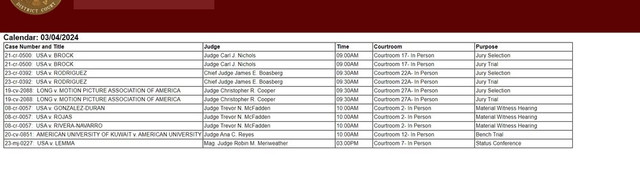 02-02-2024, 01:43 PM
-
#24
 02-02-2024, 02:24 PM
-
#25
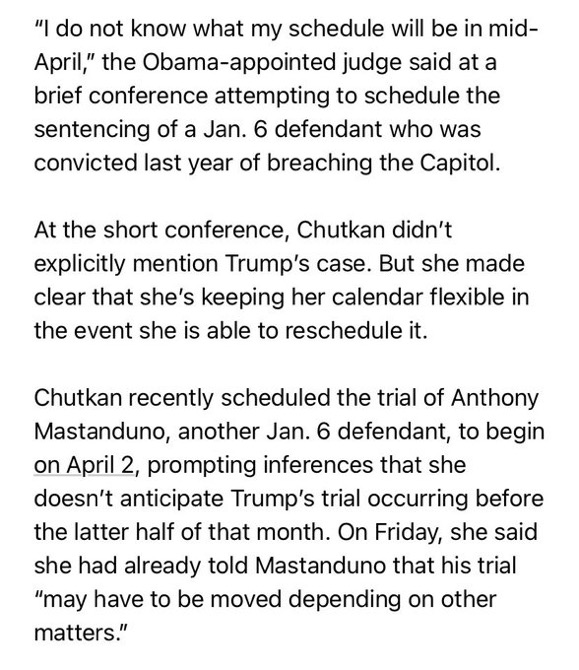
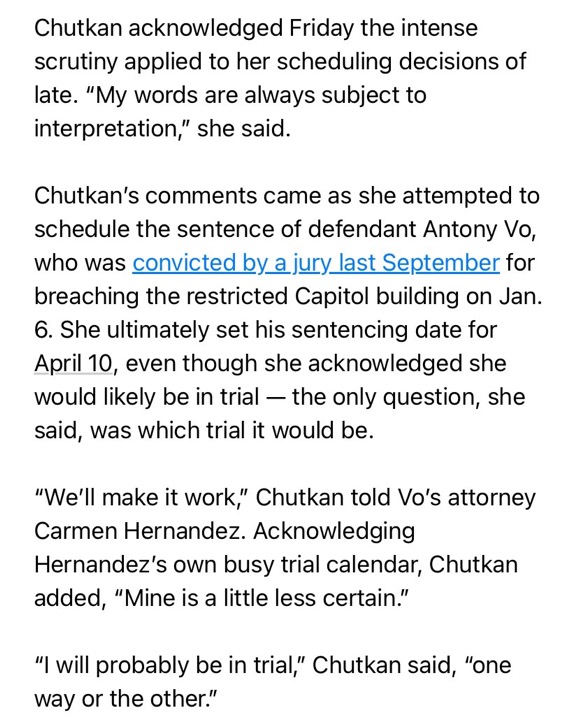 02-03-2024, 08:24 AM
-
#26
- gachase21
- Join Date: Dec 2010
- Location: Georgia, United States
- Posts: 31,767
- Subscribers: 4
- Rep Power: 389233
-
-
This does a fair job and summarizing my thread
There was some breathless commentary this week about the fact that the proposed March 4 trial date in Biden special counsel Jack Smith’s election-interference case against former president Donald Trump has been removed from the court’s calendar. In fact, this is just an administrative recognition of what, for weeks, has been an inevitable postponement.
I explained a few weeks back that the former president’s strategy has been “delay, delay, delay.” The immunity issue, on which (as this is written) we are still awaiting a decision from the three-judge D.C. Circuit panel, is more important to Trump because it was appealable pre-trial than because of the substance of his immunity claim (which is unlikely to prevail — indeed, the case is on appeal because the lower court already ruled against the former president). To repeat, when a case is on appeal, jurisdiction over it is transferred to the appellate court, which means the district-court judge — here, Judge Tanya Chutkan — cannot act on it.
As I related at the time, Trump’s gambit in seeking a contempt citation against Smith was not a serious contempt effort; it was a serious effort to have Judge Chutkan acknowledge that the case is frozen in her court. That is, there are to be no motions, no substantial matters addressed, and no expectations that the Trump team is using the delay to prepare for the eventual trial. (Logically, if there is immunity, then the constitutional offense is not merely to convict the immune official but to subject him to the prosecutorial process in the first place.)
In his effort to further delay the process, Trump has now prevailed. Chutkan has formally held the case in abeyance despite Smith’s attempts to nudge it along in hopes of getting Trump convicted before Election Day. It is frozen — potentially, not just through the panel’s consideration of immunity, but for as long as it takes to get through any additional appellate moves, such as a motion for reconsideration en banc (by the full eleven-member Circuit Court) and an application for Supreme Court review (a petition for certiorari).
Chutkan, an Obama appointee whose disdain for Trump is barely concealed, has seemed as anxious as Smith to get to trial, over the Trump camp’s strenuous objections. (Trump, naturally, wants the trial put off until after Election Day; if he wins the presidency, his Justice Department will then dismiss the indictment — and if the court fights him on that, he can always pardon himself.) Nevertheless, even if we assume Chutkan is chagrined by the delay, it cannot have been a difficult decision for her to acknowledge its ramifications. Not only is it the law; the judge knows there is an even more consequential issue brewing.
The Supreme Court granted certiorari to several January 6 defendants who challenge the Justice Department’s use against them of an obstruction statute (§1512(c)(2) of the penal code) that they claim is unconstitutionally vague. Although Trump is not a party to that appeal, the obstruction at issue is central to Smith’s case against him — two of the four charges are obstruction counts, and they are the most serious in terms of potential imprisonment.
As a practical matter, even if the immunity issue were not tying things up at the moment, Chutkan could not have started a trial on March 4 under circumstances in which the Supreme Court’s guidance on the main charge is not expected until mid-to-late June. Moreover, if the high Court were to restrict prosecutors’ use of §1512, and if in doing so the justices were to remind prosecutors (as they did last term) not to stretch criminal statutes in extravagant ways (as Smith has also done in dubiously charging Trump with fraud and civil-rights violations), it might be necessary for Smith to overhaul his case.
Of course, that is Trump’s dream scenario, and there’s a good chance it won’t go that way. Perhaps Smith won’t have to tinker with his case at all, or maybe whatever the Court says about obstruction will call for only minor adjustments. Even so, it is difficult to imagine how this two-to-three month trial could start prior to mid-summer — and even that may be optimistic.
Why? Because there is a lot of pre-trial work, including administrative detail, that must be attended to for a case to get to trial. As I elaborated in my above-linked column about Trump’s delay strategy, the pre-trial process includes discovery, motions to dismiss the case or suppress evidence, hearings on motions, and so on. Whenever jurisdiction is finally returned to Judge Chutkan, all of that will have to crank up again — it takes a long time to get through, and it’s not like this is the only case on Her Honor’s docket. (The Biden Justice Department is still arresting people in connection with the Capitol riot — in addition to the over 1,200 already charged. This is putting great strain on the D.C. district court’s resources.)
Beyond that, my friend Bill Shipley, a sharp former prosecutor who has defended a number of the January 6 cases and is very familiar with litigation practice in the D.C. district court, was ahead of the crowd when he explained on X/Twitter this week how the difficulty of seating of a jury in a trial like this factors in.
This is apt to be the highest-profile case in modern American history. As Bill points out, the parties will have to vet hundreds of potential jurors — maybe a thousand or more. To do that, the court must send out extensive questionnaires to potential jurors, which the lawyers vet under a court-supervised process; that way, when the trial begins, the parties can proceed with voir dire, strikes for cause, and discretionary (“peremptory”) strikes without undue delay. In order for that to happen in a trial scheduled to begin March 4, the questionnaires would have to have been sent out weeks before. Moreover, among the most important questions asked of prospective jurors would be: Are you available to serve as a juror for two-to-three months beginning on March 4? That is, if the trial date is unknown, it is pointless to send out the questionnaires; and if the questionnaires cannot be sent out well in advance, the trial can’t start on time. There is no getting around that.
This is why I am saying that even a midsummer start date for the anticipated trial would be ambitious. Does it eventually get so late in the election-campaign calendar that it would be too unseemly to start trial? I would hope so. The administration of justice in criminal cases is an important national priority, but it’s not the only one — or, necessarily, the highest one. How much intrusion on politics by the justice system should Americans tolerate — particularly under circumstances in which the intrusion is being orchestrated by the administration of the incumbent president against his campaign opponent?
Defendants have to be present in court for the entirety of criminal trials. Could we really have the Republican nominee stuck in a courtroom from, say, August through October? I’m sure that would be fine with the Biden Justice Department’s special counsel. The question may be whether the court will go along.
https://www.nationalreview.com/2024/...l-begin-later/I explained a few weeks back that the former president’s strategy has been “delay, delay, delay.” The immunity issue, on which (as this is written) we are still awaiting a decision from the three-judge D.C. Circuit panel, is more important to Trump because it was appealable pre-trial than because of the substance of his immunity claim (which is unlikely to prevail — indeed, the case is on appeal because the lower court already ruled against the former president). To repeat, when a case is on appeal, jurisdiction over it is transferred to the appellate court, which means the district-court judge — here, Judge Tanya Chutkan — cannot act on it.
As I related at the time, Trump’s gambit in seeking a contempt citation against Smith was not a serious contempt effort; it was a serious effort to have Judge Chutkan acknowledge that the case is frozen in her court. That is, there are to be no motions, no substantial matters addressed, and no expectations that the Trump team is using the delay to prepare for the eventual trial. (Logically, if there is immunity, then the constitutional offense is not merely to convict the immune official but to subject him to the prosecutorial process in the first place.)
In his effort to further delay the process, Trump has now prevailed. Chutkan has formally held the case in abeyance despite Smith’s attempts to nudge it along in hopes of getting Trump convicted before Election Day. It is frozen — potentially, not just through the panel’s consideration of immunity, but for as long as it takes to get through any additional appellate moves, such as a motion for reconsideration en banc (by the full eleven-member Circuit Court) and an application for Supreme Court review (a petition for certiorari).
Chutkan, an Obama appointee whose disdain for Trump is barely concealed, has seemed as anxious as Smith to get to trial, over the Trump camp’s strenuous objections. (Trump, naturally, wants the trial put off until after Election Day; if he wins the presidency, his Justice Department will then dismiss the indictment — and if the court fights him on that, he can always pardon himself.) Nevertheless, even if we assume Chutkan is chagrined by the delay, it cannot have been a difficult decision for her to acknowledge its ramifications. Not only is it the law; the judge knows there is an even more consequential issue brewing.
The Supreme Court granted certiorari to several January 6 defendants who challenge the Justice Department’s use against them of an obstruction statute (§1512(c)(2) of the penal code) that they claim is unconstitutionally vague. Although Trump is not a party to that appeal, the obstruction at issue is central to Smith’s case against him — two of the four charges are obstruction counts, and they are the most serious in terms of potential imprisonment.
As a practical matter, even if the immunity issue were not tying things up at the moment, Chutkan could not have started a trial on March 4 under circumstances in which the Supreme Court’s guidance on the main charge is not expected until mid-to-late June. Moreover, if the high Court were to restrict prosecutors’ use of §1512, and if in doing so the justices were to remind prosecutors (as they did last term) not to stretch criminal statutes in extravagant ways (as Smith has also done in dubiously charging Trump with fraud and civil-rights violations), it might be necessary for Smith to overhaul his case.
Of course, that is Trump’s dream scenario, and there’s a good chance it won’t go that way. Perhaps Smith won’t have to tinker with his case at all, or maybe whatever the Court says about obstruction will call for only minor adjustments. Even so, it is difficult to imagine how this two-to-three month trial could start prior to mid-summer — and even that may be optimistic.
Why? Because there is a lot of pre-trial work, including administrative detail, that must be attended to for a case to get to trial. As I elaborated in my above-linked column about Trump’s delay strategy, the pre-trial process includes discovery, motions to dismiss the case or suppress evidence, hearings on motions, and so on. Whenever jurisdiction is finally returned to Judge Chutkan, all of that will have to crank up again — it takes a long time to get through, and it’s not like this is the only case on Her Honor’s docket. (The Biden Justice Department is still arresting people in connection with the Capitol riot — in addition to the over 1,200 already charged. This is putting great strain on the D.C. district court’s resources.)
Beyond that, my friend Bill Shipley, a sharp former prosecutor who has defended a number of the January 6 cases and is very familiar with litigation practice in the D.C. district court, was ahead of the crowd when he explained on X/Twitter this week how the difficulty of seating of a jury in a trial like this factors in.
This is apt to be the highest-profile case in modern American history. As Bill points out, the parties will have to vet hundreds of potential jurors — maybe a thousand or more. To do that, the court must send out extensive questionnaires to potential jurors, which the lawyers vet under a court-supervised process; that way, when the trial begins, the parties can proceed with voir dire, strikes for cause, and discretionary (“peremptory”) strikes without undue delay. In order for that to happen in a trial scheduled to begin March 4, the questionnaires would have to have been sent out weeks before. Moreover, among the most important questions asked of prospective jurors would be: Are you available to serve as a juror for two-to-three months beginning on March 4? That is, if the trial date is unknown, it is pointless to send out the questionnaires; and if the questionnaires cannot be sent out well in advance, the trial can’t start on time. There is no getting around that.
This is why I am saying that even a midsummer start date for the anticipated trial would be ambitious. Does it eventually get so late in the election-campaign calendar that it would be too unseemly to start trial? I would hope so. The administration of justice in criminal cases is an important national priority, but it’s not the only one — or, necessarily, the highest one. How much intrusion on politics by the justice system should Americans tolerate — particularly under circumstances in which the intrusion is being orchestrated by the administration of the incumbent president against his campaign opponent?
Defendants have to be present in court for the entirety of criminal trials. Could we really have the Republican nominee stuck in a courtroom from, say, August through October? I’m sure that would be fine with the Biden Justice Department’s special counsel. The question may be whether the court will go along.
02-03-2024, 04:13 PM
-
#27
- gachase21
- Join Date: Dec 2010
- Location: Georgia, United States
- Posts: 31,767
- Subscribers: 4
- Rep Power: 389233
-
-
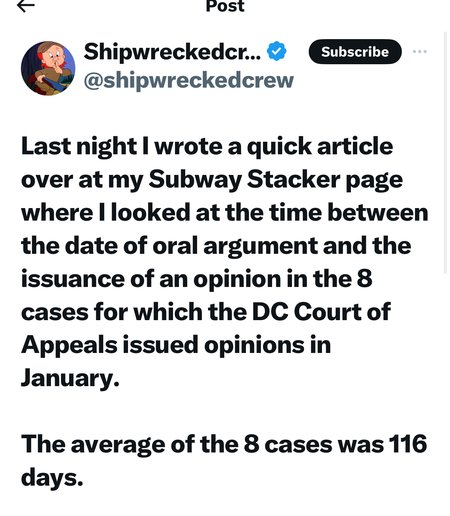
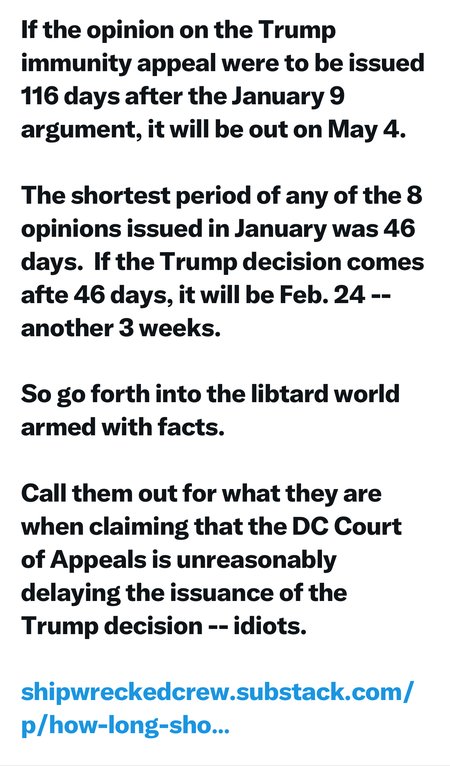
Bookmarks
-

- Digg
-

- del.icio.us
-

- StumbleUpon
-

-

Posting Permissions
- You may not post new threads
- You may not post replies
- You may not post attachments
- You may not edit your posts