
Forum
»
Economics Thread; Theory, Facts, and Fallacies
 11-22-2023, 06:34 PM
-
#31

Originally Posted By 3fifty⏩
I'm just generally concerned in a general way about the general trend lad.Your reply isn't very clear.
Are you saying that you ARE concerned that regulations will ease? What is your concern?
Ability to compete globally, is that a good or bad thing to you?
Need a bit more context to actually reply.
Are you saying that you ARE concerned that regulations will ease? What is your concern?
Ability to compete globally, is that a good or bad thing to you?
Need a bit more context to actually reply.
11-22-2023, 06:34 PM
-
#32

Originally Posted By mikebadg3⏩
As pointed out in the OP, there is nuance to this. You’re making generalizations, straw man talking points, and exceptions to the rules. Some cases, the fraud was committed as a result of taking advantage of government interference.circa industrial revolution USA where child labor was the norm
sweat shops in china present day,
where did you get the idea i said today it is like that in the us or are you just imagining things
even within the last 20-30 years you have FTX, Enron, Worldcom, CEO of Binance pleading guilty to money laundering
Lol
sweat shops in china present day,
where did you get the idea i said today it is like that in the us or are you just imagining things
even within the last 20-30 years you have FTX, Enron, Worldcom, CEO of Binance pleading guilty to money laundering
Lol
In early America, the difference between starving and surviving was everyone in the family working. Some children worked on their family farms, their family’s business, or even factories. At that time, would it have been moral to prevent children from working and having them starve to death? Capitalism created so much wealth in such a short period of time, that less people in a household had to work. In fact, when you see “household income”, you can bet it’s someone with an agenda, because households have less people, and also don’t need as many people working to afford the house. So the child labor laws only “worked” because children didn’t have to work at that point anyway.
Then we can look at other forms of theories in action, like communism/socialism, and they HAVE to force children to work or they will starve, and even if they are working, they could starve anyway. This is why I refer to socialism and communism as “backwards”. We prevent children from working and succeed, they have to make children work to succeed. Luckily we live in a capitalist nation where children don’t really have to work anymore to survive. At this point, only about 5% of the people in the nation would be forced to make their children work to survive, but now they’re getting paid to have children, soooo (example of backwardness in the US)
One party system; Most Republicans are Democrats, but no Democrats are Republicans.
Hayek and Mises were right; they're all socialists.
"To Call something fair or unfair is a subjective value judgment and not liable to any verification" Ludwig Von Mises
11-22-2023, 06:39 PM
-
#33
11-22-2023, 06:42 PM
-
#34
- 3fifty
- Registered User
-

- 3fifty
- Registered User
- Join Date: Jan 2021
- Age: 56
- Posts: 2,447
- Rep Power: 20493
-
-

Originally Posted By Kraken⏩
The bolded is a great point and another example of how easy it is to manipulate data to show what you want.As pointed out in the OP, there is nuance to this. You’re making generalizations, straw man talking points, and exceptions to the rules. Some cases, the fraud was committed as a result of taking advantage of government interference.
In early America, the difference between starving and surviving was everyone in the family working. Some children worked on their family farms, their family’s business, or even factories. At that time, would it have been moral to prevent children from working and having them starve to death? Capitalism created so much wealth in such a short period of time, that less people in a household had to work.In fact, when you see “household income”, you can bet it’s someone with an agenda, because households have less people, and also don’t need as many people working to afford the house. So the child labor laws only “worked” because children didn’t have to work at that point anyway.
Then we can look at other forms of theories in action, like communism/socialism, and they HAVE to force children to work or they will starve, and even if they are working, they could starve anyway. This is why I refer to socialism and communism as “backwards”. We prevent children from working and succeed, they have to make children work to succeed. Luckily we live in a capitalist nation where children don’t really have to work anymore to survive. At this point, only about 5% of the people in the nation would be forced to make their children work to survive, but now they’re getting paid to have children, soooo
In early America, the difference between starving and surviving was everyone in the family working. Some children worked on their family farms, their family’s business, or even factories. At that time, would it have been moral to prevent children from working and having them starve to death? Capitalism created so much wealth in such a short period of time, that less people in a household had to work.In fact, when you see “household income”, you can bet it’s someone with an agenda, because households have less people, and also don’t need as many people working to afford the house. So the child labor laws only “worked” because children didn’t have to work at that point anyway.
Then we can look at other forms of theories in action, like communism/socialism, and they HAVE to force children to work or they will starve, and even if they are working, they could starve anyway. This is why I refer to socialism and communism as “backwards”. We prevent children from working and succeed, they have to make children work to succeed. Luckily we live in a capitalist nation where children don’t really have to work anymore to survive. At this point, only about 5% of the people in the nation would be forced to make their children work to survive, but now they’re getting paid to have children, soooo
Excited to read more of your opinions ITT.
Here's another one - everyone so upset at housing costs up. Nobody wants to factor in a few things.
1960s - Average new home size was 960 square feet, with minimal regulation and lower quality materials, less drywall, etc.
2023 - Average new home size is over twice as big at 2,300 sq feet, significantly better design with safer regulations, more drywall, better foundations, etc.
When you factor in home size growth, as well a population growth, that explains a lot of cost increases. Granted there are some actual increases that are simply inflation related, but it's overstated.
We also work fewer hours per week than the generation before us, and even less than our grandparents generation.
11-22-2023, 06:50 PM
-
#35
Edited my second post with some examples and thoughts on assessing economic indicators with more objectivity. These examples are relevant to today’s economy.
One party system; Most Republicans are Democrats, but no Democrats are Republicans.
Hayek and Mises were right; they're all socialists.
"To Call something fair or unfair is a subjective value judgment and not liable to any verification" Ludwig Von Mises
11-22-2023, 06:51 PM
-
#36
Originally Posted By 3fifty⏩
I'm just winding you up. All my cash is gold and guns and i hope your economic system fails so I can become a God / Leader like that bald headed dude from Mad Max and steal your petrol.What trend? Can you be more specific?
Why are you concerned?
Full sentences please
Why are you concerned?
Full sentences please
11-22-2023, 07:06 PM
-
#37
- LogicalLifts
- Registered User
-

- LogicalLifts
- Registered User
- Join Date: Aug 2022
- Age: 56
- Posts: 13,157
- Rep Power: 204849
-
-
Good thread, OP.
On topic: I have said it before and I'll say it again - I wish more folks had read Amartya Sen. His work is still applicable today, e.g., the "capabilities" he speaks of. In particular in situations like the educational system in NYC, or "education" as such in the United States.
There's been such a rush towards economic "rights" that folks don't seem to understand the basic principles required to even consider who or what should satisfy a "right", whether it be a "right" to development, or a "right" to economic progress, etc. Rights rhetoric runs parallel to modern economics at times which is a travesty.
And fundamentally linked to "equality of opportunity". Yet time and time again on this forum when we discuss economic "success" some folks jump to criticizing the 1% (in reality, they mean the 0.1%) rather than looking at the fact of the situation: rife ignorance when it comes to prudent economic planning, both on an individual level and a wider level.
On topic: I have said it before and I'll say it again - I wish more folks had read Amartya Sen. His work is still applicable today, e.g., the "capabilities" he speaks of. In particular in situations like the educational system in NYC, or "education" as such in the United States.
There's been such a rush towards economic "rights" that folks don't seem to understand the basic principles required to even consider who or what should satisfy a "right", whether it be a "right" to development, or a "right" to economic progress, etc. Rights rhetoric runs parallel to modern economics at times which is a travesty.
And fundamentally linked to "equality of opportunity". Yet time and time again on this forum when we discuss economic "success" some folks jump to criticizing the 1% (in reality, they mean the 0.1%) rather than looking at the fact of the situation: rife ignorance when it comes to prudent economic planning, both on an individual level and a wider level.
11-22-2023, 07:50 PM
-
#38
- whitepaper
- Registered User
-

- whitepaper
- Registered User
- Join Date: Jun 2011
- Posts: 20,840
- Rep Power: 55720
-
-
Originally Posted By mikebadg3⏩
if we're talking pure/true capitalism, not the bullshiit wrapper they use in education or as a deterrent to enacting any other system, then yeah.i suspect unchecked, unregulated capitalism is the bane of existence
not that other radical ideologies aren't, but.
discuss
not that other radical ideologies aren't, but.
discuss
the reality is that capitalism is a tool and it's only as effective as is the cohesiveness of the people within it's economic boundaries/reaches, which i would argue is directly correlated with morality or some desire to do good by all belonging to said group. today we have far more individualistic principles driving any facet of the group/actor you can think of, that it just cannot work. everyone is far too split along a number of attributes that no one is remotely working together through and through. anything to make a buck, no expenses spared, morality and humanity be damned.
and i don't mean to make it political, but there are exceptions to this. one being us and our allies, or rather one ally.
Originally Posted By r32gojirra⏩
no comment on your question, but these guys here are the devil incarnate2014 Misc Resolution: Negging no pics (screen captures of text don't count as pics)
HairyWBush Reps for life - Hamster Compassion: https://forum.obnoxiousbrutes.com/showthread.php?t=181804893
11-23-2023, 11:27 AM
-
#39
Economic mobility under Capitalism
According to economist Thomas Sowell, economic mobility in the US is tremendous and helps understand how this phenom is beneficial. He points out that people move in and out of wealth brackets. The vast majority of the “poor” are the youth, and 75% of Americans will pull themselves out of poverty by median age. As we age past the median, our wealth begins to decrease again. Another example is that 56% of Americans will find themselves in the 1% wealth bracket as a result of “windfall gains”, sometimes only lasting one year. This can simply be the result of inheriting wealth and liquidating assets. Very few people remain in the 1% wealth category for long, meaning that it’s never the same people. In other words, when we talk about wealth disparity, poverty, the rich etc, we are referring to different individuals every year!
According to economist Thomas Sowell, economic mobility in the US is tremendous and helps understand how this phenom is beneficial. He points out that people move in and out of wealth brackets. The vast majority of the “poor” are the youth, and 75% of Americans will pull themselves out of poverty by median age. As we age past the median, our wealth begins to decrease again. Another example is that 56% of Americans will find themselves in the 1% wealth bracket as a result of “windfall gains”, sometimes only lasting one year. This can simply be the result of inheriting wealth and liquidating assets. Very few people remain in the 1% wealth category for long, meaning that it’s never the same people. In other words, when we talk about wealth disparity, poverty, the rich etc, we are referring to different individuals every year!
One party system; Most Republicans are Democrats, but no Democrats are Republicans.
Hayek and Mises were right; they're all socialists.
"To Call something fair or unfair is a subjective value judgment and not liable to any verification" Ludwig Von Mises
11-23-2023, 02:56 PM
-
#40
Edits in post two to include definitions of socialism and capitalism. This should help some folks understand the differences between the two and what we mean when we refer to those systems and policies.
One party system; Most Republicans are Democrats, but no Democrats are Republicans.
Hayek and Mises were right; they're all socialists.
"To Call something fair or unfair is a subjective value judgment and not liable to any verification" Ludwig Von Mises
11-23-2023, 03:09 PM
-
#41

- WoofieNugget
- Join Date: Jun 2010
- Age: 51
- Posts: 24,103
- Rep Power: 109783
-
-
Originally Posted By LogicalLifts⏩
Education does have a lot to do with it, especially financial education - which the US has basically zero of because it's such a consumer driven society. There's virtually no education on anything economic for regular joes such as budgeting, taxes, even corporate structure. Mostly because in 80% of schools people are barely passing math, let alone financial management. They also have parents who live on credit and can't afford their lives which gives them even less positive examples.Good thread, OP.
On topic: I have said it before and I'll say it again - I wish more folks had read Amartya Sen. His work is still applicable today, e.g., the "capabilities" he speaks of. In particular in situations like the educational system in NYC, or "education" as such in the United States.
There's been such a rush towards economic "rights" that folks don't seem to understand the basic principles required to even consider who or what should satisfy a "right", whether it be a "right" to development, or a "right" to economic progress, etc. Rights rhetoric runs parallel to modern economics at times which is a travesty.
And fundamentally linked to "equality of opportunity". Yet time and time again on this forum when we discuss economic "success" some folks jump to criticizing the 1% (in reality, they mean the 0.1%) rather than looking at the fact of the situation: rife ignorance when it comes to prudent economic planning, both on an individual level and a wider level.
On topic: I have said it before and I'll say it again - I wish more folks had read Amartya Sen. His work is still applicable today, e.g., the "capabilities" he speaks of. In particular in situations like the educational system in NYC, or "education" as such in the United States.
There's been such a rush towards economic "rights" that folks don't seem to understand the basic principles required to even consider who or what should satisfy a "right", whether it be a "right" to development, or a "right" to economic progress, etc. Rights rhetoric runs parallel to modern economics at times which is a travesty.
And fundamentally linked to "equality of opportunity". Yet time and time again on this forum when we discuss economic "success" some folks jump to criticizing the 1% (in reality, they mean the 0.1%) rather than looking at the fact of the situation: rife ignorance when it comes to prudent economic planning, both on an individual level and a wider level.
What another poster said above is true as well - generationally, people work FAR less now than they did even fifty years ago. Suggest to somebody that they work six days a week and they'll look at you like you have a hole in the head, meanwhile in (especially impoverished) countries it is the norm in order to support a family and have basic needs met. My kids sometimes complain when I have to do an hour of work on a weekend, but I explain to them how a business is run and that it's necessary, and I never let it interfere with activities or family time.
Because of the economic climate in the world, we are seeing much more opportunity for those who are willing to actually work, which is a good thing IMO. If you want to sit around and be lazy, don't complain.
11-23-2023, 09:16 PM
-
#42
- whitepaper
- Registered User
-
- whitepaper
- Registered User
- Join Date: Jun 2011
- Posts: 20,840
- Rep Power: 55720
-
-
Originally Posted By Kraken⏩
i wonder how much of this holds true now. there's no doubt that wealth is being concentrated within a smaller group decade after decade as the middle class effectively become erased, so at some point, this will not hold true, correct?Economic mobility under Capitalism
According to economist Thomas Sowell, economic mobility in the US is tremendous and helps understand how this phenom is beneficial. He points out that people move in and out of wealth brackets. The vast majority of the “poor” are the youth, and 75% of Americans will pull themselves out of poverty by median age. As we age past the median, our wealth begins to decrease again. Another example is that 56% of Americans will find themselves in the 1% wealth bracket as a result of “windfall gains”, sometimes only lasting one year. This can simply be the result of inheriting wealth and liquidating assets. Very few people remain in the 1% wealth category for long, meaning that it’s never the same people. In other words, when we talk about wealth disparity, poverty, the rich etc, we are referring to different individuals every year!
According to economist Thomas Sowell, economic mobility in the US is tremendous and helps understand how this phenom is beneficial. He points out that people move in and out of wealth brackets. The vast majority of the “poor” are the youth, and 75% of Americans will pull themselves out of poverty by median age. As we age past the median, our wealth begins to decrease again. Another example is that 56% of Americans will find themselves in the 1% wealth bracket as a result of “windfall gains”, sometimes only lasting one year. This can simply be the result of inheriting wealth and liquidating assets. Very few people remain in the 1% wealth category for long, meaning that it’s never the same people. In other words, when we talk about wealth disparity, poverty, the rich etc, we are referring to different individuals every year!
2014 Misc Resolution: Negging no pics (screen captures of text don't count as pics)
HairyWBush Reps for life - Hamster Compassion: https://forum.obnoxiousbrutes.com/showthread.php?t=181804893
11-23-2023, 09:19 PM
-
#43
- whitepaper
- Registered User
-
- whitepaper
- Registered User
- Join Date: Jun 2011
- Posts: 20,840
- Rep Power: 55720
-
-
Originally Posted By Kraken⏩
your definition of capitalism is largely lacking, and you ignore a key and integral aspect of capitalism that shouldn't just be implied, but explicitly stated; effort towards profitEdits in post two to include definitions of socialism and capitalism. This should help some folks understand the differences between the two and what we mean when we refer to those systems and policies.
disappointed in your incredibly narrow, cookie cutter, view of the term. it's like you're trying to run for office:
"capitalism is about the person and the government should stay out!! now don't forget to vote for me and I will keep the pesky government out of your business!!!"

2014 Misc Resolution: Negging no pics (screen captures of text don't count as pics)
HairyWBush Reps for life - Hamster Compassion: https://forum.obnoxiousbrutes.com/showthread.php?t=181804893
11-23-2023, 10:32 PM
-
#44
Originally Posted By whitepaper⏩
This is incorrect. Middle class isn’t being erased. This is socialist propaganda. We know this because the middle class is moving up (Sowell, Basic Economics). As the markets advance, and people become more educated, they are making more money. What this means is, that the middle class appears to be shrinking, but if you look at the upper income bracket, you find it’s getting larger. The government school system is largely failing in this regard and we are seeing demographics falling behind.i wonder how much of this holds true now. there's no doubt that wealth is being concentrated within a smaller group decade after decade as the middle class effectively become erased, so at some point, this will not hold true, correct?
The problem here is how the data is being interpreted. If you include 16-24 year olds, who are living at home and without jobs, maybe going to college, it will skew the data to make it look like the low income bracket is getting bigger. Instead, we look at individuals at median age, and suddenly the numbers tell a completely different story. Now those 16-24 years olds have gone through college, moved out, have experience etc. Today’s market requires more skills, education, and experience, but when they get it, they make more money than the middle class of previous decades. In previous decades, the employment of 16-24 year olds were greater. So if we look at median age, the wealth disparity and middle class arguments becomes far less relevant.
One party system; Most Republicans are Democrats, but no Democrats are Republicans.
Hayek and Mises were right; they're all socialists.
"To Call something fair or unfair is a subjective value judgment and not liable to any verification" Ludwig Von Mises
11-23-2023, 10:39 PM
-
#45
- EiFit91
- Registered User
-

- EiFit91
- Registered User
- Join Date: Oct 2020
- Age: 56
- Posts: 2,673
- Rep Power: 28191
-
-
Originally Posted By Kraken⏩
Don't know about the 1% category in particular, but at best this is a highly misleading way to represent facts. Would very much like to see evidence behind this claim in particular: "Another example is that 56% of Americans will find themselves in the 1% wealth bracket as a result of “windfall gains”", which seems wild.Economic mobility under Capitalism
According to economist Thomas Sowell, economic mobility in the US is tremendous and helps understand how this phenom is beneficial. He points out that people move in and out of wealth brackets. The vast majority of the “poor” are the youth, and 75% of Americans will pull themselves out of poverty by median age. As we age past the median, our wealth begins to decrease again. Another example is that 56% of Americans will find themselves in the 1% wealth bracket as a result of “windfall gains”, sometimes only lasting one year. This can simply be the result of inheriting wealth and liquidating assets. Very few people remain in the 1% wealth category for long, meaning that it’s never the same people. In other words, when we talk about wealth disparity, poverty, the rich etc, we are referring to different individuals every year!
According to economist Thomas Sowell, economic mobility in the US is tremendous and helps understand how this phenom is beneficial. He points out that people move in and out of wealth brackets. The vast majority of the “poor” are the youth, and 75% of Americans will pull themselves out of poverty by median age. As we age past the median, our wealth begins to decrease again. Another example is that 56% of Americans will find themselves in the 1% wealth bracket as a result of “windfall gains”, sometimes only lasting one year. This can simply be the result of inheriting wealth and liquidating assets. Very few people remain in the 1% wealth category for long, meaning that it’s never the same people. In other words, when we talk about wealth disparity, poverty, the rich etc, we are referring to different individuals every year!
Here's a good source on the role played by intergenerational transfers:
https://www.federalreserve.gov/econr...-20180601.html
"Indeed, we find that the recipients of intergenerational transfers are much more likely to be college-educated, high-income, and high-wealth, as shown in the Table 1"
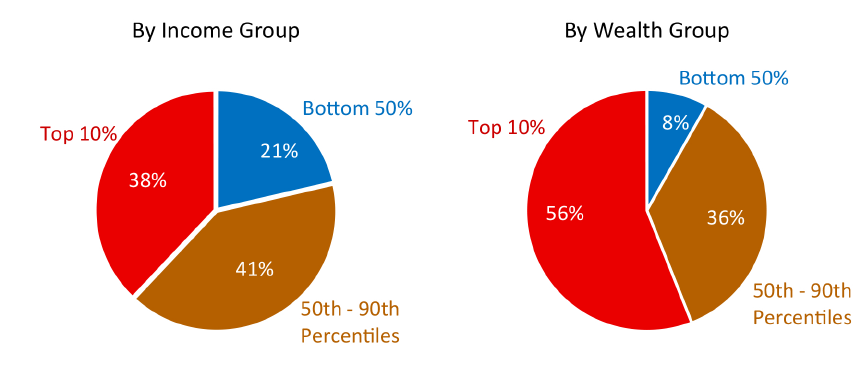
"The evidence from the SCF presented here is strongly suggestive that intergenerational wealth transmission plays an important role in helping to explain wealth concentration."
Intergenerational transfers are highly skewed and likely to be a big contribution to wealth concentration in upper classes. Does it account for everything? No but of course being born in a rich family will make a massive difference to your life, all else equal.
11-23-2023, 11:40 PM
-
#46
Originally Posted By EiFit91⏩
You left out part of what my post said. Other things can put someone up there, like liquidating assets, investments/retirement funds etc.Don't know about the 1% category in particular, but at best this is a highly misleading way to represent facts. Would very much like to see evidence behind this claim in particular: "Another example is that 56% of Americans will find themselves in the 1% wealth bracket as a result of “windfall gains”", which seems wild.
Here's a good source on the role played by intergenerational transfers:
https://www.federalreserve.gov/econr...-20180601.html
"Indeed, we find that the recipients of intergenerational transfers are much more likely to be college-educated, high-income, and high-wealth, as shown in the Table 1"
"The evidence from the SCF presented here is strongly suggestive that intergenerational wealth transmission plays an important role in helping to explain wealth concentration."
Intergenerational transfers are highly skewed and likely to be a big contribution to wealth concentration in upper classes. Does it account for everything? No but of course being born in a rich family will make a massive difference to your life, all else equal.
Here's a good source on the role played by intergenerational transfers:
https://www.federalreserve.gov/econr...-20180601.html
"Indeed, we find that the recipients of intergenerational transfers are much more likely to be college-educated, high-income, and high-wealth, as shown in the Table 1"
"The evidence from the SCF presented here is strongly suggestive that intergenerational wealth transmission plays an important role in helping to explain wealth concentration."
Intergenerational transfers are highly skewed and likely to be a big contribution to wealth concentration in upper classes. Does it account for everything? No but of course being born in a rich family will make a massive difference to your life, all else equal.
IN my previous post I emphasized the importance of education, and how the middle class has moved up as a result. Your link also points out that college education play a role in wealth accumulation.
I honestly don’t want to get in to the wealth disparity debate though, because it’s really an irrelevant talking point by socialists who are more worried about someone else than themselves. It’s a very selfish viewpoint, because what someone else has, under capitalism, has no impact on you and your ability to make money or thrive. This is easily seen when you look at consumption. The poor have cars, cell phones, buy the same groceries as the rich, air conditioning, a roof over their heads, computers, internet…in other words, if e look at consumption, suddenly there is far less “disparity”. So their house is bigger? Car is nicer? Now you’re just getting greedy, but that’s the driving force behind socialist propaganda; greed and envy.
The point was, mobility is the key and education is a sure way to develop wealth accumulation. A lot of college educated folks also do things that benefit their children. I see a lot of foilks talking about spending all of their money before they die, but if you look at those with rich families, it was their parents, grandparents, and great parents that did a lot of heavy lifting to make sure the family was taken care of.
One party system; Most Republicans are Democrats, but no Democrats are Republicans.
Hayek and Mises were right; they're all socialists.
"To Call something fair or unfair is a subjective value judgment and not liable to any verification" Ludwig Von Mises
11-24-2023, 12:57 AM
-
#47
- EiFit91
- Registered User
-
- EiFit91
- Registered User
- Join Date: Oct 2020
- Age: 56
- Posts: 2,673
- Rep Power: 28191
-
-
Originally Posted By Kraken⏩
I focused on what I felt was most misleading about your post. And there's still no reference behind the absurd claim that 56% of Americans will at some point be in the 1%, so I will assume that this is a factual error and not backed by any real data.You left out part of what my post said. Other things can put someone up there, like liquidating assets, investments/retirement funds etc.
IN my previous post I emphasized the importance of education, and how the middle class has moved up as a result. Your link also points out that college education play a role in wealth accumulation.
I honestly don’t want to get in to the wealth disparity debate though, because it’s really an irrelevant talking point by socialists who are more worried about someone else than themselves. It’s a very selfish viewpoint, because what someone else has, under capitalism, has no impact on you and your ability to make money or thrive. This is easily seen when you look at consumption. The poor have cars, cell phones, buy the same groceries as the rich, air conditioning, a roof over their heads, computers, internet…in other words, if e look at consumption, suddenly there is far less “disparity”. So their house is bigger? Car is nicer? Now you’re just getting greedy, but that’s the driving force behind socialist propaganda; greed and envy.
The point was, mobility is the key and education is a sure way to develop wealth accumulation. A lot of college educated folks also do things that benefit their children. I see a lot of foilks talking about spending all of their money before they die, but if you look at those with rich families, it was their parents, grandparents, and great parents that did a lot of heavy lifting to make sure the family was taken care of.
IN my previous post I emphasized the importance of education, and how the middle class has moved up as a result. Your link also points out that college education play a role in wealth accumulation.
I honestly don’t want to get in to the wealth disparity debate though, because it’s really an irrelevant talking point by socialists who are more worried about someone else than themselves. It’s a very selfish viewpoint, because what someone else has, under capitalism, has no impact on you and your ability to make money or thrive. This is easily seen when you look at consumption. The poor have cars, cell phones, buy the same groceries as the rich, air conditioning, a roof over their heads, computers, internet…in other words, if e look at consumption, suddenly there is far less “disparity”. So their house is bigger? Car is nicer? Now you’re just getting greedy, but that’s the driving force behind socialist propaganda; greed and envy.
The point was, mobility is the key and education is a sure way to develop wealth accumulation. A lot of college educated folks also do things that benefit their children. I see a lot of foilks talking about spending all of their money before they die, but if you look at those with rich families, it was their parents, grandparents, and great parents that did a lot of heavy lifting to make sure the family was taken care of.
On mobility,
https://www.nber.org/system/files/wo...874/w28874.pdf
"First, there are systematic differences in intergenerational mobility across developed countries. Mobility, as measured by the IGE, appears to be relatively low in the US, a bit higher in the UK and in continental Europe, and highest in Canada and the
Nordic countries (Corak, 2006; Björklund et al., 2009a; Blanden, 2013). Intergenerational mobility in education attainment follow the same pattern, although the gap between low mobility (the US) and high mobility countries (the Nordics) is smaller for education than it is for income (Landersø and Heckman, 2017; Karlson and Landersø, 2021)."
If you look at their figure 2 comparing Denmark and the US, educational mobility has been increasing in Denmark and flat in the US since the 1950s.
If you look at academia there is substantial concentration of people from similar backgrounds:
https://www.nature.com/articles/s41562-022-01425-4
"Combining national-level data on education, income and university rankings with a 2017–2020 survey of 7,204 US-based tenure-track faculty across eight disciplines in STEM, social science and the humanities, we show that faculty are up to 25 times more likely to have a parent with a Ph.D. Moreover, this rate nearly doubles at prestigious universities and is stable across the past 50 years."
Your third paragraph above is largely meaningless to me. Of course what someone else has influences my ability to make money or thrive. You're making some huge (unstated) assumptions for this statement to hold true. If you want to make outlandish claims you need to back them up by actual evidence.
Also, a more general point: It is very hard to quantify exactly what a given individual contributes to in terms of total output. Production of goods and services is an interdependent activity and isolating the contribution of a single individual is extremely hard empirically.
11-24-2023, 01:16 AM
-
#48
Originally Posted By EiFit91⏩
I just realized you're right. I misread or typoed the 1%.I focused on what I felt was most misleading about your post. And there's still no reference behind the absurd claim that 56% of Americans will at some point be in the 1%, so I will assume that this is a factual error and not backed by any real data.
On mobility,
https://www.nber.org/system/files/wo...874/w28874.pdf
"First, there are systematic differences in intergenerational mobility across developed countries. Mobility, as measured by the IGE, appears to be relatively low in the US, a bit higher in the UK and in continental Europe, and highest in Canada and the
Nordic countries (Corak, 2006; Björklund et al., 2009a; Blanden, 2013). Intergenerational mobility in education attainment follow the same pattern, although the gap between low mobility (the US) and high mobility countries (the Nordics) is smaller for education than it is for income (Landersø and Heckman, 2017; Karlson and Landersø, 2021)."
If you look at their figure 2 comparing Denmark and the US, educational mobility has been increasing in Denmark and flat in the US since the 1950s.
If you look at academia there is substantial concentration of people from similar backgrounds:
https://www.nature.com/articles/s41562-022-01425-4
"Combining national-level data on education, income and university rankings with a 2017–2020 survey of 7,204 US-based tenure-track faculty across eight disciplines in STEM, social science and the humanities, we show that faculty are up to 25 times more likely to have a parent with a Ph.D. Moreover, this rate nearly doubles at prestigious universities and is stable across the past 50 years."
Your third paragraph above is largely meaningless to me. Of course what someone else has influences my ability to make money or thrive. You're making some huge (unstated) assumptions for this statement to hold true. If you want to make outlandish claims you need to back them up by actual evidence.
Also, a more general point: It is very hard to quantify exactly what a given individual contributes to in terms of total output. Production of goods and services is an interdependent activity and isolating the contribution of a single individual is extremely hard empirically.
On mobility,
https://www.nber.org/system/files/wo...874/w28874.pdf
"First, there are systematic differences in intergenerational mobility across developed countries. Mobility, as measured by the IGE, appears to be relatively low in the US, a bit higher in the UK and in continental Europe, and highest in Canada and the
Nordic countries (Corak, 2006; Björklund et al., 2009a; Blanden, 2013). Intergenerational mobility in education attainment follow the same pattern, although the gap between low mobility (the US) and high mobility countries (the Nordics) is smaller for education than it is for income (Landersø and Heckman, 2017; Karlson and Landersø, 2021)."
If you look at their figure 2 comparing Denmark and the US, educational mobility has been increasing in Denmark and flat in the US since the 1950s.
If you look at academia there is substantial concentration of people from similar backgrounds:
https://www.nature.com/articles/s41562-022-01425-4
"Combining national-level data on education, income and university rankings with a 2017–2020 survey of 7,204 US-based tenure-track faculty across eight disciplines in STEM, social science and the humanities, we show that faculty are up to 25 times more likely to have a parent with a Ph.D. Moreover, this rate nearly doubles at prestigious universities and is stable across the past 50 years."
Your third paragraph above is largely meaningless to me. Of course what someone else has influences my ability to make money or thrive. You're making some huge (unstated) assumptions for this statement to hold true. If you want to make outlandish claims you need to back them up by actual evidence.
Also, a more general point: It is very hard to quantify exactly what a given individual contributes to in terms of total output. Production of goods and services is an interdependent activity and isolating the contribution of a single individual is extremely hard empirically.
73% end up in the top 20%, over 56% find themselves among the top 10 percent of income‐earners for at least one year during their working lives, and over 11% will be counted among the top 1%
As for the rest of this post, I'm going to have to read more on it and then share my thoughts. I didn't get to read all of it, as it's very late. I have some resources I can look through too, but I tend to be skeptical of some of the stuff coming from the Fed and particular schools of economics, but it's brought up some interesting points that I want to research.
One party system; Most Republicans are Democrats, but no Democrats are Republicans.
Hayek and Mises were right; they're all socialists.
"To Call something fair or unfair is a subjective value judgment and not liable to any verification" Ludwig Von Mises
11-24-2023, 01:35 AM
-
#49
- EiFit91
- Registered User
-
- EiFit91
- Registered User
- Join Date: Oct 2020
- Age: 56
- Posts: 2,673
- Rep Power: 28191
-
-
Originally Posted By Kraken⏩
Thanks for clearing that up, and for correcting the claim!I just realized you're right. I misread or typoed the 1%.
73% end up in the top 20%, over 56% find themselves among the top 10 percent of income‐earners for at least one year during their working lives, and over 11% will be counted among the top 1%
As for the rest of this post, I'm going to have to read more on it and then share my thoughts. I didn't get to read all of it, as it's very late. I have some resources I can look through too, but I tend to be skeptical of some of the stuff coming from the Fed and particular schools of economics, but it's brought up some interesting points that I want to research.
73% end up in the top 20%, over 56% find themselves among the top 10 percent of income‐earners for at least one year during their working lives, and over 11% will be counted among the top 1%
As for the rest of this post, I'm going to have to read more on it and then share my thoughts. I didn't get to read all of it, as it's very late. I have some resources I can look through too, but I tend to be skeptical of some of the stuff coming from the Fed and particular schools of economics, but it's brought up some interesting points that I want to research.
I find this claim much more reasonable but still unlikely to be true, 11% is a lot of people and the top 1% household's earnings are about 8 times higher than the median US earnings, so one would need a massive windfall gain to adjust for this. Also the top 1% disproportionately accumulate new wealth (about 2/3s of new wealth created since 2020:https://www.cnbc.com/2023/01/16/rich...020-oxfam.html)
It's possible that someone's true wealth can get masked by debt or losses in statistics for certain years and that by playing with data one could obtain the above kind of estimate but I would find it very misleading if taken as a measure of mobility. Measures of mobility clearly show that the US have lower mobility than the nordic countries and Canada
11-24-2023, 02:14 AM
-
#50
Originally Posted By EiFit91⏩
https://www.aei.org/carpe-diem/some-...cent-is-false/Thanks for clearing that up, and for correcting the claim!
I find this claim much more reasonable but still unlikely to be true, 11% is a lot of people and the top 1% household's earnings are about 8 times higher than the median US earnings, so one would need a massive windfall gain to adjust for this. Also the top 1% disproportionately accumulate new wealth (about 2/3s of new wealth created since 2020:https://www.cnbc.com/2023/01/16/rich...020-oxfam.html)
It's possible that someone's true wealth can get masked by debt or losses in statistics for certain years and that by playing with data one could obtain the above kind of estimate but I would find it very misleading if taken as a measure of mobility. Measures of mobility clearly show that the US have lower mobility than the nordic countries and Canada
I find this claim much more reasonable but still unlikely to be true, 11% is a lot of people and the top 1% household's earnings are about 8 times higher than the median US earnings, so one would need a massive windfall gain to adjust for this. Also the top 1% disproportionately accumulate new wealth (about 2/3s of new wealth created since 2020:https://www.cnbc.com/2023/01/16/rich...020-oxfam.html)
It's possible that someone's true wealth can get masked by debt or losses in statistics for certain years and that by playing with data one could obtain the above kind of estimate but I would find it very misleading if taken as a measure of mobility. Measures of mobility clearly show that the US have lower mobility than the nordic countries and Canada
Government intervention plays a big role in economic mobility. Interest rates, inflation, boom-bust cycles… Even at 2% inflation there is a negative effect on the measurements. Wealth accumulates at the top greatly with these too, meaning that government intervention is making the rich richer at a faster rate. The last couple years have had a significant impact on wealth and mobility.
Maybe this is why the economists that I tend to gravitate towards don’t use the IGE measurements.
https://journals.sagepub.com/doi/ful...81175019886613
Going to read all of this stuff tomorrow
One party system; Most Republicans are Democrats, but no Democrats are Republicans.
Hayek and Mises were right; they're all socialists.
"To Call something fair or unfair is a subjective value judgment and not liable to any verification" Ludwig Von Mises
11-24-2023, 02:31 AM
-
#51
 11-24-2023, 02:32 AM
-
#52
- Ironmanlet
- Adamantium User
-

- Ironmanlet
- Adamantium User
- Join Date: Aug 2009
- Location: Cajun Country
- Age: 40
- Height: 5'7"
- Weight: 185 lbs
- Posts: 52,401
- Subscribers: 5
- Rep Power: 415609
-
-

1. Money is imaginary and so are the rules that govern it.
2. It is not on accident. The economy doesn’t just do what it is going to do. Whatever happens is 100% on purpose. Intentional decision.
2. It is not on accident. The economy doesn’t just do what it is going to do. Whatever happens is 100% on purpose. Intentional decision.
“The stories and information posted here are artistic works of fiction and falsehood. Only a fool would take anything posted here as fact.“
PS: Don't eat poop, just don't let the idea of it stop you from living life to its fullest.
11-24-2023, 02:40 AM
-
#53
- BigDeeps01
- Registered User
-

- BigDeeps01
- Registered User
- Join Date: Sep 2019
- Age: 56
- Posts: 26,735
- Rep Power: 169715
-
-
Originally Posted By Ironmanlet⏩
Money is as real as what you can trade it for. When it’s worthless and you cannot trade it for anything of value, yes it can be considered imaginary. But when you can trade it for goods and services it’s definitely not imaginary1. Money is imaginary and so are the rules that govern it.
2. It is not on accident. The economy doesn’t just do what it is going to do. Whatever happens is 100% on purpose. Intentional decision.
2. It is not on accident. The economy doesn’t just do what it is going to do. Whatever happens is 100% on purpose. Intentional decision.
Somewhat agree on the second point. There is an element of an invisible hand, but then there are also definitely outside forces at play as well
11-24-2023, 03:08 AM
-
#54
- alltrapbrah
- Registered User
-

- alltrapbrah
- Registered User
- Join Date: Feb 2013
- Age: 41
- Posts: 8,035
- Rep Power: 42639
-
-
Originally Posted By BigDeeps01⏩
I think what you mean is, money is “made” real by our belief in it and acting as though it is real. But in it’s truest sense, which is what IronManlet is getting at, it is imaginary.Money is as real as what you can trade it for. When it’s worthless and you cannot trade it for anything of value, yes it can be considered imaginary. But when you can trade it for goods and services it’s definitely not imaginary
Same thing as Santa Claus. Kids can believe in him all they want but that does not make him real.
11-24-2023, 03:13 AM
-
#55
- EiFit91
- Registered User
-
- EiFit91
- Registered User
- Join Date: Oct 2020
- Age: 56
- Posts: 2,673
- Rep Power: 28191
-
-
Originally Posted By Kraken⏩
Thanks for providing the link with source. I think the following figure is interesting:https://www.aei.org/carpe-diem/some-...cent-is-false/
Government intervention plays a big role in economic mobility. Interest rates, inflation, boom-bust cycles… Even at 2% inflation there is a negative effect on the measurements. Wealth accumulates at the top greatly with these too, meaning that government intervention is making the rich richer at a faster rate. The last couple years have had a significant impact on wealth and mobility.
Maybe this is why the economists that I tend to gravitate towards don’t use the IGE measurements.
https://journals.sagepub.com/doi/ful...81175019886613
Going to read all of this stuff tomorrow
Government intervention plays a big role in economic mobility. Interest rates, inflation, boom-bust cycles… Even at 2% inflation there is a negative effect on the measurements. Wealth accumulates at the top greatly with these too, meaning that government intervention is making the rich richer at a faster rate. The last couple years have had a significant impact on wealth and mobility.
Maybe this is why the economists that I tend to gravitate towards don’t use the IGE measurements.
https://journals.sagepub.com/doi/ful...81175019886613
Going to read all of this stuff tomorrow

It supports my initial suspicion that the fact referred to is an artefact of the way it is constructed. In my opinion it is more meaningful to look at how large fraction of people at some point end up in the top 1% and stay there for a meaningful period of time. For just one year, the number 12% could be a result of comparing "bad year, rich guy" with "good year, poorer guy". As the figure shows when we look at 10 consecutive years the percentage is just 0.6%. I would expect that if you look at just 2 consecutive years you would already see a sizeable drop in the percentage. And I would expect that it's mostly the upper quantiles of the distribution who experience that transitory period in the 1% - e.g., someone in the 2% has a good year while someone previously in the 1% has a bad year, and the first guy then gets registered as belonging to the 1% that year.
I think I was able to find the academic paper that the story is based on,
https://journals.plos.org/plosone/ar...l.pone.0116370
We can see from the figure that the number drops from 11% to 4.5% even for just "two or more" consecutive years. For "five or more" we are down to 1.6%
Further, "Those who are older, white, married, with greater than 12 years of education, and who do not have a work disability, are significantly more likely to encounter a year of affluence."
So i) the fraction drops a lot when we just look at those who stay in the 1% for more than 1 year, ii) encountering a year of affluence is predicted by variables that also predict general wellbeing (white, educated, married, etc). So it's an interesting statistic but in my opinion very misleading as a measure of mobility in income or wealth.
It's fair to dispute IGE measurements, as they inevitably rest on assumptions and some of these will be false or inaccurate. But I think it's at least superior to reliance on relatively arbitrary numbers such as the one referenced by Thomas Sowell. I think that most likely he presented the facts in that way to make the US seem more mobile than it actually is. I have to assume that he is intelligent enough to do this with intent.
11-24-2023, 03:29 AM
-
#56
- PenorBrahNoHomo
- R1b
-

- PenorBrahNoHomo
- R1b
- Join Date: Aug 2011
- Location: United Kingdom (Great Britain)
- Posts: 28,218
- Rep Power: 130149
-
-
Hans Hermann Hoppe is the only Austrian economist worth anything
You must expel subversives otherwise your libertarian society and economy will not last, but most autistic ancaps think this is fascism
You must expel subversives otherwise your libertarian society and economy will not last, but most autistic ancaps think this is fascism
11-24-2023, 09:44 PM
-
#57
Energy bottleneck capable of collapsing governments. The article is long, so best to read the entire thing. It seems logical to me that inflation, coupled with debt and deficits, slow down of production that can’t meet demand, is a real concern that likely won’t have a happy ending for many countries. Thoughts?
https://www.zerohedge.com/energy/tve...or-governments
https://www.zerohedge.com/energy/tve...or-governments
Right now, there is a bottleneck in energy supply caused by too much population relative to the amount of oil of the type used to make diesel and jet fuel (Figure 1). My concern is that many governments and businesses will collapse in response to what I call the Second Squeezing Out. In 1991, the central government of the Soviet Union collapsed, following a long downward slide starting about 1982…
It seems to me that the problem of debt bubbles and of unaffordably generous pension plans is very widespread. Analysts of all kinds have missed the hidden brakes on economies caused by inadequate energy resources of the right kinds, relative to rising populations. Collapse of at least some central governments seems possible. Perhaps some of these collapses can be postponed by rollbacks in government-sponsored programs, particularly those for the elderly and for those who are not working.
But even aside from the pension problem, there is a problem with many debts not being repayable in an economy that is forced to slow, as described in Section [11]. Many other promises become iffy as well. For instance, derivatives may not be able to pay as planned.
If there are problems with inadequate supply of essential materials, they are likely to spill over to asset values. For example, a farm that cannot purchase fuel for its agricultural equipment is, in some sense, not worth very much, since workers with simple tools like shovels cannot produce very much food. Likewise, a factory with permanently broken supply lines is not worth much.
It seems to me that the problem of debt bubbles and of unaffordably generous pension plans is very widespread. Analysts of all kinds have missed the hidden brakes on economies caused by inadequate energy resources of the right kinds, relative to rising populations. Collapse of at least some central governments seems possible. Perhaps some of these collapses can be postponed by rollbacks in government-sponsored programs, particularly those for the elderly and for those who are not working.
But even aside from the pension problem, there is a problem with many debts not being repayable in an economy that is forced to slow, as described in Section [11]. Many other promises become iffy as well. For instance, derivatives may not be able to pay as planned.
If there are problems with inadequate supply of essential materials, they are likely to spill over to asset values. For example, a farm that cannot purchase fuel for its agricultural equipment is, in some sense, not worth very much, since workers with simple tools like shovels cannot produce very much food. Likewise, a factory with permanently broken supply lines is not worth much.
One party system; Most Republicans are Democrats, but no Democrats are Republicans.
Hayek and Mises were right; they're all socialists.
"To Call something fair or unfair is a subjective value judgment and not liable to any verification" Ludwig Von Mises
11-24-2023, 09:56 PM
-
#58

Kraken, your definition of socialism is strange and basically something you made up. Socialism is simply public ownership of the means of production by most definitions.
"Socialism is anything pertaining to the public sector. The public sector includes collectives and the State. For example, Any business that contains a collective of owners is socialist. Any money going to a business, individual, or group, from the State, is socialism. Unions are a collective of laborers, therefore it is socialism. Key Words; Public, Group, collective, and State."
By your definition, every company that sells stock is socialist. Money going through the state is not socialism. If it is, then every government in human history is socialist. Try harder.
"Socialism is anything pertaining to the public sector. The public sector includes collectives and the State. For example, Any business that contains a collective of owners is socialist. Any money going to a business, individual, or group, from the State, is socialism. Unions are a collective of laborers, therefore it is socialism. Key Words; Public, Group, collective, and State."
By your definition, every company that sells stock is socialist. Money going through the state is not socialism. If it is, then every government in human history is socialist. Try harder.
11-24-2023, 10:06 PM
-
#59
Originally Posted By brooootal⏩
Yeah, because the socialists and communists changed the definitions in order to push their agendas. Have you not been paying attention? Go back and read the early works on socialism and you suddenly realize what they have done.Kraken, your definition of socialism is strange and basically something you made up. Socialism is simply public ownership of the means of production by most definitions.
"Socialism is anything pertaining to the public sector. The public sector includes collectives and the State. For example, Any business that contains a collective of owners is socialist. Any money going to a business, individual, or group, from the State, is socialism. Unions are a collective of laborers, therefore it is socialism. Key Words; Public, Group, collective, and State."
By your definition, every company that sells stock is socialist. Money going through the state is not socialism. If it is, then every government in human history is socialist. Try harder.
"Socialism is anything pertaining to the public sector. The public sector includes collectives and the State. For example, Any business that contains a collective of owners is socialist. Any money going to a business, individual, or group, from the State, is socialism. Unions are a collective of laborers, therefore it is socialism. Key Words; Public, Group, collective, and State."
By your definition, every company that sells stock is socialist. Money going through the state is not socialism. If it is, then every government in human history is socialist. Try harder.
Socialism is control of the means of production.
Communism is generally ownership over the means of production, although, communism is a form of socialism.
Fascism is a type of socialism, but with specific policies.
When you go back and read the historical documents, policies, politics, it becomes clear that it’s all socialism, it’s just different means to the same end; State control and ownership. You need to go way back to the beginning though. We are talking about the Romans idea of the republic (Famliies, tribes…), Christ (Individuals), and then the modern forms of government to fully understand why these are accurate statements. What we have today is propaganda, but people have been so indocintrated, that when they hear what socialism and capitalism really are, it sounds foreign.
One party system; Most Republicans are Democrats, but no Democrats are Republicans.
Hayek and Mises were right; they're all socialists.
"To Call something fair or unfair is a subjective value judgment and not liable to any verification" Ludwig Von Mises
11-24-2023, 10:11 PM
-
#60
Here is a full history. This goes back to the Roman Empire, and the original economists that created economic theory. Smith, Mises, Hayek, Friedman…these are the men that started it all. Their definitions are what we should be using today, but aren’t because the commies have taken over everything.
Keep an open mind, because this is going to be foreign to those who never studied the history because of how perverted it has become. Socialism was being put in to the mainstream as early as the 30s and 40s in the US, reshaping education to make people believe socialism was capitalism. THis is why I recommend Mises as a fundamental starting point, but some of the commies here will bash Mises, even though he is one of the grandfathers of economic theory. His teachings should be mandatory for all economics
Keep an open mind, because this is going to be foreign to those who never studied the history because of how perverted it has become. Socialism was being put in to the mainstream as early as the 30s and 40s in the US, reshaping education to make people believe socialism was capitalism. THis is why I recommend Mises as a fundamental starting point, but some of the commies here will bash Mises, even though he is one of the grandfathers of economic theory. His teachings should be mandatory for all economics
One party system; Most Republicans are Democrats, but no Democrats are Republicans.
Hayek and Mises were right; they're all socialists.
"To Call something fair or unfair is a subjective value judgment and not liable to any verification" Ludwig Von Mises
Bookmarks
-

- Digg
-

- del.icio.us
-

- StumbleUpon
-

-

Posting Permissions
- You may not post new threads
- You may not post replies
- You may not post attachments
- You may not edit your posts