
Forum
»
Does Portuguese people fall under white?
- Results 1 to 26 of 26
-
Page 1 of 1
 08-13-2016, 07:17 AM
-
#1

Does Portuguese people fall under white?
I am asking this because I have never met them in my life and I am watching the Olympics and almost every Portuguese Olympians/Footballers I have come across are either very tanned or light brown. They look mixed and don't look like their neighboring countries.
Do they represent the general population? Is Portugal is a mix country or something?
For the misc.


Do they represent the general population? Is Portugal is a mix country or something?
For the misc.
08-13-2016, 07:20 AM
-
#2
- Bandingo
- Registered User
-

- Bandingo
- Registered User
- Join Date: Jun 2013
- Age: 46
- Posts: 3,193
- Rep Power: 6158
-
-

The chick in the top pick is mixed. Portuguese people run the gamut from light blond to swarthy dark haired white people.
White = Of complete Christian European descent.
White = Of complete Christian European descent.
Mall Ninja Crew.....Crop Dusting Crew.....Beard Crew.....Dutch Oven Crew....Blumpkin Crew .... Upper Decker Crew.....Originator of the term Cajun Hotstick
08-13-2016, 07:21 AM
-
#3
 08-13-2016, 07:22 AM
-
#4
- pellekuling
- Registered User
-

- pellekuling
- Registered User
- Join Date: May 2014
- Location: Northern Mariana Islands
- Age: 30
- Posts: 5,742
- Rep Power: 9550
-
-
invaded by the moors. So I think most look a little swarthy
there's only one way to become champion. Never lose
It's all so tiresome. - Chinese Man
https://www.youtube.com/watch?v=voF2KBScFkk
02-08-2018, 06:03 AM
-
#5

Portuguese people are one of the oldest tribe in the world. Native portuguese people are white with dark hair.
The History of Portugal can be traced from circa 400,000 years ago, when the region of present-day Portugal was inhabited by Homo heidelbergensis. The oldest human fossil is the skull discovered in the Cave of Aroeira in Almonda. Later Neanderthals roamed the northern Iberian peninsula. Homo sapiens sapiens arrived in Portugal around 35,000 years ago. Pre-Celtic tribes such as the Cynetes lived in the Algarve and Lower Alentejo regions before the 6th century BCE, developed the city of Tartessos and the written Tartessian language, and left many stelae in the south of the country.
Early in the first millennium BC, waves of Celts from Central Europe invaded and intermarried with the local populations to form several ethnic groups and many tribes. Their presence is traceable, in broad outline, through archaeological and linguistic evidence. Although they dominated much of the northern and central area, they were unable to establish in the south, which retained its non-Indo-European character until the Roman conquest. Some small, semi-permanent coastal settlements were founded by Phoenician-Carthaginians on the southern coast.
The Roman invasion in the 3rd century BC lasted several centuries, and developed the Roman provinces of Lusitania in the south and Gallaecia in the north. Numerous Roman sites include works of engineering, baths, temples, bridges, roads, circuses, theatres, layman's homes, coins, sarco****i and ceramics.
As elsewhere in Western Europe, there was a sharp decline in urban life during the Dark Ages following the fall of Rome. Germanic tribes (that the Romans referred to as Barbarians) controlled the territory between the 5th and 7th centuries. These included the Kingdom of the Suebi centred at Braga and the Visigothic Kingdom in the south.
Under the Visigoths a new class emerged, a nobility, which played a tremendous social and political role during the Middle Ages. The Church also began to play a very important part within the state, but since the Visigoths did not know Latin the Catholic bishops continued the Roman system of governance. The clergy started to emerge as a high-ranking class.
In 711 an invasion by the Umayadd Caliphate, comprising Berbers from North Africa and Arabs from the Middle East, conquered the Visigoth Kingdom and founded the Muslim state of Al Andalus. The Umayyads reigned supreme and advanced through Iberia and France until the Battle of Tours (732) but endured across Iberia until the fall of the Kingdom of Granada (Spain) in 1492. But Lisbon, Gharb Al-Andalus, and the rest of what would become Portugal, rebelled and freed themselves by the early 12th century
At the end of the 9th century, a small minor county based in the area of Portus Cale was established under King Alfonso III of Asturias, and by the 10th century the Counts were known as the Magnus Dux Portucalensium (Grand Duke of the Portuguese). (Portucale, Portugale, Portugalia) The Kingdom of Asturias was later divided so that northern "Portugal" became part of the Kingdom of León. As a vassal of the Kingdom of León, Portugal grew in power and territory and occasionally gained de facto independence during weak Leonese reigns. In 1071 Garcia II of Galicia was declared King of Portugal and in 1095, Portugal broke away from the Kingdom of Galicia.
At the end of the 11th century, the Burgundian knight Henry became count of Portugal and defended its independence by merging the County of Portugal and the County of Coimbra. Henry's son Afonso Henriques proclaimed himself Prince of Portugal on 24 June 1128 and King of Portugal in 1139. In 1179 a papal bull officially recognised Afonso I as king.
The Algarve was conquered from the Moors in 1249, and in 1255 Lisbon became the capital.
Portugal's land boundaries have remained almost unchanged since the 13th century. The Treaty of Windsor (1386) created an alliance between Portugal and England that remains in effect to this day.
From the late Middle Ages, in the 15th and 16th centuries, Portugal ascended to the status of a world power during Europe's "Age of Discovery" as it built up a vast empire, including possessions in South America, Africa, Asia, and Oceania. Over the following two centuries, Portugal kept most of its colonies, but gradually lost much of its wealth and status as the Dutch, English, and French took an increasing share of the spice and slave trades by surrounding or conquering the widely scattered Portuguese trading posts and territories.
Signs of military decline began with two disastrous battles: the Battle of Alcácer Quibir in Morocco in 1578 and Spain's abortive attempt to conquer England in 1588 by means of the Spanish Armada – Portugal was then in a dynastic union with Spain and contributed ships to the Spanish invasion fleet. The country was further weakened by the destruction of much of its capital city in an earthquake in 1755, occupation during the Napoleonic Wars and the loss of its largest colony, Brazil, in 1822. From the middle of the 19th century to the late 1950s, nearly two million Portuguese left Portugal to live in Brazil and the United States.[1]
In 1910, there was a revolution that deposed the monarchy. Amid corruption, repression of the church, and the near bankruptcy of the state, a military coup in 1926 installed a dictatorship that remained until another coup in 1974. The new government instituted sweeping democratic reforms and granted independence to all of Portugal's African colonies in 1975.
Portugal is a founding member of the North Atlantic Treaty Organization (NATO), the Organisation for Economic Co-operation and Development (OECD), and the European Free Trade Association (EFTA). It entered the European Economic Community (now the European Union) in 1986.
The History of Portugal can be traced from circa 400,000 years ago, when the region of present-day Portugal was inhabited by Homo heidelbergensis. The oldest human fossil is the skull discovered in the Cave of Aroeira in Almonda. Later Neanderthals roamed the northern Iberian peninsula. Homo sapiens sapiens arrived in Portugal around 35,000 years ago. Pre-Celtic tribes such as the Cynetes lived in the Algarve and Lower Alentejo regions before the 6th century BCE, developed the city of Tartessos and the written Tartessian language, and left many stelae in the south of the country.
Early in the first millennium BC, waves of Celts from Central Europe invaded and intermarried with the local populations to form several ethnic groups and many tribes. Their presence is traceable, in broad outline, through archaeological and linguistic evidence. Although they dominated much of the northern and central area, they were unable to establish in the south, which retained its non-Indo-European character until the Roman conquest. Some small, semi-permanent coastal settlements were founded by Phoenician-Carthaginians on the southern coast.
The Roman invasion in the 3rd century BC lasted several centuries, and developed the Roman provinces of Lusitania in the south and Gallaecia in the north. Numerous Roman sites include works of engineering, baths, temples, bridges, roads, circuses, theatres, layman's homes, coins, sarco****i and ceramics.
As elsewhere in Western Europe, there was a sharp decline in urban life during the Dark Ages following the fall of Rome. Germanic tribes (that the Romans referred to as Barbarians) controlled the territory between the 5th and 7th centuries. These included the Kingdom of the Suebi centred at Braga and the Visigothic Kingdom in the south.
Under the Visigoths a new class emerged, a nobility, which played a tremendous social and political role during the Middle Ages. The Church also began to play a very important part within the state, but since the Visigoths did not know Latin the Catholic bishops continued the Roman system of governance. The clergy started to emerge as a high-ranking class.
In 711 an invasion by the Umayadd Caliphate, comprising Berbers from North Africa and Arabs from the Middle East, conquered the Visigoth Kingdom and founded the Muslim state of Al Andalus. The Umayyads reigned supreme and advanced through Iberia and France until the Battle of Tours (732) but endured across Iberia until the fall of the Kingdom of Granada (Spain) in 1492. But Lisbon, Gharb Al-Andalus, and the rest of what would become Portugal, rebelled and freed themselves by the early 12th century
At the end of the 9th century, a small minor county based in the area of Portus Cale was established under King Alfonso III of Asturias, and by the 10th century the Counts were known as the Magnus Dux Portucalensium (Grand Duke of the Portuguese). (Portucale, Portugale, Portugalia) The Kingdom of Asturias was later divided so that northern "Portugal" became part of the Kingdom of León. As a vassal of the Kingdom of León, Portugal grew in power and territory and occasionally gained de facto independence during weak Leonese reigns. In 1071 Garcia II of Galicia was declared King of Portugal and in 1095, Portugal broke away from the Kingdom of Galicia.
At the end of the 11th century, the Burgundian knight Henry became count of Portugal and defended its independence by merging the County of Portugal and the County of Coimbra. Henry's son Afonso Henriques proclaimed himself Prince of Portugal on 24 June 1128 and King of Portugal in 1139. In 1179 a papal bull officially recognised Afonso I as king.
The Algarve was conquered from the Moors in 1249, and in 1255 Lisbon became the capital.
Portugal's land boundaries have remained almost unchanged since the 13th century. The Treaty of Windsor (1386) created an alliance between Portugal and England that remains in effect to this day.
From the late Middle Ages, in the 15th and 16th centuries, Portugal ascended to the status of a world power during Europe's "Age of Discovery" as it built up a vast empire, including possessions in South America, Africa, Asia, and Oceania. Over the following two centuries, Portugal kept most of its colonies, but gradually lost much of its wealth and status as the Dutch, English, and French took an increasing share of the spice and slave trades by surrounding or conquering the widely scattered Portuguese trading posts and territories.
Signs of military decline began with two disastrous battles: the Battle of Alcácer Quibir in Morocco in 1578 and Spain's abortive attempt to conquer England in 1588 by means of the Spanish Armada – Portugal was then in a dynastic union with Spain and contributed ships to the Spanish invasion fleet. The country was further weakened by the destruction of much of its capital city in an earthquake in 1755, occupation during the Napoleonic Wars and the loss of its largest colony, Brazil, in 1822. From the middle of the 19th century to the late 1950s, nearly two million Portuguese left Portugal to live in Brazil and the United States.[1]
In 1910, there was a revolution that deposed the monarchy. Amid corruption, repression of the church, and the near bankruptcy of the state, a military coup in 1926 installed a dictatorship that remained until another coup in 1974. The new government instituted sweeping democratic reforms and granted independence to all of Portugal's African colonies in 1975.
Portugal is a founding member of the North Atlantic Treaty Organization (NATO), the Organisation for Economic Co-operation and Development (OECD), and the European Free Trade Association (EFTA). It entered the European Economic Community (now the European Union) in 1986.
02-08-2018, 06:32 AM
-
#6
- TokenV
- I ❤ TECHNO
-

- TokenV
- I ❤ TECHNO
- Join Date: Feb 2012
- Location: Belgium
- Posts: 41,404
- Rep Power: 442514
-
-
Originally Posted By xkilo007⏩
Join Date: Oct 2006Spoiler!
Portuguese people are one of the oldest tribe in the world. Native portuguese people are white with dark hair.
The History of Portugal can be traced from circa 400,000 years ago, when the region of present-day Portugal was inhabited by Homo heidelbergensis. The oldest human fossil is the skull discovered in the Cave of Aroeira in Almonda. Later Neanderthals roamed the northern Iberian peninsula. Homo sapiens sapiens arrived in Portugal around 35,000 years ago. Pre-Celtic tribes such as the Cynetes lived in the Algarve and Lower Alentejo regions before the 6th century BCE, developed the city of Tartessos and the written Tartessian language, and left many stelae in the south of the country.
Early in the first millennium BC, waves of Celts from Central Europe invaded and intermarried with the local populations to form several ethnic groups and many tribes. Their presence is traceable, in broad outline, through archaeological and linguistic evidence. Although they dominated much of the northern and central area, they were unable to establish in the south, which retained its non-Indo-European character until the Roman conquest. Some small, semi-permanent coastal settlements were founded by Phoenician-Carthaginians on the southern coast.
The Roman invasion in the 3rd century BC lasted several centuries, and developed the Roman provinces of Lusitania in the south and Gallaecia in the north. Numerous Roman sites include works of engineering, baths, temples, bridges, roads, circuses, theatres, layman's homes, coins, sarco****i and ceramics.
As elsewhere in Western Europe, there was a sharp decline in urban life during the Dark Ages following the fall of Rome. Germanic tribes (that the Romans referred to as Barbarians) controlled the territory between the 5th and 7th centuries. These included the Kingdom of the Suebi centred at Braga and the Visigothic Kingdom in the south.
Under the Visigoths a new class emerged, a nobility, which played a tremendous social and political role during the Middle Ages. The Church also began to play a very important part within the state, but since the Visigoths did not know Latin the Catholic bishops continued the Roman system of governance. The clergy started to emerge as a high-ranking class.
In 711 an invasion by the Umayadd Caliphate, comprising Berbers from North Africa and Arabs from the Middle East, conquered the Visigoth Kingdom and founded the Muslim state of Al Andalus. The Umayyads reigned supreme and advanced through Iberia and France until the Battle of Tours (732) but endured across Iberia until the fall of the Kingdom of Granada (Spain) in 1492. But Lisbon, Gharb Al-Andalus, and the rest of what would become Portugal, rebelled and freed themselves by the early 12th century
At the end of the 9th century, a small minor county based in the area of Portus Cale was established under King Alfonso III of Asturias, and by the 10th century the Counts were known as the Magnus Dux Portucalensium (Grand Duke of the Portuguese). (Portucale, Portugale, Portugalia) The Kingdom of Asturias was later divided so that northern "Portugal" became part of the Kingdom of León. As a vassal of the Kingdom of León, Portugal grew in power and territory and occasionally gained de facto independence during weak Leonese reigns. In 1071 Garcia II of Galicia was declared King of Portugal and in 1095, Portugal broke away from the Kingdom of Galicia.
At the end of the 11th century, the Burgundian knight Henry became count of Portugal and defended its independence by merging the County of Portugal and the County of Coimbra. Henry's son Afonso Henriques proclaimed himself Prince of Portugal on 24 June 1128 and King of Portugal in 1139. In 1179 a papal bull officially recognised Afonso I as king.
The Algarve was conquered from the Moors in 1249, and in 1255 Lisbon became the capital.
Portugal's land boundaries have remained almost unchanged since the 13th century. The Treaty of Windsor (1386) created an alliance between Portugal and England that remains in effect to this day.
From the late Middle Ages, in the 15th and 16th centuries, Portugal ascended to the status of a world power during Europe's "Age of Discovery" as it built up a vast empire, including possessions in South America, Africa, Asia, and Oceania. Over the following two centuries, Portugal kept most of its colonies, but gradually lost much of its wealth and status as the Dutch, English, and French took an increasing share of the spice and slave trades by surrounding or conquering the widely scattered Portuguese trading posts and territories.
Signs of military decline began with two disastrous battles: the Battle of Alcácer Quibir in Morocco in 1578 and Spain's abortive attempt to conquer England in 1588 by means of the Spanish Armada – Portugal was then in a dynastic union with Spain and contributed ships to the Spanish invasion fleet. The country was further weakened by the destruction of much of its capital city in an earthquake in 1755, occupation during the Napoleonic Wars and the loss of its largest colony, Brazil, in 1822. From the middle of the 19th century to the late 1950s, nearly two million Portuguese left Portugal to live in Brazil and the United States.[1]
In 1910, there was a revolution that deposed the monarchy. Amid corruption, repression of the church, and the near bankruptcy of the state, a military coup in 1926 installed a dictatorship that remained until another coup in 1974. The new government instituted sweeping democratic reforms and granted independence to all of Portugal's African colonies in 1975.
Portugal is a founding member of the North Atlantic Treaty Organization (NATO), the Organisation for Economic Co-operation and Development (OECD), and the European Free Trade Association (EFTA). It entered the European Economic Community (now the European Union) in 1986.
The History of Portugal can be traced from circa 400,000 years ago, when the region of present-day Portugal was inhabited by Homo heidelbergensis. The oldest human fossil is the skull discovered in the Cave of Aroeira in Almonda. Later Neanderthals roamed the northern Iberian peninsula. Homo sapiens sapiens arrived in Portugal around 35,000 years ago. Pre-Celtic tribes such as the Cynetes lived in the Algarve and Lower Alentejo regions before the 6th century BCE, developed the city of Tartessos and the written Tartessian language, and left many stelae in the south of the country.
Early in the first millennium BC, waves of Celts from Central Europe invaded and intermarried with the local populations to form several ethnic groups and many tribes. Their presence is traceable, in broad outline, through archaeological and linguistic evidence. Although they dominated much of the northern and central area, they were unable to establish in the south, which retained its non-Indo-European character until the Roman conquest. Some small, semi-permanent coastal settlements were founded by Phoenician-Carthaginians on the southern coast.
The Roman invasion in the 3rd century BC lasted several centuries, and developed the Roman provinces of Lusitania in the south and Gallaecia in the north. Numerous Roman sites include works of engineering, baths, temples, bridges, roads, circuses, theatres, layman's homes, coins, sarco****i and ceramics.
As elsewhere in Western Europe, there was a sharp decline in urban life during the Dark Ages following the fall of Rome. Germanic tribes (that the Romans referred to as Barbarians) controlled the territory between the 5th and 7th centuries. These included the Kingdom of the Suebi centred at Braga and the Visigothic Kingdom in the south.
Under the Visigoths a new class emerged, a nobility, which played a tremendous social and political role during the Middle Ages. The Church also began to play a very important part within the state, but since the Visigoths did not know Latin the Catholic bishops continued the Roman system of governance. The clergy started to emerge as a high-ranking class.
In 711 an invasion by the Umayadd Caliphate, comprising Berbers from North Africa and Arabs from the Middle East, conquered the Visigoth Kingdom and founded the Muslim state of Al Andalus. The Umayyads reigned supreme and advanced through Iberia and France until the Battle of Tours (732) but endured across Iberia until the fall of the Kingdom of Granada (Spain) in 1492. But Lisbon, Gharb Al-Andalus, and the rest of what would become Portugal, rebelled and freed themselves by the early 12th century
At the end of the 9th century, a small minor county based in the area of Portus Cale was established under King Alfonso III of Asturias, and by the 10th century the Counts were known as the Magnus Dux Portucalensium (Grand Duke of the Portuguese). (Portucale, Portugale, Portugalia) The Kingdom of Asturias was later divided so that northern "Portugal" became part of the Kingdom of León. As a vassal of the Kingdom of León, Portugal grew in power and territory and occasionally gained de facto independence during weak Leonese reigns. In 1071 Garcia II of Galicia was declared King of Portugal and in 1095, Portugal broke away from the Kingdom of Galicia.
At the end of the 11th century, the Burgundian knight Henry became count of Portugal and defended its independence by merging the County of Portugal and the County of Coimbra. Henry's son Afonso Henriques proclaimed himself Prince of Portugal on 24 June 1128 and King of Portugal in 1139. In 1179 a papal bull officially recognised Afonso I as king.
The Algarve was conquered from the Moors in 1249, and in 1255 Lisbon became the capital.
Portugal's land boundaries have remained almost unchanged since the 13th century. The Treaty of Windsor (1386) created an alliance between Portugal and England that remains in effect to this day.
From the late Middle Ages, in the 15th and 16th centuries, Portugal ascended to the status of a world power during Europe's "Age of Discovery" as it built up a vast empire, including possessions in South America, Africa, Asia, and Oceania. Over the following two centuries, Portugal kept most of its colonies, but gradually lost much of its wealth and status as the Dutch, English, and French took an increasing share of the spice and slave trades by surrounding or conquering the widely scattered Portuguese trading posts and territories.
Signs of military decline began with two disastrous battles: the Battle of Alcácer Quibir in Morocco in 1578 and Spain's abortive attempt to conquer England in 1588 by means of the Spanish Armada – Portugal was then in a dynastic union with Spain and contributed ships to the Spanish invasion fleet. The country was further weakened by the destruction of much of its capital city in an earthquake in 1755, occupation during the Napoleonic Wars and the loss of its largest colony, Brazil, in 1822. From the middle of the 19th century to the late 1950s, nearly two million Portuguese left Portugal to live in Brazil and the United States.[1]
In 1910, there was a revolution that deposed the monarchy. Amid corruption, repression of the church, and the near bankruptcy of the state, a military coup in 1926 installed a dictatorship that remained until another coup in 1974. The new government instituted sweeping democratic reforms and granted independence to all of Portugal's African colonies in 1975.
Portugal is a founding member of the North Atlantic Treaty Organization (NATO), the Organisation for Economic Co-operation and Development (OECD), and the European Free Trade Association (EFTA). It entered the European Economic Community (now the European Union) in 1986.
Age: 43
Posts: 1
strong first post
++
02-08-2018, 06:53 AM
-
#7
- GravityLee
- Curls for the girls
-

- GravityLee
- Curls for the girls
- Join Date: Jan 2014
- Posts: 21,444
- Rep Power: 146473
-
-
Based on google I think the majority of them are some kind of mix. It wasnt clear though. Mexico would be a good example. Many dark mexicans are mixed with Aztec or African. Light skinned ones are more directly linked to Spain.
02-08-2018, 06:56 AM
-
#8
- SwimToTheMoon
- Registered User
-

- SwimToTheMoon
- Registered User
- Join Date: Aug 2011
- Location: Kwekwe, in a tent, Zimbabwe
- Age: 33
- Posts: 16,376
- Rep Power: 85971
-
-
From Portugal, I don't consider myself white, more like olive skinned master race.. But yeah, Portugal is mixed af, you'll find anything from blond and blues eyes to almost brown.. (Lots of black people too, mostly from Angola though)
02-08-2018, 07:10 AM
-
#9
- wisdommaster1
- Registered User
-

- wisdommaster1
- Registered User
- Join Date: Dec 2006
- Location: San Francisco, California, United States
- Age: 38
- Posts: 18,637
- Rep Power: 44944
-
-
Originally Posted By xkilo007⏩
nice try but we all know the Earth is only 6000 years oldPortuguese people are one of the oldest tribe in the world. Native portuguese people are white with dark hair.
The History of Portugal can be traced from circa 400,000 years ago, ....
The History of Portugal can be traced from circa 400,000 years ago, ....
02-08-2018, 07:10 AM
-
#10
 02-08-2018, 07:30 AM
-
#11
 02-08-2018, 07:36 AM
-
#12
 02-08-2018, 07:42 AM
-
#13
 02-08-2018, 07:45 AM
-
#14
 02-08-2018, 08:43 AM
-
#15
 02-08-2018, 08:51 AM
-
#16
- metafour
- Hi Mom!
-

- metafour
- Hi Mom!
- Join Date: Dec 2008
- Location: London, Ontario, Canada
- Age: 38
- Posts: 4,337
- Rep Power: 14448
-
-
Originally Posted By SwimToTheMoon⏩
You are white.From Portugal, I don't consider myself white, more like olive skinned master race..
The mixed race ones are just that: mixed race.
02-08-2018, 04:26 PM
-
#17
- chickenbroccoli
- Registered User
-

- chickenbroccoli
- Registered User
- Join Date: May 2015
- Posts: 5,971
- Rep Power: 7623
-
-
Portuguese are Mexican
02-08-2018, 04:37 PM
-
#18
- SwimToTheMoon
- Registered User
-
- SwimToTheMoon
- Registered User
- Join Date: Aug 2011
- Location: Kwekwe, in a tent, Zimbabwe
- Age: 33
- Posts: 16,376
- Rep Power: 85971
-
-
Originally Posted By metafour⏩
did you just assume my race bro??You are white.
The mixed race ones are just that: mixed race.
The mixed race ones are just that: mixed race.
02-08-2018, 04:40 PM
-
#19
- KingKringe
- To the Lost.
-

- KingKringe
- To the Lost.
- Join Date: Aug 2014
- Posts: 18,517
- Rep Power: 28654
-
-
portugal is one of the oldest countries so it's got a lot of race mixing from it's conquest days but most of them fall under the white caucasian look no doubt, same goes for spaniards.
02-08-2018, 04:41 PM
-
#20
02-08-2018, 04:42 PM
-
#21
- thorpowers
- Registered User
-

- thorpowers
- Registered User
- Join Date: Aug 2013
- Age: 35
- Posts: 3,431
- Rep Power: 9595
-
-
Most countries in Europe have been thoroughly enriched with diversity thanks to Angela Merkels multiculturalism with alot of people from the Middle East and Africa mixing into the gene pool now. Ethnic Portuguese are Mediterranean caucasians similar to Spanish, Greeks, and Italians; and will typically have light olive skin, brown or black hair, brown or green eyes, sometimes blue.
Like someone else mentioned ethnicity and nationality are completely different. You can have two Mexicans, one could be descended from Native Aztecs and probably be very dark brown skin and shorter, the other could be descended from Spanish Conquistadors, and be light skin with dark hair, basically a European. Both are considered Mexican though.
Like someone else mentioned ethnicity and nationality are completely different. You can have two Mexicans, one could be descended from Native Aztecs and probably be very dark brown skin and shorter, the other could be descended from Spanish Conquistadors, and be light skin with dark hair, basically a European. Both are considered Mexican though.
02-08-2018, 04:44 PM
-
#22
Originally Posted By thorpowers⏩
This.Most countries in Europe have been thoroughly enriched with diversity thanks to Angela Merkels multiculturalism with alot of people from the Middle East and Africa mixing into the gene pool now. Ethnic Portuguese are Mediterranean caucasians similar to Spanish, Greeks, and Italians; and will typically have light olive skin, brown or black hair, brown or green eyes, sometimes blue.
02-08-2018, 05:09 PM
-
#23
- DanyBambino
- Banned
-

- DanyBambino
- Banned
- Join Date: Jul 2017
- Age: 37
- Posts: 723
- Rep Power: 0
-
-
Negged for **** post.
02-08-2018, 05:38 PM
-
#24
- tubbygreycat
- Member
-

- tubbygreycat
- Member
- Join Date: Feb 2018
- Location: Melbourne, VIC, Australia
- Age: 36
- Posts: 201
- Rep Power: 0
-
-
this is for you op
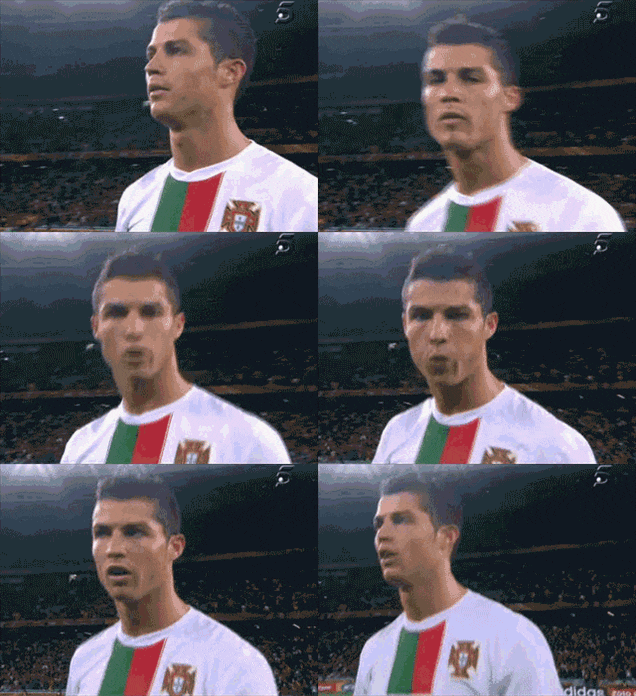
*Dont be a ******* like me crew* mad mod gonna mad
goodnight sweet zyzz
02-08-2018, 05:45 PM
-
#25

 02-08-2018, 06:08 PM
-
#26
- StinnerOzz
- Death Metal Madman
-

- StinnerOzz
- Death Metal Madman
- Join Date: Dec 2017
- Location: Michigan, United States
- Age: 44
- Posts: 2,611
- Rep Power: 16339
-
-
I'm half Portuguese, mixed w/Swedish and who knows what. I consider myself white but know some fuller Portuguese from my old town that certainly do not. They're also idiots, so who knows. I'd say we're closer to that than Mexican, Latin, etc. but perhaps they want to be their own thing. No idea. The skin tone does indeed make some people think you're of a non-white ethnicity.
Lifting. Hockey. Headbanging.
My Journal: https://forum.obnoxiousbrutes.com/showthread.php?t=175144571
Bookmarks
-

- Digg
-

- del.icio.us
-

- StumbleUpon
-

-

Posting Permissions
- You may not post new threads
- You may not post replies
- You may not post attachments
- You may not edit your posts