
Forum
»
The Meese brief
- Results 1 to 23 of 23
-
Page 1 of 1
Thread: The Meese brief
 12-24-2023, 01:50 PM
-
#1

- gachase21
- Join Date: Dec 2010
- Location: Georgia, United States
- Posts: 31,767
- Subscribers: 4
- Rep Power: 389233
-
-

The Meese brief
You might hear about this later.....
Copy of brief filed December 20th (under the radar)
[URL=https://www.supremecourt.gov/DocketPDF/23/23-624/293864/20231220140217967_US%20v.%20Trump%20amicus%20final.pdf]https://www.supremecourt.gov/DocketP...us%20final.pdf[/URL]
Context:
[QUOTE]
Is Jack Smith an Illegitimate Prosecutor? Has Every Act Taken by Him Been Without Lawful Authority?
On December 21, 2023, a very interesting amicus brief was filed with the United States Supreme Court in the matter of United States v. Trump. The brief was filed in response to Special Counsel Jack Smith’s effort to convince the Court to take up the immunity issue raised by former President Trump rather than have it decided first in the D.C. Circuit Court of Appeals. The brief was filed by former U.S. Attorney General Edwin Meese and law professors Steven Calabresi and Gary Lawson from Northwestern and Boston University Law Schools, respectively.
An amicus brief is one filed by persons who are not parties to the case but have some particularized interest or specialty with regard to the subject matter that might aid the Supreme Court in coming to a decision. Roughly translated, they are referred to as “Friend of the Court” briefs.
What the Meese brief argues is that Special Counsel Jack Smith occupies an office that is not recognized by law and was created by Attorney General Merrick Garland in violation of the Appointments Clause of the Constitution. The specific details and case law involving the Appointments Clause are beyond the scope of this one article, but the foundation of Meese’s argument is that Smith was given law enforcement authorities by Attorney General Garland that are equivalent to or greater than the authorities given to actual “Officers” of the United States – specifically U.S. Attorneys. However, unlike U.S. Attorneys who were appointed by the president and confirmed by the Senate, Special Counsel Smith – a private citizen – was put in place by Garland pursuant to a regulation of the Department of Justice.
Regulations are not “laws.” They are internal operating provisions that, for the most part, direct how the government departments conduct their business. The departments are authorized to create regulations by Congress, but some regulations are wholly internal and do not create rights or obligations for members of the public.
Jack Smith was named as “Special Counsel” under a regulation adopted by the Department of Justice after the independent counsel statute passed by Congress was allowed to expire without being extended near the end of the Clinton administration. Jack Smith’s position and authority were created by DOJ to solve an internal operating dilemma – how to conduct criminal investigations of a president or those close to him when the president is the source of the authority to conduct those investigations — a conflict of interest.
DOJ solved this problem at the end of the Clinton administration by adopting regulations that are set forth beginning at 28 CFR Sec. 600.1. That regulation reads:
[QUOTE]§ 600.1 Grounds for appointing a Special Counsel.
The Attorney General, or in cases in which the Attorney General is recused, the Acting Attorney General, will appoint a Special Counsel when he or she determines that criminal investigation of a person or matter is warranted and—
(a) That investigation or prosecution of that person or matter by a United States Attorney's Office or litigating Division of the Department of Justice would present a conflict of interest for the Department or other extraordinary circumstances; and
(b) That under the circumstances, it would be in the public interest to appoint an outside Special Counsel to assume responsibility for the matter.[/QUOTE]The Meese brief does not take issue with this regulation. Rather, the Meese brief addresses the question of the universe of individuals who can be lawfully appointed to the position of “Special Counsel” in order for this regulation to fit under federal statutes and the Constitution’s Appointment Clause.
Meese states that the appointments of Patrick Fitzgerald, John Huber, and John Durham as past “Special Counsels” were all valid because, at the time of their appointment, each was serving as a Senate-confirmed United States Attorney within the Department of Justice. Their appointment as “Special Counsel” did not alter their authority; it just granted them the same authority over a particular investigation pursuant to the regulation that they otherwise would not have under their individual geographic limitations.
Meese and his co-authors first published the objection set forth in the current brief in law journals and other publications following Robert Mueller’s appointment as Special Counsel, given that he was an attorney in private practice at the time he was named Special Counsel to investigate former President Trump, but never to a court.
Now, Meese and his co-authors are making the claim against Jack Smith to a court because of his effort to have the Supreme Court take up the immunity issue. This created an opportunity for them to raise the question by arguing that Smith lacks jurisdiction to seek the Court’s relief because he is not truly an “Officer” of the United States.
[QUOTE]Congress alone has the authority to create federal offices not established by the Constitution. And the Attorney General cannot ex nihilo fashion offices as he sees fit. Nor has Congress given the Attorney General power to appoint a Special Counsel of this nature. Thus, without legal office, Smith cannot wield the authority of the United States, including his present attempt to seek relief in this Court.[/QUOTE]The Meese brief notes that Attorney General Garland based his appointment of Smith on the language of 28 U.S.C. Sec. 515 – among other statutes – and that statute does concern the appointment by the Attorney General of “Special Attorneys.” The pertinent part of that statute reads:
[QUOTE](a) The Attorney General or any other officer of the Department of Justice, or any attorney specially appointed by the Attorney General under law, may, when specifically directed by the Attorney General, conduct any kind of legal proceeding, civil or criminal, including grand jury proceedings … which United States attorneys are authorized by law to conduct…
[/QUOTE]The Meese brief points out that while this authority to appoint “special counsels” may exist in a statute passed by Congress, that authority is nonetheless limited by provisions of the Constitution as to the individuals eligible for such appointment given the nature of the powers being conferred. Because Jack Smith was a private citizen when appointed, never having been nominated by a president or confirmed by a vote of the Senate, he was not within the scope of individuals who could be authorized by Garland to exercise prosecutorial authority equivalent to United States Attorneys. Any action purporting to create such a position – or “office” -- and vest it with the same authority as United States Attorneys is unconstitutional because it was not “created by law."
At the risk of doing great violence to the constitutional analysis set forth in the Meese brief, the following is a paraphrase of the argument advanced:
The Appointments Clause provides for the appointment of officers “which shall be established by Law.” “Officers” are – obviously – appointed to “Offices,” and the “Office of the President” is the only office created by the Constitution. Congress creates all other “offices” of the Executive Branch by statute, hence the “established by law” language.
The power to create these offices and vest them with lawful authority is part of the “Necessary and Proper” clause to carry into execution the powers conferred on the Executive. "Established by law” has been interpreted to mean not by regulation or Executive Order, as only Congress passes laws. Congress has the exclusive constitutional authority to create federal offices. The Constitution does not give the president nor the heads of Executive Branch departments the power to create offices to which individuals may be appointed.
The Department of Justice and the Office of the Attorney General were both created by Acts of Congress and vested with the prosecutorial function of the Executive Branch. The DOJ was created by Congress with several “offices” – Attorney General, Deputy Attorney General, Associate Attorney General, Solicitor General, eleven Assistant Attorneys General, a U.S. Attorney for each federal judicial district, and the heads of the various law enforcement agencies created. These are all considered officers of the Executive Branch, and the individuals picked to lead them are subject to the Appointment Clause.
One problem with the regulations establishing a Special Counsel is that the language therein specifically contemplates naming someone from outside the government to fill the role. It is curious that even though that is the case, all the Special Counsels other than Mueller and Smith have been U.S. Attorneys in the government at the time of their appointment. That suggests that the issues raised by the Meese brief have been considered in the past, and a choice was made to violate the regulation in that regard rather than potentially violate the Constitution with an unlawful appointment.
Among the most compelling arguments made by the Meese brief comes at the end when it notes the incarnation of a Special Counsel vested with a Javert-like mission, as compared to the statutorily-created officers of the Justice Department – the Attorney General, Deputy Attorney General, Associate Attorney General, Solicitor General, eleven Assistant AGs, and 94 U.S. Attorneys – all subject to presidential appointment and Senate confirmation. According to the Biden DOJ, the Attorney General can simply create a Special Counsel Office, appoint a non-government actor to that post, grant him the power to wield the authority of a grand jury, draw resources from various federal law enforcement agencies, and direct their conduct, and seek search and arrest warrants when loosed upon a member of the public.
[b]If the Meese brief’s argument is correct, then all the actions taken by Smith have been without lawful authority under federal law – beginning with the use of the grand jury in Washington D.C. to build the cases he has brought against former President Trump. The outcome would almost certainly mean that the cases would be dismissed.[/b]
What might come next? That’s a question for another day.
[/QUOTE]
[URL=https://redstate.com/shipwreckedcrew/2023/12/23/is-jack-smith-an-illegitimate-prosecutor-has-every-act-taken-by-him-been-without-lawful-authority-n2167897]https://redstate.com/shipwreckedcrew...ority-n2167897[/URL]
Copy of brief filed December 20th (under the radar)
[URL=https://www.supremecourt.gov/DocketPDF/23/23-624/293864/20231220140217967_US%20v.%20Trump%20amicus%20final.pdf]https://www.supremecourt.gov/DocketP...us%20final.pdf[/URL]
Context:
[QUOTE]
Is Jack Smith an Illegitimate Prosecutor? Has Every Act Taken by Him Been Without Lawful Authority?
On December 21, 2023, a very interesting amicus brief was filed with the United States Supreme Court in the matter of United States v. Trump. The brief was filed in response to Special Counsel Jack Smith’s effort to convince the Court to take up the immunity issue raised by former President Trump rather than have it decided first in the D.C. Circuit Court of Appeals. The brief was filed by former U.S. Attorney General Edwin Meese and law professors Steven Calabresi and Gary Lawson from Northwestern and Boston University Law Schools, respectively.
An amicus brief is one filed by persons who are not parties to the case but have some particularized interest or specialty with regard to the subject matter that might aid the Supreme Court in coming to a decision. Roughly translated, they are referred to as “Friend of the Court” briefs.
What the Meese brief argues is that Special Counsel Jack Smith occupies an office that is not recognized by law and was created by Attorney General Merrick Garland in violation of the Appointments Clause of the Constitution. The specific details and case law involving the Appointments Clause are beyond the scope of this one article, but the foundation of Meese’s argument is that Smith was given law enforcement authorities by Attorney General Garland that are equivalent to or greater than the authorities given to actual “Officers” of the United States – specifically U.S. Attorneys. However, unlike U.S. Attorneys who were appointed by the president and confirmed by the Senate, Special Counsel Smith – a private citizen – was put in place by Garland pursuant to a regulation of the Department of Justice.
Regulations are not “laws.” They are internal operating provisions that, for the most part, direct how the government departments conduct their business. The departments are authorized to create regulations by Congress, but some regulations are wholly internal and do not create rights or obligations for members of the public.
Jack Smith was named as “Special Counsel” under a regulation adopted by the Department of Justice after the independent counsel statute passed by Congress was allowed to expire without being extended near the end of the Clinton administration. Jack Smith’s position and authority were created by DOJ to solve an internal operating dilemma – how to conduct criminal investigations of a president or those close to him when the president is the source of the authority to conduct those investigations — a conflict of interest.
DOJ solved this problem at the end of the Clinton administration by adopting regulations that are set forth beginning at 28 CFR Sec. 600.1. That regulation reads:
[QUOTE]§ 600.1 Grounds for appointing a Special Counsel.
The Attorney General, or in cases in which the Attorney General is recused, the Acting Attorney General, will appoint a Special Counsel when he or she determines that criminal investigation of a person or matter is warranted and—
(a) That investigation or prosecution of that person or matter by a United States Attorney's Office or litigating Division of the Department of Justice would present a conflict of interest for the Department or other extraordinary circumstances; and
(b) That under the circumstances, it would be in the public interest to appoint an outside Special Counsel to assume responsibility for the matter.[/QUOTE]The Meese brief does not take issue with this regulation. Rather, the Meese brief addresses the question of the universe of individuals who can be lawfully appointed to the position of “Special Counsel” in order for this regulation to fit under federal statutes and the Constitution’s Appointment Clause.
Meese states that the appointments of Patrick Fitzgerald, John Huber, and John Durham as past “Special Counsels” were all valid because, at the time of their appointment, each was serving as a Senate-confirmed United States Attorney within the Department of Justice. Their appointment as “Special Counsel” did not alter their authority; it just granted them the same authority over a particular investigation pursuant to the regulation that they otherwise would not have under their individual geographic limitations.
Meese and his co-authors first published the objection set forth in the current brief in law journals and other publications following Robert Mueller’s appointment as Special Counsel, given that he was an attorney in private practice at the time he was named Special Counsel to investigate former President Trump, but never to a court.
Now, Meese and his co-authors are making the claim against Jack Smith to a court because of his effort to have the Supreme Court take up the immunity issue. This created an opportunity for them to raise the question by arguing that Smith lacks jurisdiction to seek the Court’s relief because he is not truly an “Officer” of the United States.
[QUOTE]Congress alone has the authority to create federal offices not established by the Constitution. And the Attorney General cannot ex nihilo fashion offices as he sees fit. Nor has Congress given the Attorney General power to appoint a Special Counsel of this nature. Thus, without legal office, Smith cannot wield the authority of the United States, including his present attempt to seek relief in this Court.[/QUOTE]The Meese brief notes that Attorney General Garland based his appointment of Smith on the language of 28 U.S.C. Sec. 515 – among other statutes – and that statute does concern the appointment by the Attorney General of “Special Attorneys.” The pertinent part of that statute reads:
[QUOTE](a) The Attorney General or any other officer of the Department of Justice, or any attorney specially appointed by the Attorney General under law, may, when specifically directed by the Attorney General, conduct any kind of legal proceeding, civil or criminal, including grand jury proceedings … which United States attorneys are authorized by law to conduct…
[/QUOTE]The Meese brief points out that while this authority to appoint “special counsels” may exist in a statute passed by Congress, that authority is nonetheless limited by provisions of the Constitution as to the individuals eligible for such appointment given the nature of the powers being conferred. Because Jack Smith was a private citizen when appointed, never having been nominated by a president or confirmed by a vote of the Senate, he was not within the scope of individuals who could be authorized by Garland to exercise prosecutorial authority equivalent to United States Attorneys. Any action purporting to create such a position – or “office” -- and vest it with the same authority as United States Attorneys is unconstitutional because it was not “created by law."
At the risk of doing great violence to the constitutional analysis set forth in the Meese brief, the following is a paraphrase of the argument advanced:
The Appointments Clause provides for the appointment of officers “which shall be established by Law.” “Officers” are – obviously – appointed to “Offices,” and the “Office of the President” is the only office created by the Constitution. Congress creates all other “offices” of the Executive Branch by statute, hence the “established by law” language.
The power to create these offices and vest them with lawful authority is part of the “Necessary and Proper” clause to carry into execution the powers conferred on the Executive. "Established by law” has been interpreted to mean not by regulation or Executive Order, as only Congress passes laws. Congress has the exclusive constitutional authority to create federal offices. The Constitution does not give the president nor the heads of Executive Branch departments the power to create offices to which individuals may be appointed.
The Department of Justice and the Office of the Attorney General were both created by Acts of Congress and vested with the prosecutorial function of the Executive Branch. The DOJ was created by Congress with several “offices” – Attorney General, Deputy Attorney General, Associate Attorney General, Solicitor General, eleven Assistant Attorneys General, a U.S. Attorney for each federal judicial district, and the heads of the various law enforcement agencies created. These are all considered officers of the Executive Branch, and the individuals picked to lead them are subject to the Appointment Clause.
One problem with the regulations establishing a Special Counsel is that the language therein specifically contemplates naming someone from outside the government to fill the role. It is curious that even though that is the case, all the Special Counsels other than Mueller and Smith have been U.S. Attorneys in the government at the time of their appointment. That suggests that the issues raised by the Meese brief have been considered in the past, and a choice was made to violate the regulation in that regard rather than potentially violate the Constitution with an unlawful appointment.
Among the most compelling arguments made by the Meese brief comes at the end when it notes the incarnation of a Special Counsel vested with a Javert-like mission, as compared to the statutorily-created officers of the Justice Department – the Attorney General, Deputy Attorney General, Associate Attorney General, Solicitor General, eleven Assistant AGs, and 94 U.S. Attorneys – all subject to presidential appointment and Senate confirmation. According to the Biden DOJ, the Attorney General can simply create a Special Counsel Office, appoint a non-government actor to that post, grant him the power to wield the authority of a grand jury, draw resources from various federal law enforcement agencies, and direct their conduct, and seek search and arrest warrants when loosed upon a member of the public.
[b]If the Meese brief’s argument is correct, then all the actions taken by Smith have been without lawful authority under federal law – beginning with the use of the grand jury in Washington D.C. to build the cases he has brought against former President Trump. The outcome would almost certainly mean that the cases would be dismissed.[/b]
What might come next? That’s a question for another day.
[/QUOTE]
[URL=https://redstate.com/shipwreckedcrew/2023/12/23/is-jack-smith-an-illegitimate-prosecutor-has-every-act-taken-by-him-been-without-lawful-authority-n2167897]https://redstate.com/shipwreckedcrew...ority-n2167897[/URL]

 12-24-2023, 02:04 PM
-
#3
- gachase21
- Join Date: Dec 2010
- Location: Georgia, United States
- Posts: 31,767
- Subscribers: 4
- Rep Power: 389233
-
-
So who authored this brief?
STEVEN G. CALABRESI:
Gary Lawson: also Yale law school grad
And former US attorney General Edwin Meese
https://en.m.wikipedia.org/wiki/Edwin_Meese
https://www.heritage.org/staff/the-hon-edwin-meese-iii
This isn't a bunch of flunkies that put together this brief
STEVEN G. CALABRESI:
Steven Gow Calabresi (born 1958) is an American legal scholar and the Clayton J. and Henry R. Barber Professor of Law at Northwestern University. He is the co-chairman of the Federalist Society. He is the nephew of Guido Calabresi,a U.S. Appellate judge and former dean of the Yale Law School.
Calabresi graduated from the Moses Brown School in Providence, Rhode Island, in 1976. He then attended Yale College, graduating cum laude in 1980.[2] He received his J.D. degree from Yale Law School, where he was the Note & Topics Editor of the Yale Law Journal. After law school, he served as law clerk for Judge Ralph K. Winter of the U.S. Court of Appeals for the Second Circuit, Judge Robert Bork of the U.S. Court of Appeals for the District of Columbia Circuit, and Justice Antonin Scalia of the United States Supreme Court.
While at Yale Law School, Calabresi and two Yale College friends, Lee Liberman Otis and David McIntosh, founded the Yale chapter of the Federalist Society, one of the Society's three original chapters. In 2019, he was chairman of the Society's board of directors.[3] Calabresi is an active libertarian-conservative author and commentator.[4][5]
Calabresi joined the faculty of Northwestern Law School in 1990. He has been a visiting professor at Yale Law School (in the fall semesters of 2013, 2014, 2015, and 2016), and a visiting professor of political theory at Brown University, where he has taught since 2010.
https://en.m.wikipedia.org/wiki/Steven_CalabresiCalabresi graduated from the Moses Brown School in Providence, Rhode Island, in 1976. He then attended Yale College, graduating cum laude in 1980.[2] He received his J.D. degree from Yale Law School, where he was the Note & Topics Editor of the Yale Law Journal. After law school, he served as law clerk for Judge Ralph K. Winter of the U.S. Court of Appeals for the Second Circuit, Judge Robert Bork of the U.S. Court of Appeals for the District of Columbia Circuit, and Justice Antonin Scalia of the United States Supreme Court.
While at Yale Law School, Calabresi and two Yale College friends, Lee Liberman Otis and David McIntosh, founded the Yale chapter of the Federalist Society, one of the Society's three original chapters. In 2019, he was chairman of the Society's board of directors.[3] Calabresi is an active libertarian-conservative author and commentator.[4][5]
Calabresi joined the faculty of Northwestern Law School in 1990. He has been a visiting professor at Yale Law School (in the fall semesters of 2013, 2014, 2015, and 2016), and a visiting professor of political theory at Brown University, where he has taught since 2010.
Gary Lawson: also Yale law school grad
Gary Lawson joined the Boston University School of Law faculty in 2000, after eleven years at Northwestern University School of Law. In 2022, he was named a William Fairfield Warren Distinguished Professor. He has authored or co-authored nine editions of a textbook on administrative law, a textbook on constitutional law, five university press books and more than one hundred scholarly articles on topics ranging from aspects of constitutional theory and history to the proof of legal propositions. His works have been cited in nineteen opinions of United States Supreme Court Justices. Professor Lawson twice clerked for Justice Antonin Scalia, first at the Court of Appeals for the District of Columbia Circuit and then at the United States Supreme Court. He is a founding member, and serves on the Board of Directors, of the Federalist Society for Law and Public Policy Studies and is on the Editorial Advisory Board of the Heritage Guide to the Constitution.
https://www.bu.edu/law/profile/gary-s-lawson/And former US attorney General Edwin Meese
https://en.m.wikipedia.org/wiki/Edwin_Meese
https://www.heritage.org/staff/the-hon-edwin-meese-iii
This isn't a bunch of flunkies that put together this brief
12-24-2023, 02:23 PM
-
#4
- gachase21
- Join Date: Dec 2010
- Location: Georgia, United States
- Posts: 31,767
- Subscribers: 4
- Rep Power: 389233
-
-
It gives scotus the ultimate out - they don't have to make an immunity decision- and they can fix misuse of the special counsels provisions.
And scotus would love to get out of this without having to make an immunity decision.
And scotus would love to get out of this without having to make an immunity decision.
12-24-2023, 02:30 PM
-
#5
- gachase21
- Join Date: Dec 2010
- Location: Georgia, United States
- Posts: 31,767
- Subscribers: 4
- Rep Power: 389233
-
-
Was Jack Smith's appointment unconstitutional? He has no more authority than Taylor Swift, amicus brief argues
BY DEBRA CASSENS WEISS
Special counsel Jack Smith’s appointment was unconstitutional, leaving him powerless to obtain a quick U.S. Supreme Court decision on immunity claims by former President Donald Trump, according to an amicus brief signed by former U.S. Attorney General Edwin Meese and two law professors.
“Not clothed in the authority of the federal government, Smith is a modern example of the naked emperor,” the Dec. 20 amicus brief argues. “Improperly appointed, he has no more authority to represent the United States in this court than Bryce Harper, Taylor Swift or Jeff Bezos.”
The law professors who co-wrote the brief with Meese are Steven G. Calabresi of the Northwestern University Pritzker School of Law and Gary S. Lawson of the Boston University School of Law.
Calabresi summarized the arguments in a post for the Volokh Conspiracy.
The brief argues that Attorney General Merrick Garland “exceeded his statutory and constitutional authority” when he appointed Smith in November 2022. Because Smith’s appointment was unconstitutional, “every action that he has taken since his appointment is now null and void,” Calabresi argued at the Volokh Conspiracy.
Smith—who was not nominated to be special counsel by President Joe Biden or confirmed by the U.S. Senate—has nationwide jurisdiction, making him more powerful that any of the 93 Senate-confirmed U.S. attorneys, Calabresi said. Federal law allows the attorney general to appoint attorneys to assist U.S. attorneys but not to replace them, he wrote.
The argument is that the appointments clause requires all federal offices “not otherwise provided for” in the Constitution to be established by law. Yet there is no statute establishing the Office of Special Counsel within the U.S. Department of Justice. Nor is there a statute allowing the attorney general to appoint an inferior officer special counsel with the powers given to Smith. And inferior officers, in any event, must be controlled by a superior officer, but Garland doesn’t have that power over Smith under DOJ regulations.
The appointments clause makes clear that the “default mode” of appointment for all officers is presidential nomination, Senate confirmation and presidential appointment, the brief says.
There is a proper way to appoint a special counsel like Smith, Calabresi said at the Volokh Conspiracy. Garland should “ask one of the very best Senate-confirmed U.S. attorneys now in office to prosecute the cases arising out of the events of Jan. 6, 2021, or the misuse of classified documents case, to be special counsel” with nationwide authority.
The attorney general could then appoint Smith to be the special counsel’s special assistant, and the Trump cases could then be “restarted from scratch” Calabresi wrote.
“We do not want future U.S. attorney generals, such as the ones Donald Trump might appoint, if he is reelected in 2024, to be able to pick any tough thug lawyer off the street and empower him in the way Attorney General Merrick Garland has empowered private citizen Jack Smith,” Calabresi wrote. “Think of what that would have led to during the McCarthy era.”
https://www.abajournal.com/news/arti...s-brief-arguesBY DEBRA CASSENS WEISS
Special counsel Jack Smith’s appointment was unconstitutional, leaving him powerless to obtain a quick U.S. Supreme Court decision on immunity claims by former President Donald Trump, according to an amicus brief signed by former U.S. Attorney General Edwin Meese and two law professors.
“Not clothed in the authority of the federal government, Smith is a modern example of the naked emperor,” the Dec. 20 amicus brief argues. “Improperly appointed, he has no more authority to represent the United States in this court than Bryce Harper, Taylor Swift or Jeff Bezos.”
The law professors who co-wrote the brief with Meese are Steven G. Calabresi of the Northwestern University Pritzker School of Law and Gary S. Lawson of the Boston University School of Law.
Calabresi summarized the arguments in a post for the Volokh Conspiracy.
The brief argues that Attorney General Merrick Garland “exceeded his statutory and constitutional authority” when he appointed Smith in November 2022. Because Smith’s appointment was unconstitutional, “every action that he has taken since his appointment is now null and void,” Calabresi argued at the Volokh Conspiracy.
Smith—who was not nominated to be special counsel by President Joe Biden or confirmed by the U.S. Senate—has nationwide jurisdiction, making him more powerful that any of the 93 Senate-confirmed U.S. attorneys, Calabresi said. Federal law allows the attorney general to appoint attorneys to assist U.S. attorneys but not to replace them, he wrote.
The argument is that the appointments clause requires all federal offices “not otherwise provided for” in the Constitution to be established by law. Yet there is no statute establishing the Office of Special Counsel within the U.S. Department of Justice. Nor is there a statute allowing the attorney general to appoint an inferior officer special counsel with the powers given to Smith. And inferior officers, in any event, must be controlled by a superior officer, but Garland doesn’t have that power over Smith under DOJ regulations.
The appointments clause makes clear that the “default mode” of appointment for all officers is presidential nomination, Senate confirmation and presidential appointment, the brief says.
There is a proper way to appoint a special counsel like Smith, Calabresi said at the Volokh Conspiracy. Garland should “ask one of the very best Senate-confirmed U.S. attorneys now in office to prosecute the cases arising out of the events of Jan. 6, 2021, or the misuse of classified documents case, to be special counsel” with nationwide authority.
The attorney general could then appoint Smith to be the special counsel’s special assistant, and the Trump cases could then be “restarted from scratch” Calabresi wrote.
“We do not want future U.S. attorney generals, such as the ones Donald Trump might appoint, if he is reelected in 2024, to be able to pick any tough thug lawyer off the street and empower him in the way Attorney General Merrick Garland has empowered private citizen Jack Smith,” Calabresi wrote. “Think of what that would have led to during the McCarthy era.”
12-24-2023, 03:16 PM
-
#6

At the end of the day, Smith will still be allowed to bring justice lol.
This isn't going to stop anything.
This isn't going to stop anything.
"I am a rational animal who occupies the intermediary position between angel and beast"
"The upper class is afforded their position by the collective burden the underclass must carry for them"
**Summer Walker Crew**
05-07-2024, 05:57 PM
-
#7
- gachase21
- Join Date: Dec 2010
- Location: Georgia, United States
- Posts: 31,767
- Subscribers: 4
- Rep Power: 389233
-
-
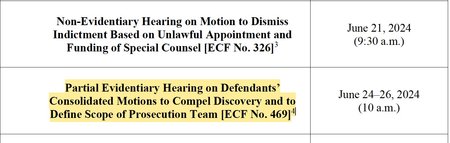
Judge Cannon has scheduled a hearing now on June 21 for this (same argument Trump team filed)
Another note - Justice Thomas directly asked Trumps teams about this during the immunity oral argument- indicating his observation of it- team Trump said they haven't filed the argument YET in that case, but the did in FL.
However being a jurisdiction question the justices could bring it up without the defense even requesting.
Kavanaugh also indirectly touched on this some
Either way- Cannon starts the argument for this in FL on the 21st.
Also 3-day hearing on June 24-26th on whether to widen discovery by redefining "prosecution team" to include people in White House, NARA, intelligence community etc (if the smith appointment argument hasn't thrown it all out yet)
Another note - Justice Thomas directly asked Trumps teams about this during the immunity oral argument- indicating his observation of it- team Trump said they haven't filed the argument YET in that case, but the did in FL.
However being a jurisdiction question the justices could bring it up without the defense even requesting.
Kavanaugh also indirectly touched on this some
Either way- Cannon starts the argument for this in FL on the 21st.
Also 3-day hearing on June 24-26th on whether to widen discovery by redefining "prosecution team" to include people in White House, NARA, intelligence community etc (if the smith appointment argument hasn't thrown it all out yet)
05-07-2024, 06:03 PM
-
#8
- Stizzel
- Rothbardian
-

- Stizzel
- Rothbardian
- Join Date: Apr 2008
- Location: Your Mom
- Posts: 83,747
- Subscribers: 1
- Rep Power: 384419
-
-
Jack smith got busted tampering with evidence, he's going to jail
“It’s the bill of rights, not the bill of requests. Rights are not up for negotiations.” Thomas Massie, MAGA enemy #1
05-07-2024, 08:06 PM
-
#9
- ChewYourFood
- ▪█───────█▪
-

- ChewYourFood
- ▪█───────█▪
- Join Date: Aug 2012
- Posts: 10,731
- Rep Power: 89931
-
-
Originally Posted By Stizzel⏩
Very optimistic. Bet nothing happens.Jack smith got busted tampering with evidence, he's going to jail
05-07-2024, 11:34 PM
-
#10

Originally Posted By gachase21⏩
Scotus doesn't need an out - they're in on the fix and make it blatantly obvious to everyone.It gives scotus the ultimate out - they don't have to make an immunity decision- and they can fix misuse of the special counsels provisions.
And scotus would love to get out of this without having to make an immunity decision.
And scotus would love to get out of this without having to make an immunity decision.
05-08-2024, 04:40 AM
-
#11

- ezmac31
- Join Date: Jun 2009
- Location: Michigan, United States
- Age: 43
- Posts: 20,160
- Subscribers: 1
- Rep Power: 247931
-
-
Originally Posted By NYPat⏩
The fix for what?Scotus doesn't need an out - they're in on the fix and make it blatantly obvious to everyone.
Is this the narrative shift? The whole system has been after blumpf for a decade but now we cope but saying the fix has been in to help him?
05-08-2024, 04:58 AM
-
#12
- gachase21
- Join Date: Dec 2010
- Location: Georgia, United States
- Posts: 31,767
- Subscribers: 4
- Rep Power: 389233
-
-
Originally Posted By NYPat⏩
They don't need one - as it looks like they are planning to just make the correct decision with certain forms of immunity and send it back to DC circuit for fact finding if he was in scope or nott.Scotus doesn't need an out - they're in on the fix and make it blatantly obvious to everyone.
It does seem the recognize Jack Smith qualification is an issue, but don't seem ready to rule in that yet in the immunity decision / if will prob come out of this trial- although the could we shall see.
Either way- it looks like the de-facto Jack smith trial starts may 22nd and will go through July 22nd with at least 12 hearings in that time. Maybe Jack survives, we shall see.
05-08-2024, 05:05 AM
-
#13

Originally Posted By ezmac31⏩
Crazy, isn't it? The COPE these people will come up with.The fix for what?
Is this the narrative shift?The whole system has been after blumpf for a decade but now we cope but saying the fix has been in to help him?
Is this the narrative shift?The whole system has been after blumpf for a decade but now we cope but saying the fix has been in to help him?
05-08-2024, 05:22 AM
-
#14
Originally Posted By ezmac31⏩
The fix for what?
Is this the narrative shift? The whole system has been after blumpf for a decade but now we cope but saying the fix has been in to help him?
Is this the narrative shift? The whole system has been after blumpf for a decade but now we cope but saying the fix has been in to help him?
Originally Posted By Polaris⏩
Scotus should have never taken up the immunity crap - they're stalling for Trump.Crazy, isn't it? The COPE these people will come up with.
And smfh at the whole system is after Trump.. Trump is being held responsible for what Trump has done himself. Period. This Trump is a victim BS is nonsense. They guy has lived his whole life getting with crap that regular people don't. Save it.
05-08-2024, 06:45 AM
-
#15
- Stizzel
- Rothbardian
-
- Stizzel
- Rothbardian
- Join Date: Apr 2008
- Location: Your Mom
- Posts: 83,747
- Subscribers: 1
- Rep Power: 384419
-
-
Originally Posted By ChewYourFood⏩
Probably not until after the trumpenreich seizes powerVery optimistic. Bet nothing happens.
Originally Posted By MinorAttractedPat⏩
This groomer knows whats comingScotus doesn't need an out - they're in on the fix and make it blatantly obvious to everyone.
“It’s the bill of rights, not the bill of requests. Rights are not up for negotiations.” Thomas Massie, MAGA enemy #1
05-08-2024, 06:48 AM
-
#16
 06-04-2024, 07:21 PM
-
#17
- gachase21
- Join Date: Dec 2010
- Location: Georgia, United States
- Posts: 31,767
- Subscribers: 4
- Rep Power: 389233
-
-
Judge cannon has an oral argument on this subject of disqualifying jack smith (de-facto dropping all the cases) June 21st.
She issues an order today allowing outside parties to participate in the oral argument, including members that wrote the Meese brief.
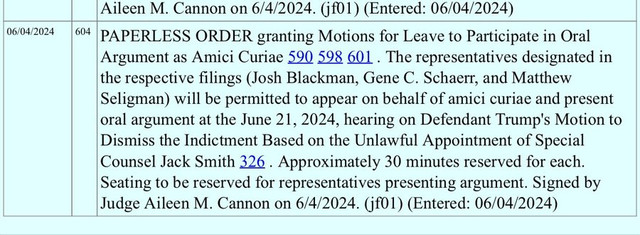
She issues an order today allowing outside parties to participate in the oral argument, including members that wrote the Meese brief.
06-04-2024, 09:38 PM
-
#18
06-05-2024, 06:51 AM
-
#19
06-05-2024, 06:58 AM
-
#20
06-05-2024, 12:30 PM
-
#21
- gachase21
- Join Date: Dec 2010
- Location: Georgia, United States
- Posts: 31,767
- Subscribers: 4
- Rep Power: 389233
-
-
Judge cannon has just issued a ruling extending the Jack Smith disqualification hearing to three days and adding time for Amicus brief attorneys as well.


https://storage.courtlistener.com/re...8652.605.0.pdf
https://storage.courtlistener.com/re...8652.605.0.pdf
06-05-2024, 12:42 PM
-
#22
06-05-2024, 12:47 PM
-
#23
- gachase21
- Join Date: Dec 2010
- Location: Georgia, United States
- Posts: 31,767
- Subscribers: 4
- Rep Power: 389233
-
-
Originally Posted By NYPat⏩
A motion was called with our very legitimate possible legal argument-Lmao at Judge Canon... I'm sure all the "the justice system is rigged" people will be in here to point out the favoritism happening here.
LOLOLOLOL
LOLOLOLOL
She is having a hearing
Where is the favoritism?
It's better than the DC judge - If the DC judge wasn't biased - and trying to move in an unconstitutional rush- and had all the fact-finding hearings she should've had in relation to immunity- she could be in trial by now.
Instead she skipped the processes and it's held up.
Cannon is simply having all the appropriate hearings -as she should -on the front end so it doesn't get log jammed stalled on the backend- this is how it should work.
The DC judge should take some lessons here....
Bookmarks
-

- Digg
-

- del.icio.us
-

- StumbleUpon
-

-

Posting Permissions
- You may not post new threads
- You may not post replies
- You may not post attachments
- You may not edit your posts