
Forum: Education/Career/Finance
Share your success tips and stories. We''re all gonna make it!
| Title / Thread Starter | Last Post By | Replies | Views | |
|---|---|---|---|---|
|
|
Last post by:
Gayford, 02-13-2023, 11:09 AM
2 posts
63,710 views
|
2 | 63,710 | |
|
|
 Feel like a failure Feel like a failure
Graduated at 26 in CS during start of Covid
Took 8 years since I switched majors. Currently work an IT job making 70k a year My job is really ez don’t even use my brain feel like I’m getting dumber My friends who Wer in my classes are making 200k a year with the same degree working at Microsoft and Tesla as software engineers. Some are also only 24 Can I get there as well? I don’t really care about $ as I live very frugally but I feel like I should be making a lot more ESP at my age And idk if the it experience even helps as I’ve accrued 2 years of it basically
Last post by:
MiscGiveMeLOLz, 12-25-2022, 05:43 PM
8 posts
40,598 views
|
|
8 | 40,598 |
|
|
Last post by:
Kewbrah, 12-25-2022, 04:34 AM
11 posts
247 views
|
11 | 247 | |
|
|
Keep getting rejected in interviews
Not sure what I’m doing wrong
I make it to the last round and get ghosted or say they moved on What am I doing wrong and how to fix?
Last post by:
Arem24, 11-23-2022, 08:33 PM
5 posts
220 views
|
5 | 220 | |
|
|
Last post by:
SouthDakotaBrah, 09-27-2022, 08:21 AM
17 posts
72,176 views
|
|
17 | 72,176 |
|
|
Working in help desk with cs degree
Working in help desk with cs degree
Idk if this is embarrassing? I graduated in may 2020 and working In help desk since February 2021. I make 62k a year on my new help desk job that I started in July 2021 and it’s fully remote and easy. I am using nothing from cs that I learnt. I have also gotten very comfortable at this job and the only reason I obviously will leave is for more $. But I can see my self working here for a long time if things don’t change. But It’s bothering me I struggled in cs to get the degree and I haven’t gotten a cs job yet or am not using the skills I learnt. But the plan is to eventually get one in the future sometime but cs jobs will still consider me right? I am worried they may wonder why this guy was working help desk with a cs degree? My friend was making fun of me saying “ do you want to be 30+ and working help desk?” Like is it really that embarrassing
Last post by:
AccountingMajor, 09-02-2022, 09:15 AM
12 posts
292 views
|
|
12 | 292 |
|
|
**OFFICIAL** Trading and Investing Thread: Part XIV -- Reopening Edition
Here’s a link to Part XIII:https://forum.obnoxiousbrutes.com/showt...hp?t=179683203
Here’s a link to Part XII:https://forum.obnoxiousbrutes.com/showt...hp?t=179120591 Here's a link to Part XI:https://forum.obnoxiousbrutes.com/showt...hp?t=178155381 Here's a link to Part X:https://forum.obnoxiousbrutes.com/showt...hp?t=173638601 Here's a link to part IX:http://forum.obnoxiousbrutes.com/showth...hp?t=169075363 Here's a link to part VIII:http://forum.obnoxiousbrutes.com/showthread.php?=164126631 Here's a link to part VII:http://forum.obnoxiousbrutes.com/showth...hp?t=159164961 Here's a link to part VI:http://forum.obnoxiousbrutes.com/showth...hp?t=154050541 Here's a link to part V:http://forum.obnoxiousbrutes.com/showth...hp?t=148493543 Here's a link to part IV:http://forum.obnoxiousbrutes.com/showth...hp?t=140949141 Here's a link to part III:http://forum.obnoxiousbrutes.com/showth...hp?t=124909341 Here's a link to part II:http://forum.obnoxiousbrutes.com/showth...hp?t=112593781 Here's a link to part I:http://forum.obnoxiousbrutes.com/showthread.php?t=3367271 Everything opening back up this summer. One last pump, then who knows. 
Last post by:
Jayl12345, 08-22-2022, 07:20 AM
11,185 posts
1,201,611 views
|
11,185 | 1,201,611 | |
|
|
Last post by:
ajctennis, 04-14-2022, 12:41 AM
3,853 posts
417,030 views
|
3,853 | 417,030 | |
|
|
MISC Crypto Crew (MCC) Vol: XIV: Scaling troubles and NFT bubbles
OG thread:https://forum.obnoxiousbrutes.com/showt...hp?t=173249701
Vol. 1:https://forum.obnoxiousbrutes.com/showt...hp?t=174270261 Vol. 2:https://forum.obnoxiousbrutes.com/showt...hp?t=174590131 Vol. 3:https://forum.obnoxiousbrutes.com/showt...hp?t=174863441 Vol. 4:https://forum.obnoxiousbrutes.com/showt...hp?t=175032101 Vol. 5:https://forum.obnoxiousbrutes.com/showt...hp?t=175123511 Vol. 6:https://forum.obnoxiousbrutes.com/showt...hp?t=175167371 Vol. 7:https://forum.obnoxiousbrutes.com/showt...hp?t=175210891 Vol. 8:https://forum.obnoxiousbrutes.com/showt...hp?t=175247631 Vol. 9:https://forum.obnoxiousbrutes.com/showt...hp?t=175280731 Vol. 10:https://forum.obnoxiousbrutes.com/showt...hp?t=175346071 Vol. 11:https://forum.obnoxiousbrutes.com/showt...hp?t=175662991 Vol. 12:https://forum.obnoxiousbrutes.com/showt...hp?t=176392981 Vol. 13:https://forum.obnoxiousbrutes.com/showt...hp?t=178838731  Bitcoin -Bitcoin Summary Ethereum - Ethereum for Everyone Beginner's Guide to ETH Where do I go if I want to get in on this??? The only ways to buy bitcoin/ethereum with your dollars are through these things called exchanges. Examples of exchanges: (Dollars -> BTC/ETH) Coinbase- most newb friendly/high fees. You can buy Bitcoins and Ethereum here with your dollars. ~~~RECOMMENDED EXCHANGES (for US brahs)~~~ GDAX- owned by Coinbase. Lower fees. Cons - requires a SSN which not everyone is comfortable with Gemini- low fees, nice interface. Cons - Takes time to get verified so you can make deposits ------------------------------------------------------------------------------ Canadian brahs use QuadrigaCX from these above exchanges, you can take your dollars and convert them to Ethereum or Bitcoins. Now..you could just hold these coins and be happy, or you could explore into the world of alt coins. Australian brahs use these to put FIAT into crypto www.coinspot.com.au(you pay a premium but you also sell at a premium on this exchange so it’s ok) www.btcmarkets.net Binance KuCoin Bittrex Common Terminology Used Glossary of terms Useful links Coin Market Cap- Basically an index of all coins with how much volume is being traded, price, %change, market cap, and also has a tab where you can see exactly which exchanges any particular coin is being traded on. HIGHLY RECOMMENDED Bitcointalk - large gathering of coin talk CryptoWatch - Price tracker for coins Ethtrader subreddit - Home of all the ETH bag holders. Good discussions there /r/CryptoCurrency - Random discussions about random cryptos here http://www.coindesk.com- Overview of what's going on in the crypto world http://cryptopanic.com- An aggregator of various crypto sites and news, filterable. I use the pro version to customize the feeds but the free version is good enough for most. http://cryptomaps.org- Visualization of price across different segments, primarily hashing functions and ICO release dates http://onchainfx.com- A better version of coin market cap, has all sort of columns and you can add flags. Only downside is it only has 61 cryptos, but its always adding news ones. http://icotracker.net- I like this site for looking at what ICO are coming up http://icobench.com- Another ICO tracker which does nice summaries, shows teams, milestones, financials and gives a rating for each ICO http://solume.io- compares the number of Twitter mention increase decrease to price http://eveningstar.io- this is basically like Morning Star except for cryptos https://bitcoin.tax- for calculating taxes owed on your crypto gains Great, I've got my coins now. HOW DO I KEEP MYSELF SECURE??? General security tips Also consider getting a Nano Ledger/off-exchange wallet [General investing tips] 1) Don't have more than 5-10% of your entire investment portfolio in crypto, and only invest what you can afford to have locked in for the long term. 2) Don't chase a pump Never buy on rapid upswing on the candlestick chart if you're not sure why it happened and can't figure it out. The reason is likely that it is a Pnd. PnD is "Pump and dump" and it refers to a trading scam where people organize to coordinate the laddered purchase of an asset, then wait for others to come in at some delay and further increase the price before coordinating the unloading of their position once a specific price target is reached. This is illegal in the stock markets, but since cryptomarkets are unregulated such schemes are rampant. There are many PnD groups and today they are largely organized on Discord channels. They are now structured into tiers where the top tiers get a signal earlier than the bottom tiers and usually by the time the bottom tiers get the signal its too late, so unless you pay money to part of the top tier or have a connection with the admins its not even profitable. They are bad for the market as a whole and they prey on those who are looking for short term moons to latch onto. Don't look for things that you think will moon today, look for investments. 3) Holding will give you more returns over a year than day trading. You will find that most people who made six figures or more in crypto did it by holding over the long term, very few get rich by day trading. That said you should definitely learn a few indicators to see if you're getting in at a reasonable entry point. I find that the MACD (moving average convergence divergence), RSI (relative strength index), market depth and support-resistance lines are the most useful indicators for crypto. MACD is useful for looking at where the long term price should be in divergence to the short term movement, RSI gives you an 0-1 rating of how overbought/oversold it is and support-resistance lines gives you a floor and ceiling for how high it will move in your buying period. If you do short term trading, do it when you have high certainty that a specific news will lead to an increase. Some of these specific events are: upcoming roadmap item releases, fork airdrops, exchange additions and partnerships. Short term buys like this are smart moves based on some underlying value assumption being changed, trading purely on volume and patterns is generally akin to gambling on markets that are as inefficient as most cryptoassets. 4) Take your time and research what you are putting your money into. I cannot stress this enough, you are buying an asset with your hard earned money, and it should have some utility. Start by reading the whitepaper that is on the main site for the coin. You can avoid a lot of scams by simply critically evaluating the question: "Why does this coin exist?" Is it simply trying to apply a blockchain to something that doesn't need it or is there a transactional inefficiency/problem that the unique properties of the blockchain can solve? Ask yourself what value the actual token would have in the ecosystem its part of. Does it pay out some kind of dividend like some coins, or is its value in that its used as part of transaction fees and is thus being burned? You can make a simple checklist for every crypto and just answer these questions to yourself for each coin you look at: What is the problem or transactional inefficiency the coin is trying to solve? What is the Dev Team like? What is their track record? How are they funded, organized? Who is their competition and how big is the market they're targeting? What is the roadmap they created? How will they attract their target market, how is their marketing? How does the coin derive its value? Is there some sort of dividend structure, profit sharing plan, or is it a store of value within a digital economy? What is the float schedule like going forward (ie. how many coins will be released or burned)? 5) Learn to recognize FOMO when it arises within you If you ever feel this itch to get in on an rapid upswing because you don't want to miss out on some new development that is causing it, stop yourself from knee jerk reacting to this feeling. This is called FOMO: "Fear of missing out" and its what drives the market now. It happens to everyone and it leads to emotional investing and knee jerk buying/selling. 6)Accept that you will miss out on a lot of moon missions, and that's perfectly okay Right now the crypto market is like a giant dumb money party filled with coked up headless chickens running around throwing money at every ****coin with a low nominal price hoping it goes to $10,000 like Bitcoin. Everyone is a genius in a bull market, and this creates a feedback loop of more money come in. You will miss out on these gains, but don't let that get to you. By taking your time to make your decisions you end up focusing on the fundamentals rather than short term movements. 7)Think of not only individual position, but how they fit in your portfolio and your diversification Your risk tolerance should dictate how much you allocate between your Core holdings (which are generally considered more "safe" since Bitcoin and Ethereum will be around for a long time) and the various segments. I personally am okay with a 30% core holdings, 70% across various other segments. However 60/40 splits between core and other segments is probably a good starting point for most newbies. You can make visualizations in excel with pie charts and keep tabs on your segment allocation.
Last post by:
SouthDakotaBrah, 11-29-2021, 09:55 AM
9,271 posts
426,911 views
|
|
9,271 | 426,911 |
|
|
MISC Crypto Crew (MCC) Vol: XV: Getting Zucked into the Metaverse
OG thread:https://forum.obnoxiousbrutes.com/showt...hp?t=173249701
Vol. 1:https://forum.obnoxiousbrutes.com/showt...hp?t=174270261 Vol. 2:https://forum.obnoxiousbrutes.com/showt...hp?t=174590131 Vol. 3:https://forum.obnoxiousbrutes.com/showt...hp?t=174863441 Vol. 4:https://forum.obnoxiousbrutes.com/showt...hp?t=175032101 Vol. 5:https://forum.obnoxiousbrutes.com/showt...hp?t=175123511 Vol. 6:https://forum.obnoxiousbrutes.com/showt...hp?t=175167371 Vol. 7:https://forum.obnoxiousbrutes.com/showt...hp?t=175210891 Vol. 8:https://forum.obnoxiousbrutes.com/showt...hp?t=175247631 Vol. 9:https://forum.obnoxiousbrutes.com/showt...hp?t=175280731 Vol. 10:https://forum.obnoxiousbrutes.com/showt...hp?t=175346071 Vol. 11:https://forum.obnoxiousbrutes.com/showt...hp?t=175662991 Vol. 12:https://forum.obnoxiousbrutes.com/showt...hp?t=176392981 Vol. 13:https://forum.obnoxiousbrutes.com/showt...hp?t=178838731 Vol. 14https://forum.obnoxiousbrutes.com/showt...hp?t=179959653  Bitcoin -Bitcoin Summary Ethereum - Ethereum for Everyone Beginner's Guide to ETH Where do I go if I want to get in on this??? The only ways to buy bitcoin/ethereum with your dollars are through these things called exchanges. Examples of exchanges: (Dollars -> BTC/ETH) Coinbase- most newb friendly/high fees. You can buy Bitcoins and Ethereum here with your dollars. ~~~RECOMMENDED EXCHANGES (for US brahs)~~~ GDAX- owned by Coinbase. Lower fees. Cons - requires a SSN which not everyone is comfortable with Gemini- low fees, nice interface. Cons - Takes time to get verified so you can make deposits ------------------------------------------------------------------------------ Canadian brahs use QuadrigaCX from these above exchanges, you can take your dollars and convert them to Ethereum or Bitcoins. Now..you could just hold these coins and be happy, or you could explore into the world of alt coins. Australian brahs use these to put FIAT into crypto www.coinspot.com.au(you pay a premium but you also sell at a premium on this exchange so it’s ok) www.btcmarkets.net Binance KuCoin Bittrex For everyone:www.Crypto.com Common Terminology Used Glossary of terms Useful links Coin Market Cap- Basically an index of all coins with how much volume is being traded, price, %change, market cap, and also has a tab where you can see exactly which exchanges any particular coin is being traded on. HIGHLY RECOMMENDED Bitcointalk - large gathering of coin talk CryptoWatch - Price tracker for coins Ethtrader subreddit - Home of all the ETH bag holders. Good discussions there /r/CryptoCurrency - Random discussions about random cryptos here http://www.coindesk.com- Overview of what's going on in the crypto world http://cryptopanic.com- An aggregator of various crypto sites and news, filterable. I use the pro version to customize the feeds but the free version is good enough for most. http://cryptomaps.org- Visualization of price across different segments, primarily hashing functions and ICO release dates http://onchainfx.com- A better version of coin market cap, has all sort of columns and you can add flags. Only downside is it only has 61 cryptos, but its always adding news ones. http://icotracker.net- I like this site for looking at what ICO are coming up http://icobench.com- Another ICO tracker which does nice summaries, shows teams, milestones, financials and gives a rating for each ICO http://solume.io- compares the number of Twitter mention increase decrease to price http://eveningstar.io- this is basically like Morning Star except for cryptos https://bitcoin.tax- for calculating taxes owed on your crypto gains Great, I've got my coins now. HOW DO I KEEP MYSELF SECURE??? General security tips Also consider getting a Nano Ledger/off-exchange wallet [General investing tips] 1) Don't have more than 5-10% of your entire investment portfolio in crypto, and only invest what you can afford to have locked in for the long term. 2) Don't chase a pump Never buy on rapid upswing on the candlestick chart if you're not sure why it happened and can't figure it out. The reason is likely that it is a Pnd. PnD is "Pump and dump" and it refers to a trading scam where people organize to coordinate the laddered purchase of an asset, then wait for others to come in at some delay and further increase the price before coordinating the unloading of their position once a specific price target is reached. This is illegal in the stock markets, but since cryptomarkets are unregulated such schemes are rampant. There are many PnD groups and today they are largely organized on Discord channels. They are now structured into tiers where the top tiers get a signal earlier than the bottom tiers and usually by the time the bottom tiers get the signal its too late, so unless you pay money to part of the top tier or have a connection with the admins its not even profitable. They are bad for the market as a whole and they prey on those who are looking for short term moons to latch onto. Don't look for things that you think will moon today, look for investments. 3) Holding will give you more returns over a year than day trading. You will find that most people who made six figures or more in crypto did it by holding over the long term, very few get rich by day trading. That said you should definitely learn a few indicators to see if you're getting in at a reasonable entry point. I find that the MACD (moving average convergence divergence), RSI (relative strength index), market depth and support-resistance lines are the most useful indicators for crypto. MACD is useful for looking at where the long term price should be in divergence to the short term movement, RSI gives you an 0-1 rating of how overbought/oversold it is and support-resistance lines gives you a floor and ceiling for how high it will move in your buying period. If you do short term trading, do it when you have high certainty that a specific news will lead to an increase. Some of these specific events are: upcoming roadmap item releases, fork airdrops, exchange additions and partnerships. Short term buys like this are smart moves based on some underlying value assumption being changed, trading purely on volume and patterns is generally akin to gambling on markets that are as inefficient as most cryptoassets. 4) Take your time and research what you are putting your money into. I cannot stress this enough, you are buying an asset with your hard earned money, and it should have some utility. Start by reading the whitepaper that is on the main site for the coin. You can avoid a lot of scams by simply critically evaluating the question: "Why does this coin exist?" Is it simply trying to apply a blockchain to something that doesn't need it or is there a transactional inefficiency/problem that the unique properties of the blockchain can solve? Ask yourself what value the actual token would have in the ecosystem its part of. Does it pay out some kind of dividend like some coins, or is its value in that its used as part of transaction fees and is thus being burned? You can make a simple checklist for every crypto and just answer these questions to yourself for each coin you look at: What is the problem or transactional inefficiency the coin is trying to solve? What is the Dev Team like? What is their track record? How are they funded, organized? Who is their competition and how big is the market they're targeting? What is the roadmap they created? How will they attract their target market, how is their marketing? How does the coin derive its value? Is there some sort of dividend structure, profit sharing plan, or is it a store of value within a digital economy? What is the float schedule like going forward (ie. how many coins will be released or burned)? 5) Learn to recognize FOMO when it arises within you If you ever feel this itch to get in on an rapid upswing because you don't want to miss out on some new development that is causing it, stop yourself from knee jerk reacting to this feeling. This is called FOMO: "Fear of missing out" and its what drives the market now. It happens to everyone and it leads to emotional investing and knee jerk buying/selling. 6)Accept that you will miss out on a lot of moon missions, and that's perfectly okay Right now the crypto market is like a giant dumb money party filled with coked up headless chickens running around throwing money at every ****coin with a low nominal price hoping it goes to $10,000 like Bitcoin. Everyone is a genius in a bull market, and this creates a feedback loop of more money come in. You will miss out on these gains, but don't let that get to you. By taking your time to make your decisions you end up focusing on the fundamentals rather than short term movements. 7)Think of not only individual position, but how they fit in your portfolio and your diversification Your risk tolerance should dictate how much you allocate between your Core holdings (which are generally considered more "safe" since Bitcoin and Ethereum will be around for a long time) and the various segments. I personally am okay with a 30% core holdings, 70% across various other segments. However 60/40 splits between core and other segments is probably a good starting point for most newbies. You can make visualizations in excel with pie charts and keep tabs on your segment allocation.
Last post by:
entropy91, 11-21-2021, 11:38 PM
30 posts
30,650 views
|
30 | 30,650 | |
|
|
MISC Crypto Crew (MCC) Vol: XIII: Money printer goes brrrrrr, But Bitcoin doesnt
OG thread:https://forum.obnoxiousbrutes.com/showt...hp?t=173249701
Vol. 1:https://forum.obnoxiousbrutes.com/showt...hp?t=174270261 Vol. 2:https://forum.obnoxiousbrutes.com/showt...hp?t=174590131 Vol. 3:https://forum.obnoxiousbrutes.com/showt...hp?t=174863441 Vol. 4:https://forum.obnoxiousbrutes.com/showt...hp?t=175032101 Vol. 5:https://forum.obnoxiousbrutes.com/showt...hp?t=175123511 Vol. 6:https://forum.obnoxiousbrutes.com/showt...hp?t=175167371 Vol. 7:https://forum.obnoxiousbrutes.com/showt...hp?t=175210891 Vol. 8:https://forum.obnoxiousbrutes.com/showt...hp?t=175247631 Vol. 9:https://forum.obnoxiousbrutes.com/showt...hp?t=175280731 Vol. 10:https://forum.obnoxiousbrutes.com/showt...hp?t=175346071 Vol. 11:https://forum.obnoxiousbrutes.com/showt...hp?t=175662991 Vol. 12:https://forum.obnoxiousbrutes.com/showt...hp?t=176392981 Bitcoin -Bitcoin Summary Ethereum - Ethereum for Everyone Beginner's Guide to ETH Where do I go if I want to get in on this??? The only ways to buy bitcoin/ethereum with your dollars are through these things called exchanges. Examples of exchanges: (Dollars -> BTC/ETH) Coinbase- most newb friendly/high fees. You can buy Bitcoins and Ethereum here with your dollars. ~~~RECOMMENDED EXCHANGES (for US brahs)~~~ GDAX- owned by Coinbase. Lower fees. Cons - requires a SSN which not everyone is comfortable with Gemini- low fees, nice interface. Cons - Takes time to get verified so you can make deposits ------------------------------------------------------------------------------ Canadian brahs use QuadrigaCX from these above exchanges, you can take your dollars and convert them to Ethereum or Bitcoins. Now..you could just hold these coins and be happy, or you could explore into the world of alt coins. Australian brahs use these to put FIAT into crypto www.coinspot.com.au(you pay a premium but you also sell at a premium on this exchange so it’s ok) www.btcmarkets.net Binance KuCoin Bittrex Common Terminology Used Glossary of terms Useful links Coin Market Cap- Basically an index of all coins with how much volume is being traded, price, %change, market cap, and also has a tab where you can see exactly which exchanges any particular coin is being traded on. HIGHLY RECOMMENDED Bitcointalk - large gathering of coin talk CryptoWatch - Price tracker for coins Ethtrader subreddit - Home of all the ETH bag holders. Good discussions there /r/CryptoCurrency - Random discussions about random cryptos here http://www.coindesk.com- Overview of what's going on in the crypto world http://cryptopanic.com- An aggregator of various crypto sites and news, filterable. I use the pro version to customize the feeds but the free version is good enough for most. http://cryptomaps.org- Visualization of price across different segments, primarily hashing functions and ICO release dates http://onchainfx.com- A better version of coin market cap, has all sort of columns and you can add flags. Only downside is it only has 61 cryptos, but its always adding news ones. http://icotracker.net- I like this site for looking at what ICO are coming up http://icobench.com- Another ICO tracker which does nice summaries, shows teams, milestones, financials and gives a rating for each ICO http://solume.io- compares the number of Twitter mention increase decrease to price http://eveningstar.io- this is basically like Morning Star except for cryptos https://bitcoin.tax- for calculating taxes owed on your crypto gains Great, I've got my coins now. HOW DO I KEEP MYSELF SECURE??? General security tips Also consider getting a Nano Ledger/off-exchange wallet [General investing tips] 1) Don't have more than 5-10% of your entire investment portfolio in crypto, and only invest what you can afford to have locked in for the long term. 2) Don't chase a pump Never buy on rapid upswing on the candlestick chart if you're not sure why it happened and can't figure it out. The reason is likely that it is a Pnd. PnD is "Pump and dump" and it refers to a trading scam where people organize to coordinate the laddered purchase of an asset, then wait for others to come in at some delay and further increase the price before coordinating the unloading of their position once a specific price target is reached. This is illegal in the stock markets, but since cryptomarkets are unregulated such schemes are rampant. There are many PnD groups and today they are largely organized on Discord channels. They are now structured into tiers where the top tiers get a signal earlier than the bottom tiers and usually by the time the bottom tiers get the signal its too late, so unless you pay money to part of the top tier or have a connection with the admins its not even profitable. They are bad for the market as a whole and they prey on those who are looking for short term moons to latch onto. Don't look for things that you think will moon today, look for investments. 3) Holding will give you more returns over a year than day trading. You will find that most people who made six figures or more in crypto did it by holding over the long term, very few get rich by day trading. That said you should definitely learn a few indicators to see if you're getting in at a reasonable entry point. I find that the MACD (moving average convergence divergence), RSI (relative strength index), market depth and support-resistance lines are the most useful indicators for crypto. MACD is useful for looking at where the long term price should be in divergence to the short term movement, RSI gives you an 0-1 rating of how overbought/oversold it is and support-resistance lines gives you a floor and ceiling for how high it will move in your buying period. If you do short term trading, do it when you have high certainty that a specific news will lead to an increase. Some of these specific events are: upcoming roadmap item releases, fork airdrops, exchange additions and partnerships. Short term buys like this are smart moves based on some underlying value assumption being changed, trading purely on volume and patterns is generally akin to gambling on markets that are as inefficient as most cryptoassets. 4) Take your time and research what you are putting your money into. I cannot stress this enough, you are buying an asset with your hard earned money, and it should have some utility. Start by reading the whitepaper that is on the main site for the coin. You can avoid a lot of scams by simply critically evaluating the question: "Why does this coin exist?" Is it simply trying to apply a blockchain to something that doesn't need it or is there a transactional inefficiency/problem that the unique properties of the blockchain can solve? Ask yourself what value the actual token would have in the ecosystem its part of. Does it pay out some kind of dividend like some coins, or is its value in that its used as part of transaction fees and is thus being burned? You can make a simple checklist for every crypto and just answer these questions to yourself for each coin you look at: What is the problem or transactional inefficiency the coin is trying to solve? What is the Dev Team like? What is their track record? How are they funded, organized? Who is their competition and how big is the market they're targeting? What is the roadmap they created? How will they attract their target market, how is their marketing? How does the coin derive its value? Is there some sort of dividend structure, profit sharing plan, or is it a store of value within a digital economy? What is the float schedule like going forward (ie. how many coins will be released or burned)? 5) Learn to recognize FOMO when it arises within you If you ever feel this itch to get in on an rapid upswing because you don't want to miss out on some new development that is causing it, stop yourself from knee jerk reacting to this feeling. This is called FOMO: "Fear of missing out" and its what drives the market now. It happens to everyone and it leads to emotional investing and knee jerk buying/selling. 6)Accept that you will miss out on a lot of moon missions, and that's perfectly okay Right now the crypto market is like a giant dumb money party filled with coked up headless chickens running around throwing money at every ****coin with a low nominal price hoping it goes to $10,000 like Bitcoin. Everyone is a genius in a bull market, and this creates a feedback loop of more money come in. You will miss out on these gains, but don't let that get to you. By taking your time to make your decisions you end up focusing on the fundamentals rather than short term movements. 7)Think of not only individual position, but how they fit in your portfolio and your diversification Your risk tolerance should dictate how much you allocate between your Core holdings (which are generally considered more "safe" since Bitcoin and Ethereum will be around for a long time) and the various segments. I personally am okay with a 30% core holdings, 70% across various other segments. However 60/40 splits between core and other segments is probably a good starting point for most newbies. You can make visualizations in excel with pie charts and keep tabs on your segment allocation.
Last post by:
Serenadium, 09-08-2021, 06:59 PM
9,201 posts
655,345 views
|
|
9,201 | 655,345 |
|
|
 U mirin project brah? U mirin project brah?
Sup brahs! It's been a while since I last posted on the misc but I figured it would be appropriate to share a project I'm working on for those looking to be early investors, spread fud, or do whatever you choose with the information I'm about to share. It goes without saying that any and all feedback/criticism is greatly welcomed, if not expected. This is the misc after all..
I'll begin with a summary, for you cuns who can't be bothered to read more than a couple paragraphs. The project name is "Baddies", and the ticker is $BAD. The main focus is to offer a marketplace in which bad girls can mint and sell photo/video content via NFT's. The transactions can be done using the native $BAD token. Purchasing content with other tokens will also be possible, but with an additional 2.5% fee. Periodically, said fees will be used for a buy-back, for the tokens to be burned. 3rd party accepted tokens are limited to BNB, BTC, ETH, and UST. The marketplace will offer a totally customized experience for the artists and models, allowing them to track and manage their growth from a centralized dashboard. I will now list some $BADass features for those still reading: Re-sale: If a creator chooses to mint a public resell-able NFT, a smart contract will automatically redistribute a cut of every NFT re-sale to the original creator. Referral system: The system rewards content creators that increase our user base with an additional avenue for revenue. 1% of transaction funds from referred content gets paid to the referee. The source of the revenue comes does not cost whom is referred, it will come out of the 10% transactional fee. There is no cap referral cap, so there is technically infinitely money to be maid. As an example, if a content creator refers 100 accounts, they stand to benefit financially from the transactions of those 100 referred users. EG: 100 referred models earn $1000 on average for the month, the referee will receive $1000 x 100 x .01 = $1000. Baddies is a deflationary Binance Smart Chain token. The content creator keeps 90% of the transaction, which is higher than all current competitors, if you choose to consider Cumrocket or whatever as actual competition. Baddies will not take a share of any fees. 70% of total fees will be designated to token burning. 20% of fees are rewarded to holders, and 10% are rewarded to referrers. If there was no referral, that 10% is added to the burn. Baddies will take 0% of these fees. Raffle system: The raffle system provides an opportunity for subscribers to participate in a raffle through purchase of entry. The prizes will be stated ahead of time, and will include content such as NFTs, engagement opportunities, and other unique content. The cap on tickets purchasable for each subscriber can be specified by the content creator. Live cam sessions: A Baddie can schedule a live session with fans in advance, or start a spontaneous session whenever they so choose. They can choose to allow non-subscribers to participate in such sessions. All public sessions will be advertised as joinable live sessions on the platform. A tipping system will be integrated and creators/models can be tipped during streams, as well as directly on their profiles and posts. Tipping can be for any increment, no caps! Featured Models: Models can auction for a space on the front page's featured model section. They can be featured once per week through the slot auction system. Half of the slots will be featured for free based on their trending status. 10 will be featured per day. Subscription system: Users can subscribe to content creator's pages to see their content. Content creators can charge a monthly price for access to their pages, or allow free access to such, full sovereignty. Creators can deploy their own strategy as to how to profit from their content, but we will offer guidance for those unfamiliar with the monetization of personal content via virtual means. It goes without saying that we will offer support for creators and consumers who are new to transacting via crypto. A creator may want to allow free subscriptions to share some basic content in order to gain an audience/subscribers, while providing privately purchasable content on the marketplace. Alternatively, a creator may choose that a monthly subscription be required to gain access to most of their content while also providing more exclusive content to be purchased by those who fall in love with them. Merchandise store front: Content creators can sell their own physical merchandise through their page. Apparel, lingerie, makeup, jewelry, and any LEGAL merchandise they choose to make available for purchase. Physical merchandise has a 5% transaction fee. The transaction fee goes towards token burns once the transaction is verified. If the tokens used for purchases are not the native token ($BAD), the 5% fee will be placed into a pool for our monthly burn buyback process. I will post links to the website and medium if allowed but, for now, feel free to ask questions in case I've missed anything
Last post by:
knightofday, 06-13-2021, 05:23 PM
4 posts
61,440 views
|
|
4 | 61,440 |
|
|
**Un-OFFICIAL** Trading and Investing Thread: Part XIII -- Robber Baron Edition
Let's swap some stock.

Last post by:
Travis99, 05-02-2021, 07:51 PM
8,672 posts
361,015 views
|
8,672 | 361,015 | |
|
|
|
283 | 283,958 | |
|
|
Last post by:
_zman, 03-13-2021, 11:33 AM
9 posts
108,866 views
|
9 | 108,866 | |
|
|
Last post by:
underjeep, 03-10-2021, 06:37 PM
10 posts
46,498 views
|
10 | 46,498 | |
|
|
Last post by:
jn677, 03-03-2021, 09:51 AM
21 posts
17,385 views
|
21 | 17,385 | |
|
|
Last post by:
Romancoholic, 02-15-2021, 12:52 AM
7 posts
131,248 views
|
|
7 | 131,248 |
|
|
Last post by:
cavillac, 02-13-2021, 06:40 PM
14 posts
131,132 views
|
14 | 131,132 | |
|
|
**OFFICIAL** Trading and Investing Thread- Part -XII- Money Printer Go BRRRRRRRR
Here's a link to Part XI:https://forum.obnoxiousbrutes.com/showt...hp?t=178155381
Here's a link to Part X:https://forum.obnoxiousbrutes.com/showt...hp?t=173638601 Here's a link to part IX:http://forum.obnoxiousbrutes.com/showth...hp?t=169075363 Here's a link to part VIII:http://forum.obnoxiousbrutes.com/showthread.php?=164126631 Here's a link to part VII:http://forum.obnoxiousbrutes.com/showth...hp?t=159164961 Here's a link to part VI:http://forum.obnoxiousbrutes.com/showth...hp?t=154050541 Here's a link to part V:http://forum.obnoxiousbrutes.com/showth...hp?t=148493543 Here's a link to part IV:http://forum.obnoxiousbrutes.com/showth...hp?t=140949141 Here's a link to part III:http://forum.obnoxiousbrutes.com/showth...hp?t=124909341 Here's a link to part II:http://forum.obnoxiousbrutes.com/showth...hp?t=112593781 Here's a link to part I:http://forum.obnoxiousbrutes.com/showthread.php?t=3367271 Welcome to the12th edition of the Trading and Investing Thread! This will perhaps be one of the wildest markets and financial times in the past century. We will see what the effects of central bank intervention and negative interest rates have done to the world and how this will affect their role moving forward. US Shares markets have collapsed 30% in a month due to Coronavirus pandemic fears and governments putting aside business and economic functionality in order to try and contain the virus, or so they say. We will be monitoring the EU and see if BREXIT was just the beginning and if there is still confidence that the Union will last, or will it dismantle and become yet another failed experiment and attempt to nationalize Europe? The 2020 elections in the US will see rising political discontent as there is no more civility left. Will either side accept the results of the election or will there be riots and unrest following them? Is there a crisis in liquidity in the bonds market? With the ECB being the sole purchaser of bonds in the EU, what will happen when they stop buying them? Have they technically destroyed the bond market? The stock market is a game of capital flows and confidence. Know where the safe havens and troubles lie, and you will know what rises and falls. Good luck, and may your emotions always be kept at bay. Make sound, emotionless decisions, and ask questions! 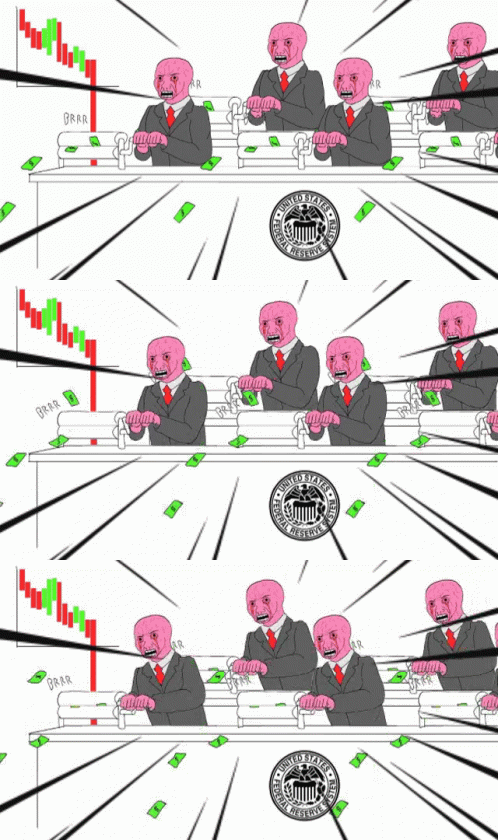 
Last post by:
VoxExMachina, 01-30-2021, 11:12 PM
11,945 posts
745,101 views
|
|
11,945 | 745,101 |
|
|
Last post by:
Heaney, 01-10-2021, 02:32 PM
5 posts
168,760 views
|
5 | 168,760 | |
|
|
**OFFICIAL** Trading and Investing Thread- Part -X-
Here's a link to part IX:http://forum.obnoxiousbrutes.com/showth...hp?t=169075363
Here's a link to part VIII:http://forum.obnoxiousbrutes.com/showthread.php?=164126631 Here's a link to part VII:http://forum.obnoxiousbrutes.com/showth...hp?t=159164961 Here's a link to part VI:http://forum.obnoxiousbrutes.com/showth...hp?t=154050541 Here's a link to part V:http://forum.obnoxiousbrutes.com/showth...hp?t=148493543 Here's a link to part IV:http://forum.obnoxiousbrutes.com/showth...hp?t=140949141 Here's a link to part III:http://forum.obnoxiousbrutes.com/showth...hp?t=124909341 Here's a link to part II:http://forum.obnoxiousbrutes.com/showth...hp?t=112593781 Here's a link to part I:http://forum.obnoxiousbrutes.com/showthread.php?t=3367271 Welcome to the10thedition of the Trading and Investing Thread. ITT, we talk about Trading a variety of securities; Stocks, Currencies, Real-estate, Lending Deals, and anything else that makes us money!! ITT, we also talk about strategies for retirement, savings, and finding deals. ITT, we also talk smack about anything and everything .... however if this gets out of hand then you will be asked to get on task or leave. Disclaimer Trading and Investing should not be taken lightly, and we of this thread assume NO responsibility if you choose to invest in anything we mention! Investments come in many shapes and sizes and you should ONLY put real money on the line when you feel that you are ready to accept the worst case scenario. Very few investments are considered a "sure thing". ITT we understand that investments are looked at in terms of risk:reward and bring with it certain levels of probability. We try to put the odds in our favor and diversify our risk. Useful links: >http://www.google.com/finance >http://www.investopedia.com/ >http://www.babypips.com/tools/forex-calendar/ >http://www.sec.gov/edgar/searchedgar/companysearch.html >http://www.marketwatch.com/ For those that are about to ask ... HOW/WHERE CAN I LEARN THIS STUFF? Follow these links to books that could change your life. >http://forum.obnoxiousbrutes.com/showth...post1067987391 >http://forum.obnoxiousbrutes.com/showth...#post859806913 Disclaimer: Some links in this thread may offer copyright material, we do not encourage or condone downloading any of these without paying for them. You are entering a marathon not a sprint and those who want to make the fast bucks may laugh first but we usually laugh last.  
Last post by:
Hayes21890, 03-18-2020, 11:37 AM
12,001 posts
604,727 views
|
|
12,001 | 604,727 |
|
|
MISC Crypto Crew (MCC) Vol XI: The sun is rising, proceed with caution.
OG thread:https://forum.obnoxiousbrutes.com/showt...hp?t=173249701
Vol. 1:https://forum.obnoxiousbrutes.com/showt...hp?t=174270261 Vol. 2:https://forum.obnoxiousbrutes.com/showt...hp?t=174590131 Vol. 3:https://forum.obnoxiousbrutes.com/showt...hp?t=174863441 Vol. 4:https://forum.obnoxiousbrutes.com/showt...hp?t=175032101 Vol. 5:https://forum.obnoxiousbrutes.com/showt...hp?t=175123511 Vol. 6:https://forum.obnoxiousbrutes.com/showt...hp?t=175167371 Vol. 7:https://forum.obnoxiousbrutes.com/showt...hp?t=175210891 Vol. 8:https://forum.obnoxiousbrutes.com/showt...hp?t=175247631 Vol. 9:https://forum.obnoxiousbrutes.com/showt...hp?t=175280731 Vol. 10:https://forum.obnoxiousbrutes.com/showt...hp?t=175346071  Bitcoin -Bitcoin Summary Ethereum - Ethereum for Everyone Beginner's Guide to ETH Where do I go if I want to get in on this??? The only ways to buy bitcoin/ethereum with your dollars are through these things called exchanges. Examples of exchanges: (Dollars -> BTC/ETH) Coinbase- most newb friendly/high fees. You can buy Bitcoins and Ethereum here with your dollars. ~~~RECOMMENDED EXCHANGES (for US brahs)~~~ GDAX- owned by Coinbase. Lower fees. Cons - requires a SSN which not everyone is comfortable with Gemini- low fees, nice interface. Cons - Takes time to get verified so you can make deposits ------------------------------------------------------------------------------ Canadian brahs use QuadrigaCX from these above exchanges, you can take your dollars and convert them to Ethereum or Bitcoins. Now..you could just hold these coins and be happy, or you could explore into the world of alt coins. Australian brahs use these to put FIAT into crypto www.coinspot.com.au(you pay a premium but you also sell at a premium on this exchange so it’s ok) www.btcmarkets.net Or you can use coinbase (you can buy here but you can’t sell) (BTC -> alt coins) Binance KuCoin Bittrex Common Terminology Used Glossary of terms Useful links Coin Market Cap- Basically an index of all coins with how much volume is being traded, price, %change, market cap, and also has a tab where you can see exactly which exchanges any particular coin is being traded on. HIGHLY RECOMMENDED Bitcointalk - large gathering of coin talk CryptoWatch - Price tracker for coins Ethtrader subreddit - Home of all the ETH bag holders. Good discussions there /r/CryptoCurrency - Random discussions about random cryptos here http://www.coindesk.com- Overview of what's going on in the crypto world http://cryptopanic.com- An aggregator of various crypto sites and news, filterable. I use the pro version to customize the feeds but the free version is good enough for most. http://cryptomaps.org- Visualization of price across different segments, primarily hashing functions and ICO release dates http://onchainfx.com- A better version of coin market cap, has all sort of columns and you can add flags. Only downside is it only has 61 cryptos, but its always adding news ones. http://icotracker.net- I like this site for looking at what ICO are coming up http://icobench.com- Another ICO tracker which does nice summaries, shows teams, milestones, financials and gives a rating for each ICO http://solume.io- compares the number of Twitter mention increase decrease to price http://eveningstar.io- this is basically like Morning Star except for cryptos https://bitcoin.tax- for calculating taxes owed on your crypto gains Great, I've got my coins now. HOW DO I KEEP MYSELF SECURE??? General security tips Also consider getting a Nano Ledger/off-exchange wallet [General investing tips] 1) Don't have more than 5-10% of your entire investment portfolio in crypto, and only invest what you can afford to have locked in for the long term. 2) Don't chase a pump Never buy on rapid upswing on the candlestick chart if you're not sure why it happened and can't figure it out. The reason is likely that it is a Pnd. PnD is "Pump and dump" and it refers to a trading scam where people organize to coordinate the laddered purchase of an asset, then wait for others to come in at some delay and further increase the price before coordinating the unloading of their position once a specific price target is reached. This is illegal in the stock markets, but since cryptomarkets are unregulated such schemes are rampant. There are many PnD groups and today they are largely organized on Discord channels. They are now structured into tiers where the top tiers get a signal earlier than the bottom tiers and usually by the time the bottom tiers get the signal its too late, so unless you pay money to part of the top tier or have a connection with the admins its not even profitable. They are bad for the market as a whole and they prey on those who are looking for short term moons to latch onto. Don't look for things that you think will moon today, look for investments. 3) Holding will give you more returns over a year than day trading. You will find that most people who made six figures or more in crypto did it by holding over the long term, very few get rich by day trading. That said you should definitely learn a few indicators to see if you're getting in at a reasonable entry point. I find that the MACD (moving average convergence divergence), RSI (relative strength index), market depth and support-resistance lines are the most useful indicators for crypto. MACD is useful for looking at where the long term price should be in divergence to the short term movement, RSI gives you an 0-1 rating of how overbought/oversold it is and support-resistance lines gives you a floor and ceiling for how high it will move in your buying period. If you do short term trading, do it when you have high certainty that a specific news will lead to an increase. Some of these specific events are: upcoming roadmap item releases, fork airdrops, exchange additions and partnerships. Short term buys like this are smart moves based on some underlying value assumption being changed, trading purely on volume and patterns is generally akin to gambling on markets that are as inefficient as most cryptoassets. 4) Take your time and research what you are putting your money into. I cannot stress this enough, you are buying an asset with your hard earned money, and it should have some utility. Start by reading the whitepaper that is on the main site for the coin. You can avoid a lot of scams by simply critically evaluating the question: "Why does this coin exist?" Is it simply trying to apply a blockchain to something that doesn't need it or is there a transactional inefficiency/problem that the unique properties of the blockchain can solve? Ask yourself what value the actual token would have in the ecosystem its part of. Does it pay out some kind of dividend like some coins, or is its value in that its used as part of transaction fees and is thus being burned? You can make a simple checklist for every crypto and just answer these questions to yourself for each coin you look at: What is the problem or transactional inefficiency the coin is trying to solve? What is the Dev Team like? What is their track record? How are they funded, organized? Who is their competition and how big is the market they're targeting? What is the roadmap they created? How will they attract their target market, how is their marketing? How does the coin derive its value? Is there some sort of dividend structure, profit sharing plan, or is it a store of value within a digital economy? What is the float schedule like going forward (ie. how many coins will be released or burned)? 5) Learn to recognize FOMO when it arises within you If you ever feel this itch to get in on an rapid upswing because you don't want to miss out on some new development that is causing it, stop yourself from knee jerk reacting to this feeling. This is called FOMO: "Fear of missing out" and its what drives the market now. It happens to everyone and it leads to emotional investing and knee jerk buying/selling. 6) Recognize that lots of people actually are also losing money. Right now there is a confirmation bias happening where people who get quick gains go out and brag to all their friends all over social media, leading to this illusion that making money trading crypto is a surefire way to make money. That dopamine fix you get from seeing the position double will make you feel like a genius and its human nature to want to advertise it. What you forget is that those who lose money keep quiet about it and don't advertise their failure. 7) Accept that you will miss out on a lot of moon missions, and that's perfectly okay Right now the crypto market is like a giant dumb money party filled with coked up headless chickens running around throwing money at every ****coin with a low nominal price hoping it goes to $10,000 like Bitcoin. Everyone is a genius in a bull market, and this creates a feedback loop of more money come in. You will miss out on these gains, but don't let that get to you. By taking your time to make your decisions you end up focusing on the fundamentals rather than short term movements. 8) Think of not only individual position, but how they fit in your portfolio and your diversification Your risk tolerance should dictate how much you allocate between your Core holdings (which are generally considered more "safe" since Bitcoin and Ethereum will be around for a long time) and the various segments. I personally am okay with a 30% core holdings, 70% across various other segments. However 60/40 splits between core and other segments is probably a good starting point for most newbies. You can make visualizations in excel with pie charts and keep tabs on your segment allocation.
Last post by:
SleeveStretchin, 10-30-2018, 10:25 PM
10,251 posts
547,257 views
|
|
10,251 | 547,257 |
|
|
MISC Crypto Crew (MCC) Vol X:Crypto is red, my balls are blue, hodl the dip, btfd too
OG thread:https://forum.obnoxiousbrutes.com/showt...hp?t=173249701
Vol. 1:https://forum.obnoxiousbrutes.com/showt...hp?t=174270261 Vol. 2:https://forum.obnoxiousbrutes.com/showt...hp?t=174590131 Vol. 3:https://forum.obnoxiousbrutes.com/showt...hp?t=174863441 Vol. 4:https://forum.obnoxiousbrutes.com/showt...hp?t=175032101 Vol. 5:https://forum.obnoxiousbrutes.com/showt...hp?t=175123511 Vol. 6:https://forum.obnoxiousbrutes.com/showt...hp?t=175167371 Vol. 7:https://forum.obnoxiousbrutes.com/showt...hp?t=175210891 Vol. 8:https://forum.obnoxiousbrutes.com/showt...hp?t=175247631 Vol. 9:https://forum.obnoxiousbrutes.com/showt...hp?t=175280731  Bitcoin -Bitcoin Summary Ethereum - Ethereum for Everyone Beginner's Guide to ETH Where do I go if I want to get in on this??? The only ways to buy bitcoin/ethereum with your dollars are through these things called exchanges. Examples of exchanges: (Dollars -> BTC/ETH) Coinbase- most newb friendly/high fees. You can buy Bitcoins and Ethereum here with your dollars. ~~~RECOMMENDED EXCHANGES (for US brahs)~~~ GDAX- owned by Coinbase. Lower fees. Cons - requires a SSN which not everyone is comfortable with Gemini- low fees, nice interface. Cons - Takes time to get verified so you can make deposits ------------------------------------------------------------------------------ Canadian brahs use QuadrigaCX from these above exchanges, you can take your dollars and convert them to Ethereum or Bitcoins. Now..you could just hold these coins and be happy, or you could explore into the world of alt coins. Australian brahs use these to put FIAT into crypto www.coinspot.com.au(you pay a premium but you also sell at a premium on this exchange so it’s ok) www.btcmarkets.net Or you can use coinbase (you can buy here but you can’t sell) (BTC -> alt coins) Binance KuCoin Bittrex Common Terminology Used Glossary of terms Useful links Coin Market Cap- Basically an index of all coins with how much volume is being traded, price, %change, market cap, and also has a tab where you can see exactly which exchanges any particular coin is being traded on. HIGHLY RECOMMENDED Bitcointalk - large gathering of coin talk CryptoWatch - Price tracker for coins Ethtrader subreddit - Home of all the ETH bag holders. Good discussions there /r/CryptoCurrency - Random discussions about random cryptos here http://www.coindesk.com- Overview of what's going on in the crypto world http://cryptopanic.com- An aggregator of various crypto sites and news, filterable. I use the pro version to customize the feeds but the free version is good enough for most. http://cryptomaps.org- Visualization of price across different segments, primarily hashing functions and ICO release dates http://onchainfx.com- A better version of coin market cap, has all sort of columns and you can add flags. Only downside is it only has 61 cryptos, but its always adding news ones. http://icotracker.net- I like this site for looking at what ICO are coming up http://icobench.com- Another ICO tracker which does nice summaries, shows teams, milestones, financials and gives a rating for each ICO http://solume.io- compares the number of Twitter mention increase decrease to price http://eveningstar.io- this is basically like Morning Star except for cryptos https://bitcoin.tax- for calculating taxes owed on your crypto gains Great, I've got my coins now. HOW DO I KEEP MYSELF SECURE??? General security tips Also consider getting a Nano Ledger/off-exchange wallet [General investing tips] 1) Don't have more than 5-10% of your entire investment portfolio in crypto, and only invest what you can afford to have locked in for the long term. 2) Don't chase a pump Never buy on rapid upswing on the candlestick chart if you're not sure why it happened and can't figure it out. The reason is likely that it is a Pnd. PnD is "Pump and dump" and it refers to a trading scam where people organize to coordinate the laddered purchase of an asset, then wait for others to come in at some delay and further increase the price before coordinating the unloading of their position once a specific price target is reached. This is illegal in the stock markets, but since cryptomarkets are unregulated such schemes are rampant. There are many PnD groups and today they are largely organized on Discord channels. They are now structured into tiers where the top tiers get a signal earlier than the bottom tiers and usually by the time the bottom tiers get the signal its too late, so unless you pay money to part of the top tier or have a connection with the admins its not even profitable. They are bad for the market as a whole and they prey on those who are looking for short term moons to latch onto. Don't look for things that you think will moon today, look for investments. 3) Holding will give you more returns over a year than day trading. You will find that most people who made six figures or more in crypto did it by holding over the long term, very few get rich by day trading. That said you should definitely learn a few indicators to see if you're getting in at a reasonable entry point. I find that the MACD (moving average convergence divergence), RSI (relative strength index), market depth and support-resistance lines are the most useful indicators for crypto. MACD is useful for looking at where the long term price should be in divergence to the short term movement, RSI gives you an 0-1 rating of how overbought/oversold it is and support-resistance lines gives you a floor and ceiling for how high it will move in your buying period. If you do short term trading, do it when you have high certainty that a specific news will lead to an increase. Some of these specific events are: upcoming roadmap item releases, fork airdrops, exchange additions and partnerships. Short term buys like this are smart moves based on some underlying value assumption being changed, trading purely on volume and patterns is generally akin to gambling on markets that are as inefficient as most cryptoassets. 4) Take your time and research what you are putting your money into. I cannot stress this enough, you are buying an asset with your hard earned money, and it should have some utility. Start by reading the whitepaper that is on the main site for the coin. You can avoid a lot of scams by simply critically evaluating the question: "Why does this coin exist?" Is it simply trying to apply a blockchain to something that doesn't need it or is there a transactional inefficiency/problem that the unique properties of the blockchain can solve? Ask yourself what value the actual token would have in the ecosystem its part of. Does it pay out some kind of dividend like some coins, or is its value in that its used as part of transaction fees and is thus being burned? You can make a simple checklist for every crypto and just answer these questions to yourself for each coin you look at: What is the problem or transactional inefficiency the coin is trying to solve? What is the Dev Team like? What is their track record? How are they funded, organized? Who is their competition and how big is the market they're targeting? What is the roadmap they created? How will they attract their target market, how is their marketing? How does the coin derive its value? Is there some sort of dividend structure, profit sharing plan, or is it a store of value within a digital economy? What is the float schedule like going forward (ie. how many coins will be released or burned)? 5) Learn to recognize FOMO when it arises within you If you ever feel this itch to get in on an rapid upswing because you don't want to miss out on some new development that is causing it, stop yourself from knee jerk reacting to this feeling. This is called FOMO: "Fear of missing out" and its what drives the market now. It happens to everyone and it leads to emotional investing and knee jerk buying/selling. 6) Recognize that lots of people actually are also losing money. Right now there is a confirmation bias happening where people who get quick gains go out and brag to all their friends all over social media, leading to this illusion that making money trading crypto is a surefire way to make money. That dopamine fix you get from seeing the position double will make you feel like a genius and its human nature to want to advertise it. What you forget is that those who lose money keep quiet about it and don't advertise their failure. 7) Accept that you will miss out on a lot of moon missions, and that's perfectly okay Right now the crypto market is like a giant dumb money party filled with coked up headless chickens running around throwing money at every ****coin with a low nominal price hoping it goes to $10,000 like Bitcoin. Everyone is a genius in a bull market, and this creates a feedback loop of more money come in. You will miss out on these gains, but don't let that get to you. By taking your time to make your decisions you end up focusing on the fundamentals rather than short term movements. 8) Think of not only individual position, but how they fit in your portfolio and your diversification Its good to diversify across different opportunities, but too much diversification is just saying you don't feel confident about your positions and are just casting a wide net hoping to hook something. Generally 6-12 positions is the ideal diversification spread in my opinion. It gives you a good spread across sectors, doesn't spread you too thin and any more than that is too much to keep track of. Your risk tolerance should dictate how much you allocate between your Core holdings (which are generally considered more "safe" since Bitcoin and Ethereum will be around for a long time) and the arious segments. I personally am okay with a 30% core holdings, 70% across various other segments. However 60/40 splits between core and other segments is probably a good starting point for most newbies. You can make visualizations in excel with pie charts and keep tabs on your segment allocation. [b]9) Try to not check your portfolio more than once a day.[/b]
Last post by:
Aboozer5, 07-21-2018, 01:04 AM
9,668 posts
1,272,938 views
|
9,668 | 1,272,938 | |
|
|
MISC Crypto Crew (MCC) Vol 9: At first I was like lambooo and then I was like lamooo
OG thread:https://forum.obnoxiousbrutes.com/showt...hp?t=173249701
Vol. 1:https://forum.obnoxiousbrutes.com/showt...hp?t=174270261 Vol. 2:https://forum.obnoxiousbrutes.com/showt...hp?t=174590131 Vol. 3:https://forum.obnoxiousbrutes.com/showt...hp?t=174863441 Vol. 4:https://forum.obnoxiousbrutes.com/showt...hp?t=175032101 Vol. 5:https://forum.obnoxiousbrutes.com/showt...hp?t=175123511 Vol. 6:https://forum.obnoxiousbrutes.com/showt...hp?t=175167371 Vol. 7:https://forum.obnoxiousbrutes.com/showt...hp?t=175210891 Vol. 8:https://forum.obnoxiousbrutes.com/showt...hp?t=175247631  Bitcoin -Bitcoin Summary Ethereum - Ethereum for Everyone Beginner's Guide to ETH Where do I go if I want to get in on this??? The only ways to buy bitcoin/ethereum with your dollars are through these things called exchanges. Examples of exchanges: (Dollars -> BTC/ETH) Coinbase- most newb friendly/high fees. You can buy Bitcoins and Ethereum here with your dollars. ~~~RECOMMENDED EXCHANGES (for US brahs)~~~ GDAX- owned by Coinbase. Lower fees. Cons - requires a SSN which not everyone is comfortable with Gemini- low fees, nice interface. Cons - Takes time to get verified so you can make deposits ------------------------------------------------------------------------------ Canadian brahs use QuadrigaCX from these above exchanges, you can take your dollars and convert them to Ethereum or Bitcoins. Now..you could just hold these coins and be happy, or you could explore into the world of alt coins. Australian brahs use these to put FIAT into crypto www.coinspot.com.au(you pay a premium but you also sell at a premium on this exchange so it’s ok) www.btcmarkets.net Or you can use coinbase (you can buy here but you can’t sell) (BTC -> alt coins) Binance KuCoin Bittrex Common Terminology Used Glossary of terms Useful links Coin Market Cap- Basically an index of all coins with how much volume is being traded, price, %change, market cap, and also has a tab where you can see exactly which exchanges any particular coin is being traded on. HIGHLY RECOMMENDED Bitcointalk - large gathering of coin talk CryptoWatch - Price tracker for coins Ethtrader subreddit - Home of all the ETH bag holders. Good discussions there /r/CryptoCurrency - Random discussions about random cryptos here http://www.coindesk.com- Overview of what's going on in the crypto world http://cryptopanic.com- An aggregator of various crypto sites and news, filterable. I use the pro version to customize the feeds but the free version is good enough for most. http://cryptomaps.org- Visualization of price across different segments, primarily hashing functions and ICO release dates http://onchainfx.com- A better version of coin market cap, has all sort of columns and you can add flags. Only downside is it only has 61 cryptos, but its always adding news ones. http://icotracker.net- I like this site for looking at what ICO are coming up http://icobench.com- Another ICO tracker which does nice summaries, shows teams, milestones, financials and gives a rating for each ICO http://solume.io- compares the number of Twitter mention increase decrease to price http://eveningstar.io- this is basically like Morning Star except for cryptos https://bitcoin.tax- for calculating taxes owed on your crypto gains Great, I've got my coins now. HOW DO I KEEP MYSELF SECURE??? General security tips Also consider getting a Nano Ledger/off-exchange wallet [General investing tips] 1) Don't have more than 5-10% of your entire investment portfolio in crypto, and only invest what you can afford to have locked in for the long term. 2) Don't chase a pump Never buy on rapid upswing on the candlestick chart if you're not sure why it happened and can't figure it out. The reason is likely that it is a Pnd. PnD is "Pump and dump" and it refers to a trading scam where people organize to coordinate the laddered purchase of an asset, then wait for others to come in at some delay and further increase the price before coordinating the unloading of their position once a specific price target is reached. This is illegal in the stock markets, but since cryptomarkets are unregulated such schemes are rampant. There are many PnD groups and today they are largely organized on Discord channels. They are now structured into tiers where the top tiers get a signal earlier than the bottom tiers and usually by the time the bottom tiers get the signal its too late, so unless you pay money to part of the top tier or have a connection with the admins its not even profitable. They are bad for the market as a whole and they prey on those who are looking for short term moons to latch onto. Don't look for things that you think will moon today, look for investments. 3) Holding will give you more returns over a year than day trading. You will find that most people who made six figures or more in crypto did it by holding over the long term, very few get rich by day trading. That said you should definitely learn a few indicators to see if you're getting in at a reasonable entry point. I find that the MACD (moving average convergence divergence), RSI (relative strength index), market depth and support-resistance lines are the most useful indicators for crypto. MACD is useful for looking at where the long term price should be in divergence to the short term movement, RSI gives you an 0-1 rating of how overbought/oversold it is and support-resistance lines gives you a floor and ceiling for how high it will move in your buying period. If you do short term trading, do it when you have high certainty that a specific news will lead to an increase. Some of these specific events are: upcoming roadmap item releases, fork airdrops, exchange additions and partnerships. Short term buys like this are smart moves based on some underlying value assumption being changed, trading purely on volume and patterns is generally akin to gambling on markets that are as inefficient as most cryptoassets. 4) Take your time and research what you are putting your money into. I cannot stress this enough, you are buying an asset with your hard earned money, and it should have some utility. Start by reading the whitepaper that is on the main site for the coin. You can avoid a lot of scams by simply critically evaluating the question: "Why does this coin exist?" Is it simply trying to apply a blockchain to something that doesn't need it or is there a transactional inefficiency/problem that the unique properties of the blockchain can solve? Ask yourself what value the actual token would have in the ecosystem its part of. Does it pay out some kind of dividend like some coins, or is its value in that its used as part of transaction fees and is thus being burned? You can make a simple checklist for every crypto and just answer these questions to yourself for each coin you look at: What is the problem or transactional inefficiency the coin is trying to solve? What is the Dev Team like? What is their track record? How are they funded, organized? Who is their competition and how big is the market they're targeting? What is the roadmap they created? How will they attract their target market, how is their marketing? How does the coin derive its value? Is there some sort of dividend structure, profit sharing plan, or is it a store of value within a digital economy? What is the float schedule like going forward (ie. how many coins will be released or burned)? 5) Learn to recognize FOMO when it arises within you If you ever feel this itch to get in on an rapid upswing because you don't want to miss out on some new development that is causing it, stop yourself from knee jerk reacting to this feeling. This is called FOMO: "Fear of missing out" and its what drives the market now. It happens to everyone and it leads to emotional investing and knee jerk buying/selling. 6) Recognize that lots of people actually are also losing money. Right now there is a confirmation bias happening where people who get quick gains go out and brag to all their friends all over social media, leading to this illusion that making money trading crypto is a surefire way to make money. That dopamine fix you get from seeing the position double will make you feel like a genius and its human nature to want to advertise it. What you forget is that those who lose money keep quiet about it and don't advertise their failure. 7) Accept that you will miss out on a lot of moon missions, and that's perfectly okay Right now the crypto market is like a giant dumb money party filled with coked up headless chickens running around throwing money at every ****coin with a low nominal price hoping it goes to $10,000 like Bitcoin. Everyone is a genius in a bull market, and this creates a feedback loop of more money come in. You will miss out on these gains, but don't let that get to you. By taking your time to make your decisions you end up focusing on the fundamentals rather than short term movements. 8) Think of not only individual position, but how they fit in your portfolio and your diversification Its good to diversify across different opportunities, but too much diversification is just saying you don't feel confident about your positions and are just casting a wide net hoping to hook something. Generally 6-12 positions is the ideal diversification spread in my opinion. It gives you a good spread across sectors, doesn't spread you too thin and any more than that is too much to keep track of. Your risk tolerance should dictate how much you allocate between your Core holdings (which are generally considered more "safe" since Bitcoin and Ethereum will be around for a long time) and the various segments. I personall am okay with a 30% core holdings, 70% across various other segments. However 60/40 splits between core and other segments is probably a good starting point for most newbies. You can make visualizations in excel with pie charts and keep tabs on your segment allocation. [b]9) Try to not check your portfolio more than once a day.[/b]
Last post by:
redraider86, 02-02-2018, 01:09 PM
9,406 posts
607,937 views
|
|
9,406 | 607,937 |

| Forum Information and Options |
|---|
Moderators of this Forum |
Icon Legend
Thread is visited and contains unread posts
Thread contains no unread posts
Thread has not been visited
Thread is locked
Posting Permissions
- You may not post new threads
- You may not post replies
- You may not post attachments
- You may not edit your posts